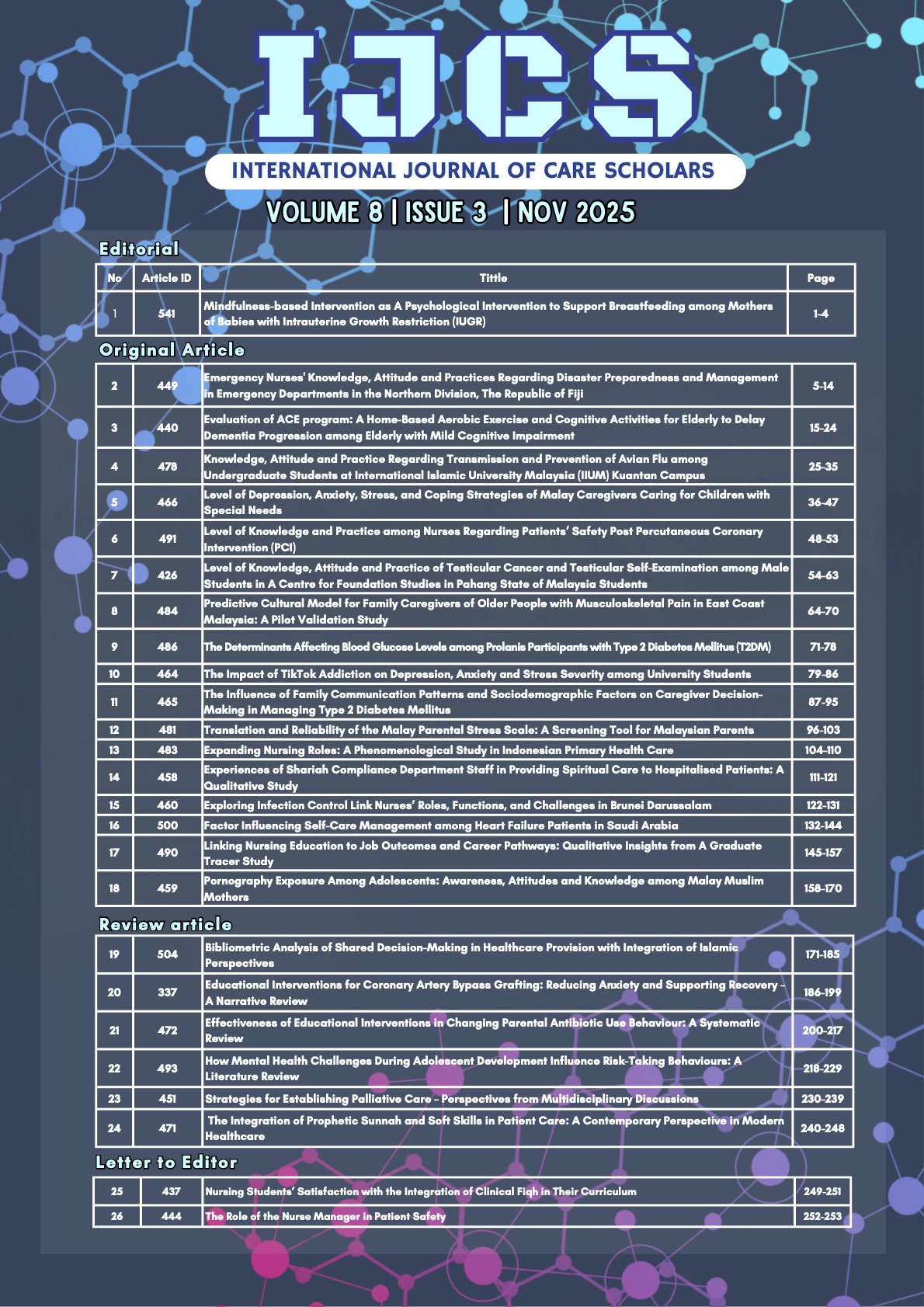
Experiences of Personnel Providing Shariah-Guided Support in Clinical Practice: A Qualitative Study
DOI:
https://doi.org/10.31436/ijcs.v8i3.458Keywords:
Spirituality, Hospital, Patient, Shariah compliance, MalaysiaAbstract
Background: Spiritual care is a vital component of holistic healthcare, supporting patients in aligning with their beliefs to foster inner peace and overall well-being. However, there is limited research on the experiences of hospital staff in providing spiritual care. This study aims to explore the experiences of Shariah-compliant hospital staff in delivering spiritual care to hospitalised patients.
Methods: A qualitative study was conducted through face-to-face interviews with eight purposively selected participants between April and May 2024 at a Shariah-compliant hospital in Malaysia. The interviews took place in the participants’ respective offices. With prior consent, all interviews were audio-recorded, transcribed verbatim, and analysed using thematic analysis.
Results: Three major themes emerged from the analysis: (1) Addressing challenges in delivering spiritual care with the sub-themes: a) Resource constraints, b) Reluctant to talk, c) Emotional challenges, d) Role ambiguity, and e) Navigating family misunderstanding, (2) Strategies for effective spiritual care delivery with the sub-themes: a) Respectful communication, b) Listening and being present, c) Initiating spiritual conversations, d) Knowing the patient, e) Guiding through mentorship, and f) Be knowledgeable, and (3) Impacts of spiritual care to the patients with the sub-themes: a) Rediscovering faith, b) Behavioural change, c) Embracing acceptance, and d) Family support in well-being.
Conclusion: Addressing challenges in spiritual care delivery and implementing effective strategies can enhance the provision of spiritual care, ultimately leading to improved patient outcomes. Future research should include diverse samples from various hospitals to deepen the understanding of spiritual care across different healthcare settings.
References
Hvidt NC, Nielsen KT, Kørup AK, Prinds C, Hansen DG, Viftrup DT, Hvidt EA, Hammer ER, Falkø E, Locher F, Boelsbjerg HB, Wallin JA, Thomsen KF, Schrøder K, Moestrup L, Nissen RD, Stewart-Ferrer S, Stripp TK, Steenfeldt VS, Wæhrens EE. What is spiritual care? Professional perspectives on the concept of spiritual care identified through group concept mapping. BMJ Open. 2020;10:e042142. https://doi.org/10.1136/bmjopen-2020-042142
Sabki ZA, Sa'ari CZ, Syed Muhsin SB, Kheng GL, Sulaiman AH, Koenig HG. Islamic integrated cognitive behavior therapy: A shari'ah-compliant intervention for Muslims with depression. Malaysian Journal of Psychiatry. 2019;28(1):29-38.
Pies RW. Care of the Soul in the time of COVID-19. Psychiatric Times. 2020;37(5):16–17.
Büssing A. Application and implementation of the spiritual needs questionnaire in spiritual care processes. In: Büssing A, editor. Spiritual needs in research and practice: The spiritual needs questionnaire as a global resource for health and social care. Cham: Pelgrave McMillan; 2021. p. 79-85.
Miller M, Addicott K, Rosa WE. Spiritual care as a core component of palliative nursing. AJN, American Journal of Nursing. 2023 Feb;123(2):54–59. https://doi.org/10.1097/01.naj.0000919748.95749.e5
Akbari M, Hossaini SM. The relationship of spiritual health with quality of life, mental health, and burnout: The mediating role of emotional regulation. Iran Journal of Psychiatry. 2018;13(1):22-31.
Fitch MI, Bartlett R. Patient perspectives about spirituality and spiritual care. Asia Pac J Oncol Nurs. 2019;6(2):111-21. https://doi.org/10.4103/apjon.apjon_62_18
Mamat WHW, Hairi NAHM, Mohamad Shariff N, Che Ahmad A, Machouche S, Jaafar SNI.. Exploring the experiences of healthcare workers in delivering spiritual care to patients in Shari’ah compliance hospital. In: Proceedings of the 14th National and the 10th International PIM Conference; 2024 Jun 13-14; Bangkok.
Hairi NAHM, Mamat WHW Mohamad Shariff N, Jaafar SNI, Che Ahmad AC, Salah M,. Challenges in providing spiritual care among healthcare workers: a qualitative study. IMJM. 2025;24(1):67-73.
Batstone E, Bailey C, Hallett N. Spiritual care provision to end-of-life patients: A systematic literature review. Journal of Clinical Nursing. 2020;29:3609–3624.
Ødbehr L, Kvigne K, Hauge S, Danbolt LJ. Nurses’ and care workers’ experiences of spiritual needs in residents with dementia in nursing homes: A qualitative study. BMC Nursing. 2014;13:12.
Giske T, Cone PH. Discerning the healing path: How nurses assist patient spirituality in diverse healthcare settings. Journal of Clinical Nursing. 2015;24:2926–2935.
Masud I, Halim SA, Shafi SM, Ramli NAA, Awang MZ, Subhan IA. What Is Ibadah Friendly Hospital. J Br Islam Med Assoc. 2021;7(3):53-60.
Cour PL, Ausker NH, Hvidt NC. Six understandings of the word ‘spirituality’ in a secular country. Archive for the Psychology of Religion. 2012 Jan;34(1):63–81. https://doi.org/10.1163/157361212x649634
Farahani AS, Rassouli M, Salmani N, Mojen LK, Sajjadi M, Heidarzadeh M, Masoudifar Z, Khademi F. Evaluation of healthcare providers’ perception of spiritual care and the obstacles to its implementation. Asia-Pacific Journal of Oncology Nursing. 2019;6(2):122–129. https://doi.org/10.4103/apjon
Rababa M, Al-Sabbah S. The use of Islamic spiritual care practices among critically ill adult patients: A systematic review. Heliyon. 2023 Mar 1;9(3):e13862. https://doi.org/10.1016/j.heliyon.2023.e13862
Pathak V, Jena B, Kalra S. Qualitative research. Perspectives in Clinical Research. 2013;4(3):192-194. https://doi.org/10.4103/2229-3485.115389
Guest G, Bunce A, Johnson L. How many interviews are enough? Field Methods. 2006;18(1):59-82. https://doi.org/10.1177/1525822x05279903
Kiger ME, Varpio L. Thematic analysis of qualitative data: AMEE Guide No. 131. Medical teacher. 2020;42(8):846-54. https://doi.org/10.1080/0142159X.2020.1755030
Janis I. Strategies for establishing dependability between two qualitative intrinsic case studies: A reflexive thematic analysis. Field Methods. 2022 Feb 25;34(3):240–255. https://doi.org/10.1177/1525822x211069636
Korstjens I, Moser A. Series: Practical guidance to qualitative research. Part 4: Trustworthiness and publishing. European Journal of General Practice. 2018;24(1):120-4. https://doi.org/10.1080/13814788.2017.1375092
Momeni G, Hashemi MS, Hemati Z. Barriers to providing spiritual care from a nurses’ perspective: A content analysis study. Iran Journal of Nursing and Midwifery Res. 2022;27(6):575. https://doi.org/10.4103/ijnmr.ijnmr_422_21
Balboni TA, VanderWeele TJ, Doan-Soares SD, et al. Spirituality in serious illness and health. JAMA. 2022;328(2):184-197.
Koenig HG. Religion, spirituality, and health: The research and clinical implications. ISRN Psychiatry.2012;2012:1-33. https://doi.org/10.5402/2012/278730
Puchalski CM, Vitillo R, Hull SK, Reller N. Improving the spiritual dimension of whole person care: Reaching national and international consensus. Journal of Palliative Medicine. 2014;17(6):642-656. https://doi.org/10.1089/jpm.2014.9427
Southard ME. Spirituality: The Missing Link for Holistic Health Care. Journal of Holistic Nursing. 2020;38(1):4-7. https://doi.org/10.1177/0898010119880361
Gaston-Johansson F, Haisfield-Wolfe ME, Reddick B, Goldstein N, Lawal TA. The relationships among coping strategies, religious coping, and spirituality in African American women with breast cancer receiving chemotherapy. Oncology Nursing Forum. 2013;40(2):120-31. https://doi.org/10.1188/13.ONF.120-131
Halim RZ, Saidi S, Yusof NM, Hassan NH. Spiritual Enrichment Through Solah: Impact on Patients and Navigating Challenges in Addressing Spiritual Needs Within Hospital Settings-A Narrative Literature Review. International Journal of Care Scholars. 2024 Jul 31;7(2):132-43.
Hairi NAHM, Mamat WHW, Shariff NM, Ahmad CA, Machouche S, Jaafar SNI. A qualitative study of patients’ coping strategies and expectations regarding spirituality during hospitalisation. International Journal of Care Scholars. 2024;7(2):31-7. https://doi.org/10.31436/ijcs.v7i2.380
Downloads
Published
How to Cite
Issue
Section
License
Copyright (c) 2025 INTERNATIONAL JOURNAL OF CARE SCHOLARS (ISSN: 2600-898X)

This work is licensed under a Creative Commons Attribution-NonCommercial 4.0 International License.