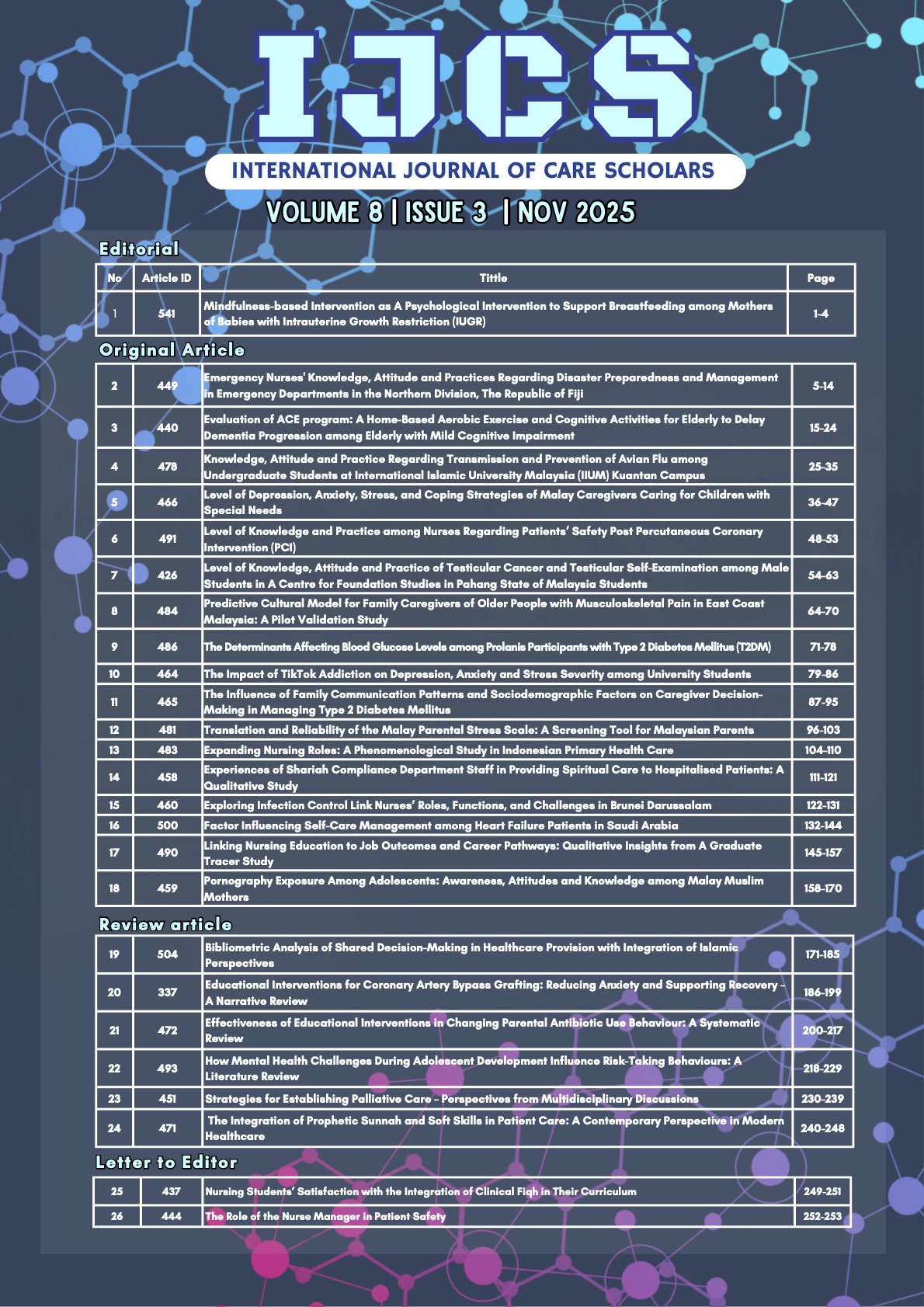
Level of Depression, Anxiety, Stress, and Coping Strategies of Malay Caregivers Caring for Children with Special Needs
DOI:
https://doi.org/10.31436/ijcs.v8i3.466Keywords:
Depression, Anxiety, Stress, Coping strategies, Caregiver, Special needs childrenAbstract
Background: Caring for children with special needs can be one of a caregiver's most rewarding yet challenging experiences. It is crucial to assess the level of depression, anxiety, and stress among caregivers and their coping mechanisms. This study aims to evaluate the level of depression, anxiety, stress, and coping strategies of Malay caregivers of children with special needs.
Methods: A cross-sectional study was conducted among 210 Malay primary caregivers recruited purposively from Community-Based Rehabilitation (CBR) centres in Kuantan. A self-completion questionnaire: Depression, Anxiety and Stress Scale 21 (DASS-21) and Coping Strategies were employed. Descriptive, chi-square, and multinomial logistic regression analyses were used to analyse the data using IBM SPSS Statistics version 27.0.
Results: The findings indicated that most participants were caregivers aged between 31 and 40 years old (44.3%), had a monthly income of less than RM 3000 (53.3%), and had completed a tertiary level of education (51.0%). More than half of the caregivers had normal levels of depression, anxiety, and stress. Notably, a proportion experienced abnormal levels of depression (28.1%), anxiety (34.8%), and stress (18.1%), which may require support. Most caregivers employed a high level of coping strategies (65.4%), including positive reappraisal and escape strategies, such as praying (86.0%) and avoiding problems (40.2%). In terms of high coping levels, education proved to be a significant factor. However, results show no statistically significant association between depression level (p=0.813), anxiety (p=0.251), and stress level (p=0.077) with coping mechanisms among Malay caregivers.
Conclusion: The findings indicate that while many caregivers maintain stable mental health and effective coping, certain vulnerable subgroups may still require additional support. Additionally, the educational level may impact caregivers' ability to cope with their mental well-being when caring for children with special needs.
References
Isa SNI, Ishak I, Rahman AA, Saat NZM, Din NC, Lubis SH, et al. Quality of life among caregivers of children with special needs in Kelantan, Malaysia: The importance of psychosocial mediators. Malaysian Journal of Medical Sciences. 2021;28(2):128–41.
Bourke-Taylor HM, Joyce KS, Grzegorczyn S, Tirlea L. Mental health and health behaviour changes for mothers of children with a disability: effectiveness of a health and wellbeing workshop. J Autism Dev Disord. 2022 Feb 1;52(2):508–21.
Jabatan Kesihatan Masyarakat. Statistik Pendaftaran OKU. 2023 Jan 31;
Megreya AM, Al-Attiyah AA, Moustafa AA, Hassanein EEA. Cognitive emotion regulation strategies, anxiety, and depression in mothers of children with or without neurodevelopmental disorders. Res Autism Spectr Disord [Internet]. 2020 Aug 1 [cited 2025 Oct 15];76:101600. Available from: https://www.sciencedirect.com/science/article/pii/S1750946720300908?via%3Dihub
Rasoulpoor S, Salari N, Shiani A, Khaledi-Paveh B, Mohammadi M. Determining the relationship between over-care burden and coping styles, and resilience in mothers of children with autism spectrum disorder. Ital J Pediatr. 2023 Dec 1;49(1).
Kutuk MO, Tufan AE, Kilicaslan F, Vural P, Gokcen C, Alsen Guney S, et al. Functional outcome in late adolescence/early adulthood of patients with autism spectrum disorder and its relationships with parental burnout and depression: A preliminary multi-center, cross-sectional study. Heliyon [Internet]. 2023 Oct 1 [cited 2025 Oct 15];9(10):e20766. Available from: https://www.sciencedirect.com/science/article/pii/S2405844023079744?via%3Dihub
Priego-Ojeda, M., & Rusu, P. P. (2023). Emotion regulation, parental stress and family functioning: Families of children with disabilities vs normative families. Research in Developmental Disabilities, 139. https://doi.org/10.1016/j.ridd.2023.104548
Yan, T., Hou, Y., & Deng, M. (2022). Direct, indirect, and buffering effect of social support on parental involvement among chinese parents of children with autism spectrum disorders. Journal of Autism and Developmental Disorders, 52(7), 2911–2923. https://doi.org/10.1007/s10803-021-05170-x
Özdemir, T., Karada?, G., & Kul, S. (2022). Relationship of gratitude and coping styles with depression in caregivers of children with special needs. Journal of Religion and Health, 61(1), 214–227. https://doi.org/10.1007/s10943-021-01389-1
Adib, N. A. N., Ibrahim, M. I., Rahman, A. A., Bakar, R. S., Yahaya, N. A., Hussin, S., & Wan Mansor, W. N. A. (2019). Perceived stress among caregivers of children with autism spectrum disorder: A state-wide study. International Journal of Environmental Research and Public Health, 16(8). https://doi.org/10.3390/ijerph16081468
Barros, A. L. O., de Gutierrez, G. M., Barros, A. O., & Santos, M. T. B. R. (2019). Quality of life and burden of caregivers of children and adolescents with disabilities. Special Care in Dentistry. https://doi.org/10.1111/scd.12400
Joseph, L., & Delariarte, C. F. (2022). Prevalence of depression, anxiety and stress among mothers of children with autism spectrum disorder in India during COVID-19 pandemic. Indian Journal of Health and Well Being, 13(3), 301–306.
Toledano-Toledano F, Luna D. The psychosocial profile of family caregivers of children with chronic diseases: a cross-sectional study. Biopsychosoc Med. 2020;14. doi:10.1186/s13030-020-00201-y.
Isa S, Ishak I, Ab Rahman A, Saat N, Din NC, Lubis S, Ismail M. Perceived stress and coping styles among Malay caregivers of children with learning disabilities in Kelantan. Malays J Med Sci MJMS. 2017;24(1):81-93. doi:10.21315/mjms2017.24.1.9.
Adib NA, Ibrahim M, Ab Rahman A, Bakar RS, Yahaya N, Hussin S, et al. Perceived stress among caregivers of children with autism spectrum disorder: a state-wide study. Int J Environ Res Public Health. 2019;16. doi:10.3390/ijerph16081468.
Omar AF, Mokhtar I, Ahmad M. Challenges in healthcare management of individuals with special needs in Malaysia: perceptions of caregivers. J Int Soc Prev Community Dent. 2023;13:148-56. doi:10.4103/jispcd.JISPCD_234_22.
Tinagaran S, Mohd Rasdi HF, Harun D, Hassan K, Md Rasid S. Psychometric properties of the Malay version of the personal wellbeing index: a preliminary study among caregivers of children with autism spectrum disorder. J Sains Kesihatan Malaysia. 2023. doi:10.17576/jskm-2023-2102
Forner-Puntonet M, Gisbert-Gustemps L, Castell-Panisello E, et al. Stress and coping strategies of families of pediatric solid organ transplant recipients in times of pandemic. Front Psychol. 2023;14. doi:10.3389/fpsyg.2023.1067477.
Chong A, Ahmad M, Harizan NB, Alias H, Hussain RI, Lateh A, Chan CMH. Predictors of post-traumatic stress symptoms (PTSS), depression, and anxiety among caregivers of children with acute lymphoblastic leukaemia (ALL). Asian Pac J Cancer Prev. 2023;24(6):1923-9. doi:10.31557/APJCP.2023.24.6.1923.
Tan SH. Assessing the needs of caregivers of children with disabilities in Penang, Malaysia. Health Soc Care Community. 2017;25:447-57. doi:10.1111/hsc.12325.
Mohamad MS, Subhi N, Zakaria E, Saadah N, Aun M. Cultural influences in mental health help-seeking among Malaysian family caregivers. Pertanika J Soc Sci Humanit. 2013;21:1-15. Available on Consensus.
Tew S, Ahmad Fauzi A. Parental perceptions of paediatric rehabilitation services using the Malay measure of processes of care. Child Care Health Dev. 2020. doi:10.1111/cch.12773.
Altundal Duru H, Y?lmaz S, Yaman Z, Bo?ahan M, Y?lmaz M. Individuals' coping styles and levels of depression, anxiety, and stress during the COVID-19 pandemic in Turkey: A web-based cross-sectional study. Sage Open. 2023 Jan 25;13(1):21582440221148628. doi:10.1177/21582440221148628.
Tinagaran S, Rasdi HFM, Harun D, Hassan K, Md Rasid S. Psychometric properties of the Malay version of the personal wellbeing index: a preliminary study among caregivers of children with autism spectrum disorder. J Sains Kesihatan Malaysia. 2023. doi:10.17576/jskm-2023-2102-12.
Ibrahim H, Razak M, Aman A, Ahmad I. Our child is dying: exploring the experiences, challenges, and coping mechanisms of Malaysian parents as caregivers of a child with cancer. J Southeast Asian Stud. 2019;24:67-90. doi:10.22452/jati.vol24no2.5.
Nath SD, Jamshed KM, Shaikh JM. The impact of the COVID-19 pandemic on subsistence consumers' well-being and coping strategies: Insights from India and Bangladesh. J Consum Aff. 2022 Spring;56(1):180-210. doi:10.1111/joca.12440.
Idris S, Razak A, Wong P. Religion as a coping mechanism for Malaysian caregivers. Int J Soc Psychiatry. 2023;69(1):45-53.
Ahmad R, Mohd Isa A, Rashid MR, Yusoff N, Mohd Tahir L, Huda M, Marsinun R. Prevalence of anxiety and depression among caregivers of cancer patients: A case study in a public hospital in Malaysia. IIUM Med J Malaysia. 2023;22(1). doi:10.31436/imjm.v22i1.2146. Available on Consensus.
Chong A, Ahmad M, Mohd Harizan NB, Alias H, Hussain RI, Lateh A, Chan CMH. Predictors of post-traumatic stress symptoms (PTSS), depression, and anxiety among caregivers of children with acute lymphoblastic leukaemia (ALL). Asian Pac J Cancer Prev. 2023;24(6):1923-9. doi:10.31557/APJCP.2023.24.6.1923. Available on Consensus.
Din SHS, Jaafar NRN, Zakaria H, Saini SNA, Ahmad SNA, Midin M. Anxiety disorders in family caregivers of breast cancer patients receiving oncologic treatment in Malaysia. Asian Pac J Cancer Prev. 2017;18(2):465-71. doi:10.22034/APJCP.2017
Downloads
Published
How to Cite
Issue
Section
License
Copyright (c) 2025 INTERNATIONAL JOURNAL OF CARE SCHOLARS (ISSN: 2600-898X)

This work is licensed under a Creative Commons Attribution-NonCommercial 4.0 International License.