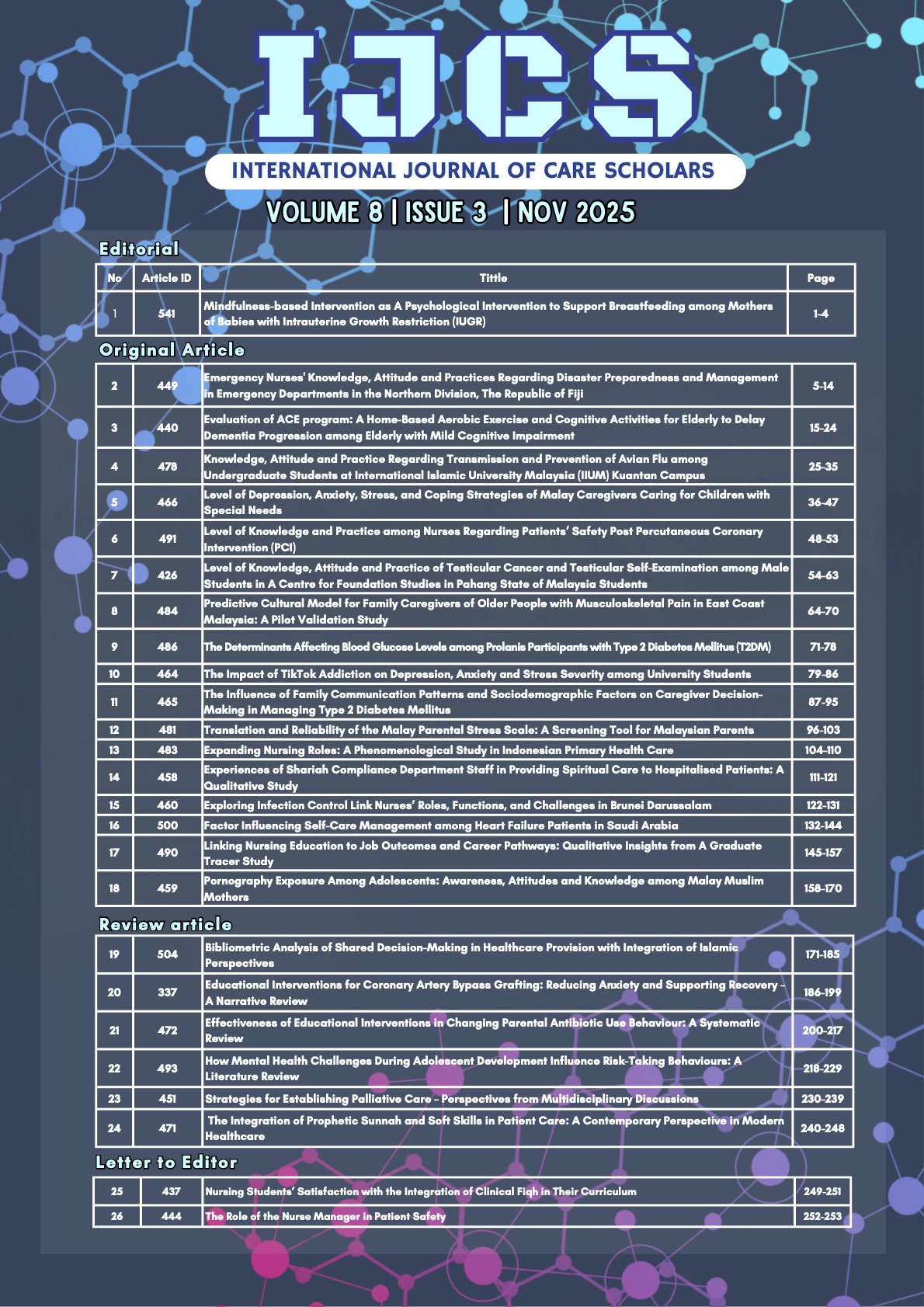
How Mental Health Challenges During Adolescent Development Influence Risk-Taking Behaviours: A Literature Review
DOI:
https://doi.org/10.31436/ijcs.v8i3.493Keywords:
Mental health, Risk-taking behavior, AdolescentsAbstract
Background: Adolescents are becoming more susceptible to mental health problems and risk-taking behaviours, profoundly impact their development and general well-being. Approximately 14% of adolescents worldwide encounter mental health problems. Risk -taking behaviours such as drug abuse, delinquency, and unprotected sexual activity are also linked to mental health problems. While numerous studies have explored adolescent mental health or risk-taking behaviour independently, few have systematically examined the relationship between these two variables. Thus, this literature review aims to synthesize recent evidence on the patterns, associations, and underlying mechanisms linking adolescent mental health problems with risk-taking behaviours, to inform prevention strategies and support adolescent development.
Methods: A systematic literature review was carried out using PubMed, Scopus, ScienceDirect, and Taylor & Francis Online. Boolean operators and set inclusion criteria were used to identify relevant English-language, open-access studies published between 2014 and 2025. Following the PRISMA framework, 34 studies were included in the review.
Results: The findings reveal a strong connection between adolescent mental health problems and involvement in risk-taking behaviours. Individuals with poor mental health are more likely to abuse drugs, have unsafe sex, and become aggressive. These behaviours harmed their physical health, education, and relationships with other individuals.
Conclusion: Understanding the relationship between risk-taking behaviours and mental health problems in adolescents is essential for implementation of effective preventative measures. Early mental health interventions, family involvement, and educational programmes are essential for mitigating risks and fostering optimum adolescent development.
References
World Health Organization. Adolescent health. 2023 [cited 2025 Jan 8]. Available from: https://www.who.int/health-topics/adolescent-health
Singh S, Lai CH, Iderus NHM, Ghazali SM, Ahmad LCRQ, Cheng LM, et al. Prevalence and determinants of depressive symptoms among young adolescents in Malaysia: A cross-sectional study. Children. 2023;10(1):141
Scheiner C, Grashoff J, Kleindienst N, Buerger A. Mental disorders at the beginning of adolescence: Prevalence estimates in a sample aged 11-14 years. Public Health Pract. 2022;4:100348.
Mucci F, Bouanani S, Cerù A, Mauro A, Diolaiuti F. Navigating the “mental health crisis” in adolescents in the aftermath of COVID-19 pandemic: Experience and insights from frontline psychiatric service. Clinical Neuropsychiatry. 2023;20(4):309?15.
Joyce Lee. Mental health effects of school closures during COVID-19. The Lancet Child and Adolescent Health. 2020;4(6):421.
Meherali S, Punjani N, Louie-Poon S, Rahim KA, Das JK, Salam RA, Lassi ZS. Mental health of children and adolescents amidst COVID-19 and past pandemics: a rapid systematic review. Int J Environ Res Public Health. 2021;18(7):3432.
World Health Organization. Mental health of children and adolescents. World Health Organization; 2021 [cited 2025 Jan 8]. Available from: https://www.who.int/news-room/fact-sheets/detail/adolescent-mental-health
Pedrelli P, Nyer M, Yeung A, Zulauf C, Wilens T. College students: Mental health problems and treatment considerations. Acad Psychiatry. 2015;39(5):503-11.
Babicka-Wirkus A, Koz?owski P, Wirkus ?, Stasiak K. Internalizing and externalizing disorder levels among adolescents: Data from Poland. Int J Environ Res Public Health. 2023;20(3):2752.
Crockett MA, Martínez V, Jiménez-Molina Á. Subthreshold depression in adolescence: Gender differences in prevalence, clinical features, and associated factors. J Affect Disord. 2020;272:269-76.
Bozzini AB, Bauer A, Maruyama J, Simões R, Matijasevich A. Factors associated with risk behaviors in adolescence: a systematic review. Braz J Psychiatry. 2021;43(2):210-21.
Davis AL. Risk-taking behavior in adolescence: exploring the roles of family, peers, and school [PhD thesis]. Memphis (TN): University of Memphis; 2016.
Kwon SJ. Neurodevelopmental changes in social and adaptive risk taking in adolescence [PhD thesis]. Chapel Hill (NC): University of North Carolina at Chapel Hill; 2023.
Ciranka S, van den Bos W. Adolescent risk-taking in the context of exploration and social influence. Dev Rev. 2021;61:100979.
Kann L, Kinchen S, Shanklin S, Flint KH, Hawkins J, Harris AW, et al. Youth Risk Behavior Surveillance - United States, 2017. MMWR Surveill Summ. 2018;67(8):1-162.
Hanapi NN, Daud MN, Mansor M. Gender differences in risk-taking attitudes among adolescents: Method participants. Malays J Soc Sci Humanit. 2019;4(4):71-5.
Smout A, Newton NC, Slade T, O’Donoghue B, Chapman C. The relationship between early risk-taking behavior and mental health problems among a nationally representative sample of Australian youth. J Affect Disord. 2020;272:239-48
Cheah YK, Kee CC, Lim KH, Omar MA. Mental health and risk behaviors among secondary school students: A study on ethnic minorities. Pediatr Neonatol. 2021;62(6):628-37.
Chung JE, Song G, Kim K, Yee J, Kim JH, Lee KE, Gwak HS. Association between anxiety and aggression in adolescents: A cross-sectional study. BMC Pediatr. 2019;19:115.
D’Agati D, Kahn GD, Swartz KL. Preteen behaviors and sexual orientation of high school students who report depressive symptoms, United States, 2015–2017. Public Health Rep. 2021;136(2):132-5.
Moher D, Liberati A, Tetzlaff J, Altman DG, Antes G, Atkins D, et al. Preferred reporting items for systematic reviews and meta-analyses: the PRISMA statement. PLoS Med. 2009;6(7):e1000097.
Hilton M. JBI critical appraisal checklist for systematic reviews and research syntheses (product review). J Can Health Libr Assoc. 2024;45(3):180-3.
Blakemore SJ. Adolescence and mental health. The Lancet. 2019;393(10185):2030-1.
Dumontheil I. Adolescent brain development. Curr Opin Behav Sci. 2016;10:39-44.
National Academies of Sciences, Engineering, and Medicine. Promoting Positive Adolescent Health Behaviors and Outcomes: Thriving in the 21st Century. Washington (DC): The National Academies Press; 2020.
World Health Organization. Adolescent mental health. World Health Organization; 2024 [cited 2025 Jan 8]. Available from: https://www.who.int/news-room/fact-sheets/detail/adolescent-mental-health
Szücs A, van der Lubbe SCC, Arias de la Torre J, Valderas JM, Hay SI, Bisignano C, et al. The epidemiology and burden of ten mental disorders in countries of the Association of Southeast Asian Nations (ASEAN), 1990–2021: findings from the Global Burden of Disease Study 2021. Lancet Public Health. 2025;10(6):e480–91.
Kim H, Jeong W, Jang S, Kim Y, Park E. Association between sexual behavior and depression in South Korean adolescents: a cross-sectional study. Int J Environ Res Public Health. 2021;18(8):4288.
World Health Organization. COVID-19 pandemic triggers 25% increase in prevalence of anxiety and depression worldwide. World Health Organization; 2022 [cited 2025 Jan 8]. Available from: https://www.who.int/news/item/02-03-2022-covid-19-pandemic-triggers-25-increase-in-prevalence-of-anxiety-and-depression-worldwide
Mohamed NF, Jiun Ting T, Ab Manan N, Mohd Senari IF, Muhammad Firdaus Chan MF, Rahmatullah B, et al. Prevalence and predictors of social anxiety disorders among Malaysian secondary school students during the COVID-19 pandemic: exploring the influence of internet gaming disorder and impulsivity. Clin Child Psychol Psychiatry. 2023 Jan.
de Lijster JM, Dieleman GC, Utens EMWJ, Dierckx B, Wierenga M, Verhulst FC, et al. Social and academic functioning in adolescents with anxiety disorders: a systematic review. J Affect Disord. 2018;230:108–17.
Dyer ML, Easey KE, Heron J, Hickman M, Munafò MR. Associations of child and adolescent anxiety with later alcohol use and disorders: a systematic review and meta-analysis of prospective cohort studies. Addiction. 2019;114(6):968–82.
Essau CA, Lewinsohn PM, Olaya B, Seeley JR. Anxiety disorders in adolescents and psychosocial outcomes at age 30. J Affect Disord. 2014;163:125–32.
Roy R, Kumar P, Pandey S, Ranjan A, Singh C. Tobacco usage and its association with mental health status of school-going adolescents near Patna, Bihar: a community-based cross-sectional study in Eastern India. Cureus. 2023;15(5):1–11.
Kok JK, Low SK. Risk factors contributing to vulnerability of mental health disorders and the protective factors among Malaysian youth. Int J Sch Educ Psychol. 2019;7(2):102–12.
Azmawati MN, Hazariah AHS, Shamsul AS, Norfazilah A, Azimatun NA, Rozita H. Risk taking behaviour among urban and rural adolescents in two selected districts in Malaysia. S Afr Fam Pract. 2015;57(3):160-5.
Young S, Greer B, Church R. Juvenile delinquency, welfare, justice and therapeutic interventions: a global perspective. BJPsych Bull. 2017;41(1):21-9.
Chau K, Mayet A, Legleye S, Beck F, Hassler C, Khlat M, et al. Association between cumulating substances use and cumulating several school, violence and mental health difficulties in early adolescents. Psychiatry Res. 2019;280:112480.
Thepthien B, Celyn. Risky sexual behavior and associated factors among sexually-experienced adolescents in Bangkok, Thailand: findings from a school web-based survey. Reprod Health. 2022;19(1):1-11.
Yusoff F, Sahril N, Rasidi NM, Zaki NAM, Muhamad N, Ahmad NA. Illicit drug use among school-going adolescents in Malaysia. Asia Pac J Public Health. 2014;26(5 Suppl).
Folayan MO, Arowolo O, Mapayi B, Chukwumah NM, Alade MA, Yassin RH, et al. Associations between mental health problems and risky oral and sexual behaviour in adolescents in a sub-urban community in Southwest Nigeria. BMC Oral Health. 2021;21(1):1-11.
Murray AL, Zhu X, Mirman JH, Ribeaud D, Eisner M. An evaluation of dual systems theories of adolescent delinquency in a normative longitudinal cohort study of youth. J Youth Adolesc. 2021;50(7):1293-307.
Ying WK, Rahman MM, Kiyu A. Prevalence and factors determining adolescents risk taking behaviours in Sarawak, Malaysia. IIUM Med J Malaysia. 2024;23(1):123-32.
Riehm KE, Young AS, Feder KA, Krawczyk N, Tormohlen KN, Pacek LR, et al. Mental health problems and initiation of e-cigarette and combustible cigarette use. Pediatrics. 2019;144(1):1-9.
Peltzer K, Pengpid S. Tobacco use and its association with mental morbidity and health compromising behaviours in adolescents in Indonesia. Asian Pac J Cancer Prev. 2021;22(1):31-5.
Duell N, Steinberg L, Icenogle G, Chein J, Chaudhary N, Di Giunta L, et al. Age patterns in risk taking across the world. J Youth Adolesc. 2018;47(5):1052–72.
Patel V, Saxena S, Lund C, Thornicroft G, Baingana F, Bolton P, et al. The Lancet Commission on global mental health and sustainable development. Lancet. 2018;392(10157):1553-98.
Willoughby T, Good M, Adachi PJC, Hamza C, Tavernier R. Examining the link between adolescent brain development and risk taking from a social-developmental perspective (reprinted). Brain Cogn. 2014;89:70-8.
Erhabor J, Boakye E, Osuji N, Obisesan O, Osei AD, Mirbolouk H, et al. Psychosocial stressors and current e-cigarette use in the youth risk behavior survey. BMC Public Health. 2023;23(1):1-9.
Pozuelo JR, Desborough L, Stein A, Cipriani A. Systematic review and meta-analysis: Depressive symptoms and risky behaviors among adolescents in low- and middle-income countries. J Am Acad Child Adolesc Psychiatry. 2022;61(2):255-76.
Grigsby TJ, Lopez A, Albers L, Rogers CJ, Forster M. A scoping review of risk and protective factors for negative cannabis use consequences. Subst Abuse Res Treat. 2023;17:1-15.
Kim J, Kim R, Oh H, Lippert AM, Subramanian SV. Estimating the influence of adolescent delinquent behavior on adult health using sibling fixed effects. Soc Sci Med. 2020;265:113397.
Smith AR, Chein J, Steinberg L. Peers increase adolescent risk taking even when the probabilities of negative outcomes are known. Dev Psychol. 2014;50(5):1564-8.
Kaushik A, Srivastava S, Pemde H. Improving practice of nurses to deliver respectful adolescent care (RAC): A psychological interventional study. J ReAttach Ther Dev Divers. 2023;6(5):292-6.
Martel R, Shepherd M, Goodyear-Smith F. Implementing the routine use of electronic mental health screening for youth in primary care: Systematic review. JMIR Ment Health. 2021;8(11):e30479.
Moyes A, McGough S, Wynaden D. Hidden and unacknowledged: The mental health and psychosocial interventions delivered by school nurses in Western Australia. Int J Ment Health Nurs. 2024;33(2):463-72.
Downloads
Published
How to Cite
Issue
Section
License
Copyright (c) 2025 INTERNATIONAL JOURNAL OF CARE SCHOLARS (ISSN: 2600-898X)

This work is licensed under a Creative Commons Attribution-NonCommercial 4.0 International License.