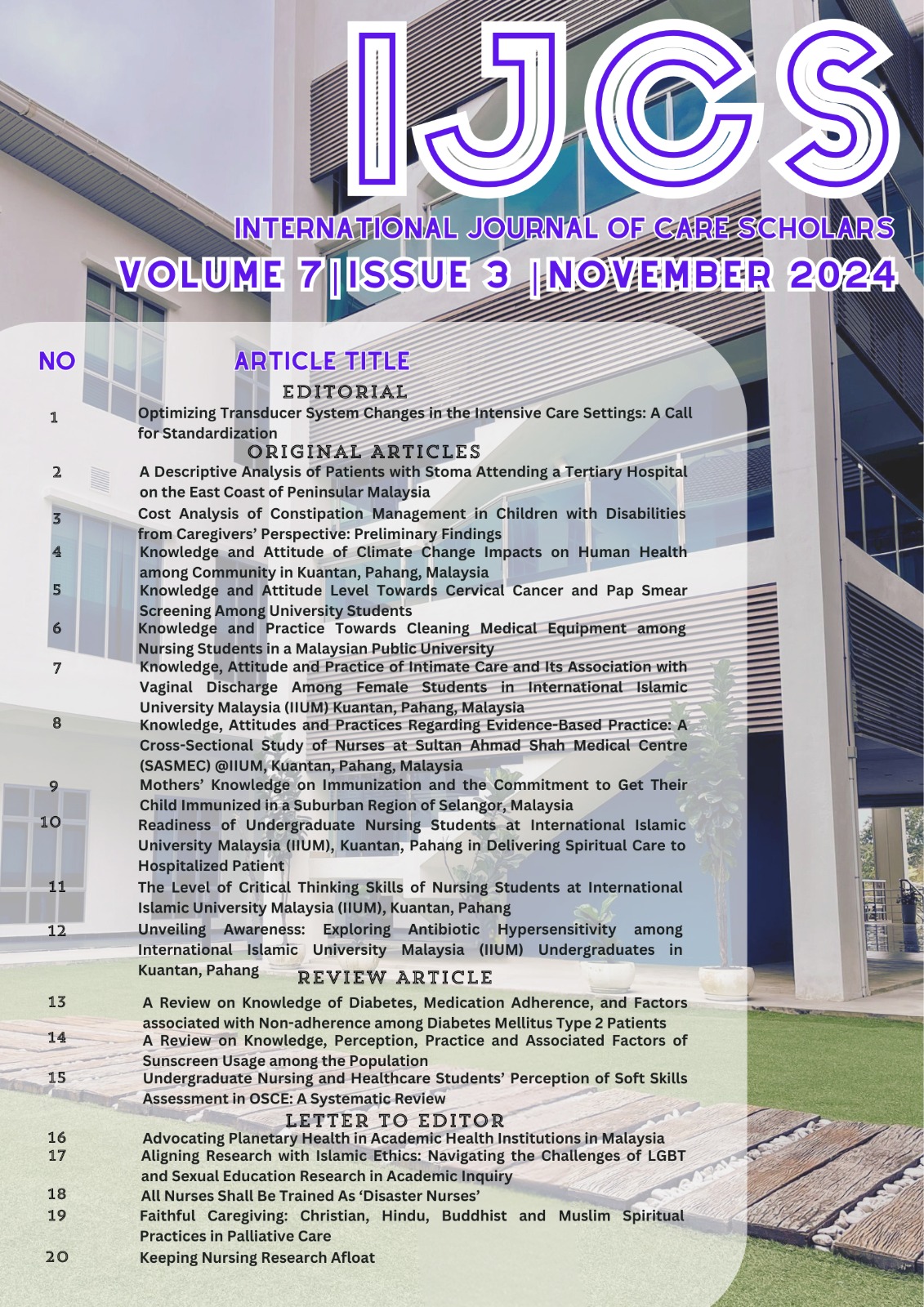
Undergraduate Nursing and Healthcare Students’ Perception of Soft Skills Assessment in OSCE: A Systematic Review
DOI:
https://doi.org/10.31436/ijcs.v7i3.390Keywords:
Undergraduate, Nursing, Healthcare, Soft skills, Clinical skills assessmentAbstract
Background: The Objective Structured Clinical Examination (OSCE) is widely recognized in healthcare education for assessing clinical skills, yet its application in evaluating soft skills is still evolving. Soft skills, such as communication, empathy, and teamwork, are essential in patient-centered care but are not consistently included in OSCE assessment.
Methods: This systematic review aims to identify undergraduate nursing and healthcare students' perceptions of integrating soft skills and their assessment within OSCE. A comprehensive literature review was conducted, adhering to PRISMA guidelines, yielding 29 relevant studies published between 2017 and 2023. Studies were appraised using the Joanna Briggs Institute (JBI) Critical Appraisal Checklist for Quasi-Experimental Studies, the Critical Appraisal Skills Programme (CASP) Qualitative Research Checklist, and the Mixed Methods Appraisal Tool (MMAT).
Results: Three themes emerged from the analysis: (1) Perception and satisfaction of nursing students towards OSCE, (2) Perception and satisfaction of other healthcare students towards OSCE, and (3) Implementation of soft skills in OSCE. The findings indicate a positive reception of OSCE as an objective assessment tool, with students appreciating its structure and consistency. However, students highlighted challenges related to the time constraints and stress associated with OSCEs, particularly when soft skills are evaluated. Incorporating soft skills enhances students’ readiness for real-world clinical practice, yet its assessment remains inconsistent across studies.
Conclusion: Integrating soft skills into OSCE is critical for developing well-rounded healthcare professionals. Future research should focus on standardizing soft skill assessments in OSCE and exploring their impact on student performance and patient outcomes to meet the evolving demands of healthcare practice.
References
Harden RM, Stevenson M, Downie WW, Wilson GM. Assessment of clinical competence using objective structured examination. Br Med J. 1975;1(5955):447-51. DOI: https://doi.org/10.1136/bmj.1.5955.447
Awad L A, Ahmed S, Alshamandy AA & Abolwafa NF. Perception of undergraduate nursing students towards objective structured clinical examination (OSCE). IOSR Journal of Nursing and Health Science Ver. 2017; 7(6), 5.
Mohammed NA& Amer HA. Nursing students’ perceptions regarding modality use of the objective structured clinical examination (OSCE). Nursing, 51. 2018.
Jamaludin TSS, Nurumal MS, Ahmad N, Muhammad SAN & Chan CM. Development and Evaluating Content Validity of Clinical Skill Analysis Index Tools. Open Access Macedonian Journal of Medical Sciences. 2022; 9 (T5), 6-12. doi: doi.org/10.3889/oamjms.2022.7824. DOI: https://doi.org/10.3889/oamjms.2021.7824
Jamaludin TSS, Nurumal MS, & Ahmad N. The Art of Nursing: Time to Resuscitate. International Journal of Care Scholars. 2023; 6 (2): 1-3. Available from: https://journals.iium.edu.my/ijcs/index.php/ijcs/article/view/295 DOI: https://doi.org/10.31436/ijcs.v6i2.295
Alaskar A, Subbarayalu AV, Alfaraj E, Ramzi OI, Alameri NS, Alhababi A & Vijayan M. Health science students' perceptions about Objective Structured Clinical Examination (OSCE) as a method of clinical evaluation. Electronic Journal of General Medicine. 2022;19(6). DOI: https://doi.org/10.29333/ejgm/12466
Anyanwu CE, Ugwu AC, Ugwuanyi DC, Maduka BU & Robinson ED. Objective Structured Clinical Examination: An Evaluation of Radiography Students’ Perception and Preference. Greener Journal of Medical Sciences. 2022; 12(1): 63-73.
Jamaludin TSS, Nurumal MS, Ahmad N, Muhammad SAN & Chan CM. Soft skill elements in structured clinical nursing assessment for undergraduate nursing student: a systematic review. Enfermería Clínica. 2021; 31, S58 -S62. doi.org/10.1016/j.enfcli.2020.10.019. DOI: https://doi.org/10.1016/j.enfcli.2020.10.019
Jamaludin TSS, Nurumal MS, Ahmad N, Muhammad SAN & Chan CM. Soft Skill Components in Structured Nursing Clinical Skill Assessment on Assisted Procedures:
A Clinical Audit. International Journal of Care Scholars. 2024; 7(2): 24-30. doi.org/10.31436/ijcs.v7i2 DOI: https://doi.org/10.31436/ijcs.v7i2.361
Harden A. Mixed method systematic review: Integrating qualitative and quantitative findings. A publication of the national center for the dissemination of disability research. 2010. Accessed from http://www.ktdrr.org/ktlibrary/articles.
Jamaludin TSS & Chan CM. (2019) Influence of Perceive Social Support or Pre-Operative Support Program on Quality of Life in Patients Awaiting Coronary Artery Bypass Grafting (CABG) Surgery: Mixed Method Systematic Review. International Journal of Care Scholars. 2 (1). DOI: https://doi.org/10.31436/ijcs.v2i1.106
Page MJ, McKenzie JE, B later L, et al. The PRISMA 2020 statement: an updated guideline for reporting systematic reviews. BMJ. 2021;372. doi:10.1136/bmj.n71. DOI: https://doi.org/10.1136/bmj.n71
Thomas, J., & Harden, A. (2008). Methods for the thematic synthesis of qualitative research in systematic reviews. BMC Medical Research Methodology, 8(1), 1-10. DOI: https://doi.org/10.1186/1471-2288-8-45
Harden, A., & Thomas, J. (2005). Methodological issues in combining diverse study types in systematic reviews. International Journal of Social Research Methodology, 8(3), 257-271. DOI: https://doi.org/10.1080/13645570500155078
Hong QN, Pluye P, Fabregues S, Bartlett G, Boardman F, Cargo M & Vedel I. Mixed Methods Appraisal Tool (MMAT), version 2018. Education for Information. 2018; 34(4), 285-291. DOI: https://doi.org/10.3233/EFI-180221
Sandelowski M, Voils CI & Barroso J. Defining and designing mixed research synthesis studies. Research in the Schools. 2016; 13(1), 29-40.
Kattil S, Manju SS & Varkey E. OSCE: Nursing Students’ Perception, Satisfaction and Feedback. The nursing journal of India. 2022; 4, 189-192. DOI: https://doi.org/10.48029/NJI.2022.CXIII407
Alamri S, Al Hashmi I, Shruba K, Jamaan S, Alrahbi Z & Al Kaabi T. Nursing Students’ Perception and Attitude towards Objective Structured Clinical Examination in Oman. Sultan Qaboos University Medical Journal. 2022; 22(3), 343. DOI: https://doi.org/10.18295/squmj.2.2022.012
John B. Exploring Nursing Students Experience with Objective Structured Clinical Examination (OSCE) as an Assessment Tool: A Mixed Methods Research. JRL J Sci Technol. 2020.
Chabrera C, Diago E & Curell L. Development, Validity and Reliability of Objective Structured Clinical Examination in Nursing Students. SAGE Open Nursing. 2023; 9, 23779608231207217. DOI: https://doi.org/10.1177/23779608231207217
Fawaz M & Alsalamah Y. Perceptions of Lebanese nursing students and examiners regarding the Objective Structured Clinical Examination Method (OSCE) in nursing fundamentals: A mixed method study. International Journal of Africa Nursing Sciences. 2021; 15, 100373. DOI: https://doi.org/10.1016/j.ijans.2021.100373
Elbilgahy AA, Eltaib FA & Mohamed RK. Implementation of objective structured clinical examination (OSCE): Perceiving nursing students and teachers attitude & satisfaction. American Journal of Nursing. 2020; 8(2), 220-226.
Raziani Y, Qadir SH, Othman BS & Ahmed AM. The Student Voice To Improve OSCE. Mosul Journal of Nursing. 2022; 10(1), 89-97. DOI: https://doi.org/10.33899/mjn.2022.170470
Jaiswal P & Mehta RK. Medical students’ perception regarding objective structured clinical examination in Medical College, Chitwan. Journal of Chitwan Medical College. 2019; 9(1), 52-60. DOI: https://doi.org/10.3126/jcmc.v9i1.23786
Pari S, Anwar SB, Baloch ZH, Ghafoor S, Aftab S, Rashid S & Salauddin Z. Perception of OSCE as An Assessment Tool in Undergraduate Students of Private Medical College in Karachi, Pakistan. 2021. DOI: https://doi.org/10.53350/pjmhs211582370
Jha RK, Mishra S& Kosta S. Perception of Students and Faculties for OSCE as A Tool for Assessment of Clinical Competence in Summative Examination of General Medicine. Perception. 2023; 4(3).
Elfagi S, Elamni SF, Nouh F, Eltohami A & Omar M. Undergraduate Student Feedback on OSCE: The First Experience of a Nutrition Department, University of Benghazi 2019. Journal of Advances in Education and Philosophy. 2020; 4(5), 104-1110. DOI: https://doi.org/10.36348/jaep.2020.v04i05.001
Piumatti G, Cerutti B & Perron N J. Assessing communication skills during OSCE: need for integrated psychometric approaches. BMC medical education. 2021; 21(1), 1-10. DOI: https://doi.org/10.1186/s12909-021-02552-8
Yuan H B. Evaluation of undergraduate students’ nursing assessment and communication skills through an objective structured clinical examination within a high-fidelity simulation using a student-simulated patient. Frontiers of Nursing. 2021; 8(2), 159-168. DOI: https://doi.org/10.2478/fon-2021-0018
Mohamed S A & Fashafsheh I H. The effect of simulation-based training on nursing students’ communication skill, self-efficacy and clinical competence for nursing practice. Open Journal of Nursing. 2019; 9(08), 855. DOI: https://doi.org/10.4236/ojn.2019.98064
Roshal J A, Chefitz D, Terregino CA & Petrova A. Comparison of self and simulated patient assessments of first-year medical students’ Interpersonal and Communication Skills (ICS) during Objective Structured Clinical Examinations (OSCE). BMC Medical Education. 2031; 21, 1-8. DOI: https://doi.org/10.1186/s12909-021-02540-y
Terng S J, Nair A A, Jafri M, Binti NA, Pillai S, Kularatne R & Umakanth S. Perception of Malaysian Undergraduate Medical Students Regarding Soft Skills: A Qualitative Study. Malaysian Journal of Medicine & Health Sciences. 2022; 18(3).
González-Pascual J L, López-Martín I, Saiz-Navarro E M, Oliva-Fernández Ó, Acebedo-Esteban F J & Rodríguez-García M. Using a station within an objective structured clinical examination to assess interprofessional competence performance among undergraduate nursing students. Nurse Education in Practice. 2021; 56, 103190. DOI: https://doi.org/10.1016/j.nepr.2021.103190
Graf J, Loda T, Zipfel S, Wosnik A, Mohr D & Herrmann-Werner A. Communication skills of medical students: survey of self-and external perception in a longitudinally based trend study. BMC medical education. 2020; 20(1), 1-10. DOI: https://doi.org/10.1186/s12909-020-02049-w
Doloresco F, Maerten-Rivera J, Zhao Y, Foltz-Ramos K & Fusco N M. Pharmacy students’ standardized self-assessment of interprofessional skills during an objective structured clinical examination. American Journal of Pharmaceutical Education. 2019; 83(10), 7439. DOI: https://doi.org/10.5688/ajpe7439
Groene OR, Bergelt C & Ehrhardt M. How good are medical students at communicating risk? An implementation study at three German medical schools. Patient Education and Counseling. 2022; 105(1), 128-135. DOI: https://doi.org/10.1016/j.pec.2021.05.019
Jamaludin TSS, Nurumal MS, Ahmad N, Muhammad SAN & Chan CM. Soft skills elements in structured clinical skill assessment: a qualitative study. Bali Medical Journal. 2022; 11(3), 1666-1674. doi.org/10.15562/bmj.v11i3.3721 DOI: https://doi.org/10.15562/bmj.v11i3.3721
Nurumal MS, Jamaludin TSS, Ahmad N, Muhammad SAN & Chan CM. Numeracy Skills for Undergraduate Nursing Students’ Clinical Skill Assessment: An Expository Analysis. Nursing & Healthcare International Journal. 2022; (2), 1-5. DOI: https://doi.org/10.23880/nhij-16000261
Downloads
Published
How to Cite
Issue
Section
License
Copyright (c) 2024 INTERNATIONAL JOURNAL OF CARE SCHOLARS

This work is licensed under a Creative Commons Attribution-NonCommercial 4.0 International License.