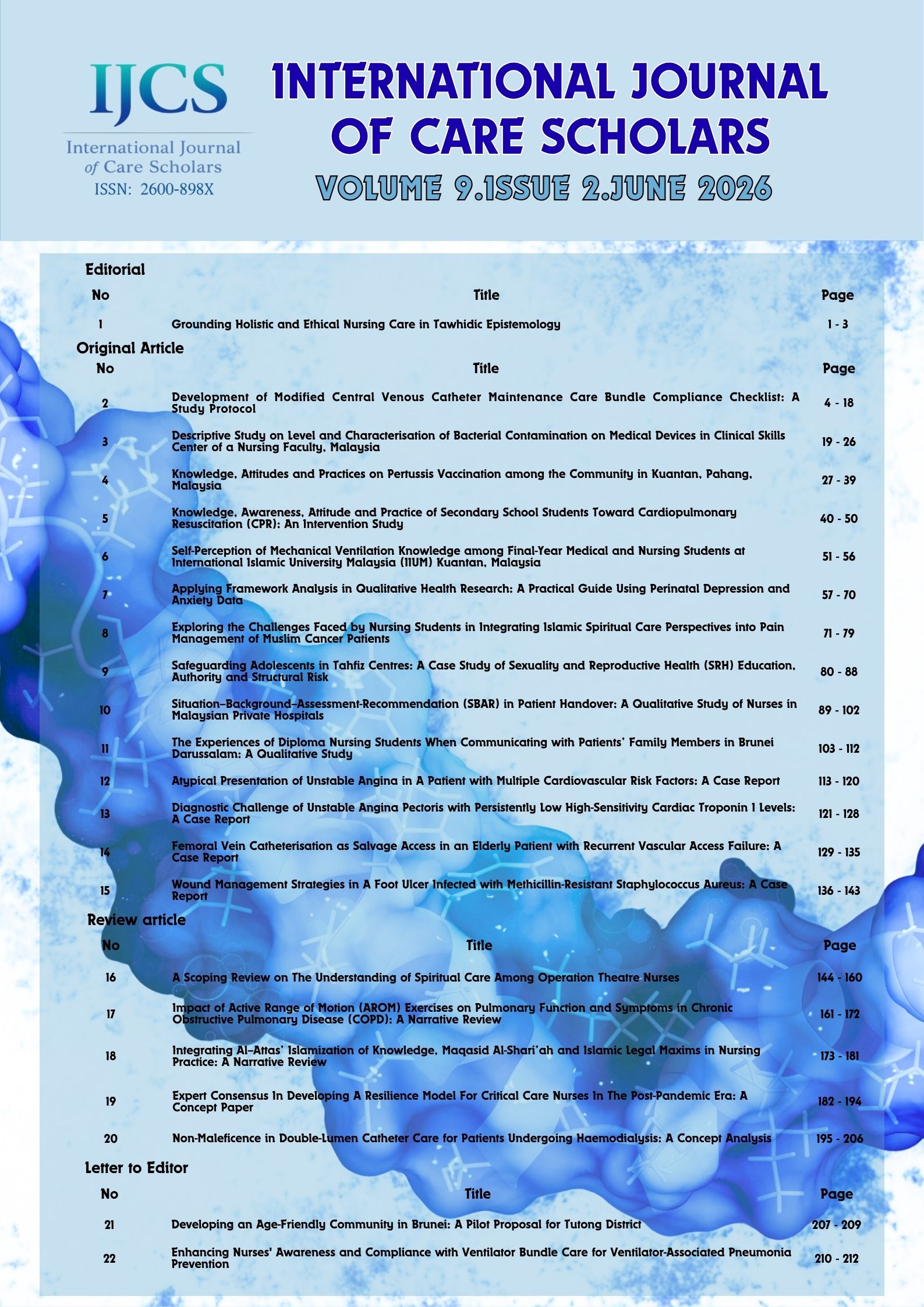
Diagnostic Challenge of Unstable Angina Pectoris with Persistently Low High-Sensitivity Cardiac Troponin I Levels: A Case Report
DOI:
https://doi.org/10.31436/ijcs.v9i2.519Keywords:
Unstable angina, Troponin I, Myocardial ischemia, Biomarkers, Case report, Acute coronary syndromeAbstract
Background: High-sensitivity cardiac troponin I (hs-cTnI) is a key biomarker for detecting myocardial injury and is central to the diagnosis of acute coronary syndrome (ACS). However, in unstable angina pectoris (UAP), hs-cTnI levels may remain below the 99th percentile upper reference limit, making diagnosis challenging despite ongoing myocardial ischemia. This case report aims to highlight the diagnostic challenges of UAP in the presence of persistently low hs-cTnI levels and to emphasize the importance of integrating clinical assessment, serial electrocardiographic findings, and biomarker interpretation for accurate diagnosis.
Case Presentation: A descriptive case report design was used. Clinical data were obtained from a 64-year-old male patient with hypertension and diabetes mellitus who presented to the emergency department with chest pain, palpitations, and mild shortness of breath. Diagnostic evaluation included serial electrocardiography, laboratory investigations including high-sensitivity cardiac troponin I (hs-cTnI), and comprehensive clinical assessment during hospitalization. Electrocardiography demonstrated sinus rhythm without acute ischemic changes throughout admission. Serial hs-cTnI measurements remained persistently low, ranging from 2.77 pg/mL to 4.35 pg/mL, with no dynamic rise or fall. Despite normal troponin levels and absence of myocardial necrosis, the patient was diagnosed with unstable angina pectoris based on typical ischemic chest pain and significant cardiovascular risk factors.
Conclusion: This case illustrates the diagnostic complexity of UAP when hs-cTnI levels remain within the normal range. It highlights the necessity of integrating clinical evaluation, serial ECG findings, and risk stratification rather than relying solely on biomarkers. From a nursing perspective, comprehensive assessment, continuous hemodynamic monitoring, patient education, and early evidence-based intervention are essential. Multidisciplinary management is crucial to prevent progression to acute myocardial infarction and adverse outcomes.
References
Roth GA, A. MG, O. JC, Giovanni A, Enrico A, M. BL, et al. Global Burden of Cardiovascular Diseases and Risk Factors, 1990–2019. JACC [Internet]. 2020 Dec 22;76(25):2982–3021. Available from: https://doi.org/10.1016/j.jacc.2020.11.010
Virani SS, Alonso A, Aparicio HJ, Benjamin EJ, Bittencourt MS, Callaway CW, et al. Heart Disease and Stroke Statistics—2021 Update. Circulation [Internet]. 2021 Feb 23;143(8):e254–743. Available from: https://doi.org/10.1161/CIR.0000000000000950
Collet JP, Thiele H, Barbato E, Barthélémy O, Bauersachs J, Bhatt DL, et al. 2020 ESC Guidelines for the management of acute coronary syndromes in patients presenting without persistent ST-segment elevation. Eur Heart J. 2021 Apr;42(14):1289–367.
Manfredi R, Verdoia M, Compagnucci P, Barbarossa A, Stronati G, Casella M, et al. Angina in 2022: Current Perspectives. J Clin Med. 2022 Nov;11(23).
Balla C, Pavasini R, Ferrari R. Treatment of Angina: Where Are We? Cardiology. 2018;140(1):52–67.
Apple FS, Sandoval Y, Jaffe AS, Ordonez-Llanos J, Bio-Markers for the ITF on CA of C. Cardiac Troponin Assays: Guide to Understanding Analytical Characteristics and Their Impact on Clinical Care. Clin Chem [Internet]. 2017 Jan 1;63(1):73–81. Available from: https://doi.org/10.1373/clinchem.2016.255109
Shah AS V, Anand A, Strachan FE, Ferry A V, Lee KK, Chapman AR, et al. High-sensitivity troponin in the evaluation of patients with suspected acute coronary syndrome: a stepped-wedge, cluster-randomised controlled trial. Lancet. 2018;392(10151):919–28.
Potter JM, Hickman PE, Cullen L. Troponins in myocardial infarction and injury. Aust Prescr. 2022 Apr;45(2):53–7.
Fadel R, Miller J, Cook B, Nguyen F, Alqarqaz M, Fuller B, et al. the Incidence of Unstable Angina in Patients With Low High-Sensitivity Troponin I Values: a Subgroup Analysis of the Race-It Trial. J Am Coll Cardiol [Internet]. 2024;83(13):1268. Available from: http://dx.doi.org/10.1016/S0735-1097(24)03258-3
Katrukha IA, Katrukha AG. Myocardial Injury and the Release of Troponins I and T in the Blood of Patients. Clin Chem [Internet]. 2021 Jan 8;67(1):124–30. Available from: https://doi.org/10.1093/clinchem/hvaa281
Sandoval Y, Januzzi JL, Jaffe AS. Cardiac Troponin for Assessment of Myocardial Injury in COVID-19: JACC Review Topic of the Week. J Am Coll Cardiol [Internet]. 2020;76(10):1244–58. Available from: https://doi.org/10.1016/j.jacc.2020.06.068
Jouen R, Meunier PA, Moulis L, Roubille F, Macia JC, Berdeu JM, et al. Incidence and 1-Year Prognostic of Unstable Angina After High-Sensitivity Troponin Assessment. Catheter Cardiovasc Interv Off J Soc Card Angiogr Interv. 2025 May;105(6):1445–52.
Dakshi A, Salmon T, Collinson P, Ihsan J, Campbell M, Khand A. Unstable angina in the context of high-sensitive troponins: Still a marker of high risk? A comparison of outcomes with adjudicated type 1 myocardial infarction. Int J Cardiol [Internet]. 2023;391. Available from: https://www.scopus.com/inward/record.uri?eid=2-s2.0-85169029243&doi=10.1016%2Fj.ijcard.2023.131226&partnerID=40&md5=f0bdd65f6fbd50deeeae1c3f6e300d0a
Maayah M, Grubman S, Allen S, Ye Z, Park DY, Vemmou E, et al. Clinical Interpretation of Serum Troponin in the Era of High-Sensitivity Testing. Vol. 14, Diagnostics. 2024.
Hsiao JJ, Celedon MA, Rudolph JL, Konnyu KJ, Erqou SA, Baig M, et al. Accelerated diagnostic protocols using high-sensitivity troponin assays to rule in or out myocardial infarction: A systematic review. JEM Reports [Internet]. 2024;3(2):100086. Available from: https://www.sciencedirect.com/science/article/pii/S2773232024000166
Nguyen MT, Lambrakis K, Lehman S, Haustead D, Psaltis PJ, Chew DP, et al. High-Sensitivity Cardiac Troponin T Reporting, Clinical Outcomes, and Health Care Resource Use. JAMA Netw open. 2024 Oct;7(10):e2438541.
Wereski R, Adamson P, Shek Daud NS, McDermott M, Taggart C, Bularga A, et al. High-Sensitivity Cardiac Troponin for Risk Assessment in Patients With Chronic Coronary Artery Disease. J Am Coll Cardiol. 2023 Aug;82(6):473–85.
Gulati M, Levy PD, Mukherjee D, Amsterdam E, Bhatt DL, Birtcher KK, et al. 2021 AHA/ACC/ASE/CHEST/SAEM/SCCT/SCMR guideline for the evaluation and diagnosis of chest pain: a report of the American College of Cardiology/American Heart Association Joint Committee on Clinical Practice Guidelines. J Am Coll Cardiol. 2021;78(22):e187–285.
Shan Y, Chen J, Zhou S, Wen G. Nursing Interventions and Care Strategies for Patients with Coronary Heart Disease: A Comprehensive Review. Galen Med J. 2023;12:e2994.
Lukitasari M, Apriliyawan S, Manistamara H, Sella YO, Rohman MS, Jonnagaddala J. Focused Chest Pain Assessment for Early Detection of Acute Coronary Syndrome: Development of a Cardiovascular Digital Health Intervention. Glob Heart. 2023;17(1):18.
Anderson HV (“Skip”), Masri SC, Abdallah MS, Chang AM, Cohen MG, Elgendy IY, et al. 2022 ACC/AHA Key Data Elements and Definitions for Chest Pain and Acute Myocardial Infarction: A Report of the American Heart Association/American College of Cardiology Joint Committee on Clinical Data Standards. Circ Cardiovasc Qual Outcomes [Internet]. 2022 Oct 1;15(10):e000112. Available from: https://doi.org/10.1161/HCQ.0000000000000112
Silva RC da, Gondim MC, Melo GM, Silva VM da, Cavalcante AMRZ, Almeida M de A, et al. Decreased cardiac output: an integrative review. Rev Bras Enferm. 2023;76(2):e20220265.
Jacquet-Lagrèze M, Pernollet A, Kattan E, Ait-Oufella H, Chesnel D, Ruste M, et al. Prognostic value of capillary refill time in adult patients: a systematic review with meta-analysis. Crit Care [Internet]. 2023;27(1):473. Available from: https://doi.org/10.1186/s13054-023-04751-9
Holm MS, Fålun N, Pettersen TR, Bendz B, Nilsen RM, Langørgen J, et al. Appropriateness and outcomes of hospitalized patients telemetry monitored for cardiac arrhythmias in accordance with the American Heart Association Practice Standards–A multicenter study. Hear Lung [Internet]. 2024;68:217–26. Available from: https://www.sciencedirect.com/science/article/pii/S014795632400133X
Bagheri H, Shakeri S, Nazari AM, Goli S, Khajeh M, Mardani A, et al. Effectiveness of nurse-led counselling and education on self-efficacy of patients with acute coronary syndrome: A randomized controlled trial. Nurs open. 2022 Jan;9(1):775–84.
Downloads
Published
How to Cite
Issue
Section
License
Copyright (c) 2026 INTERNATIONAL JOURNAL OF CARE SCHOLARS

This work is licensed under a Creative Commons Attribution-NonCommercial 4.0 International License.