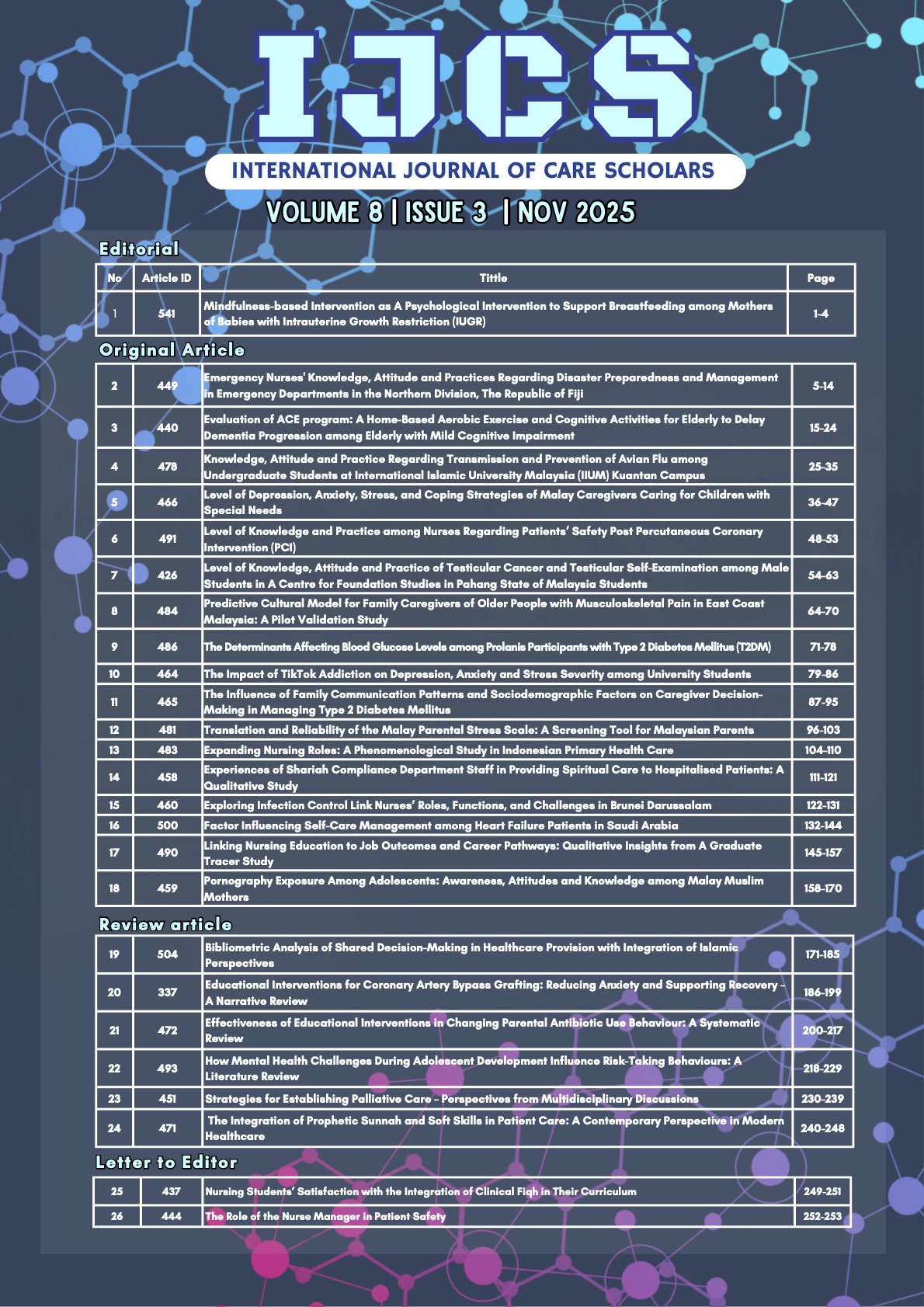
The Integration of Prophetic Sunnah and Soft Skills in Patient Care: A Contemporary Perspective in Modern Healthcare
DOI:
https://doi.org/10.31436/ijcs.v8i3.471Keywords:
Prophetic sunnah, Soft skills, Healthcare, Patient-centered careAbstract
Background: The Sunnah of the Prophet Muhammad (?) provides a timeless model of compassionate, ethical, and emotionally intelligent behavior that closely aligns with the soft skills essential in modern patient care. As healthcare increasingly recognizes the value of empathy, communication, respect, and moral integrity, the Prophetic tradition offers an authentic framework for integrating spiritual and ethical dimensions into professional practice. The purpose of this conceptual review is threefold: (1) to clarify how soft skills manifest in healthcare as distinct from other contexts; (2) to map these soft-skill domains onto the ethical-behavioural framework of the Prophetic Sunnah; and (3) to propose a conceptual framework for integrating Prophetic traits and values into healthcare education and practice, particularly within Muslim-majority contexts.
Methods: To achieve these aims, a narrative review of literature published between 1999 and 2025 was conducted, drawing from healthcare, psychology, and Islamic literature sources. Relevant classical and contemporary references were synthesised to establish conceptual linkages between soft skills and Prophetic characteristics such as rahmah (compassion), amanah (trust), adab (respect), hikmah (communication), and sabar (patience).
Results: The findings highlight how the Prophetic Sunnah complements the healthcare competencies and provides a culturally and spiritually grounded approach to soft-skills development. Embedding these values in healthcare education can strengthen moral resilience, enhance patient-centered care, and reinforce professional identity among Muslim healthcare providers.
Conclusion: This review concludes that integrating Prophetic-based soft skills within healthcare training represents not only a moral imperative but also a pathway toward more holistic, compassionate, and ethically coherent healthcare systems.
References
Jamaludin TSS, Nurumal S, Ahmad N, Naznin Muhammad SA & Chan CM. A Clinical Audit on Soft Skills Elements in Structured Nursing Clinical Skill Assessment on Health Education Procedure. Malaysian Journal of Medicine & Health Sciences. 2025; 21(SUPP6):81-86. https://doi:10.47836/mjmhs.21.s6.14
Laari L, Anim-Boamah O, Nyame M. Defining soft skills in nursing: a concept analysis. Frontiers of Nursing [Internet]. 2024;11(3):243–51. Available from: https://doi.org/10.2478/fon-2024-0023
Wilson College. 9 Essential Soft Skills for Nursing. . 2024;
BeyondBerea. Why soft skills are essential in healthcare. 2023. Retrieved from https://www.beyondberea.org/blog/2023/03/22/why-soft-skills-are-essential-in-healthcare/
Jamaludin TSS, Nurumal S, Ahmad N, Naznin Muhammad SA & Chan CM. Soft Skills Elements in Structured Clinical Skill Assessment: A Qualitative Study. Bali Medical Journal. 2022; 11(3), 1666–1674. https://doi.org/10.15562/bmj.v11i3.3721
Ofori-Manteaw B, Nelson T, Barry K, Al Mousa D, Nabasenja C, Frame N, et al. Beyond technical proficiency: A scoping review of the role of soft skills in medical radiation science. Radiography [Internet]. 2025 May 1 [cited 2025 Nov 6];31(3):102924. Available from: https://www.sciencedirect.com/science/article/pii/S1078817425000653
Jamaludin TSS, Nurumal S, Ahmad N, Naznin Muhammad SA & Chan CM. Soft Skill Elements in Structured Clinical Nursing Assessment for Undergraduate Nursing Student: A Systematic Review. Enfermería Clínica. 2021; 31, S58–S62. https://doi.org/10.1016/j.enfcli.2020.10.0
Dolev N, Naamati Schneider L, Meirovich A. Making soft skills a part of the curriculum of healthcare studies. In 2021.
Ray J, Overman A. Hard Facts About Soft Skills. Am J Nurs. 2014 Feb 1;114:64–8.
Tehranineshat B, Rakhshan M, Torabizadeh C, Fararouei M. Compassionate care in healthcare systems: a systematic review. J Natl Med Assoc [Internet]. 2019 Oct 1 [cited 2025 Nov 6];111(5):546–54. Available from: https://www.sciencedirect.com/science/article/abs/pii/S0027968417303309
Bordbar S, Bahmaei J, Rad H, Yusefi A. Investigate the state of critical thinking and its impact on moral courage and moral sensitivity; evidence from nurses’ perspective. BMC Nurs. 2024 Nov 13;23.
Chen LH, Chen CH, Loverio JP, Wang MJ (Sebrina), Lee LH, Hou YP. Examining soft and hard attributes of health care service quality and their impacts on patient satisfaction and loyalty. Quality Management in Healthcare [Internet]. 2024;33(3). Available from: https://journals.lww.com/qmhcjournal/fulltext/2024/07000/examining_soft_and_hard_attributes_of_health_care.7.aspx
Jamaludin TSS, Nurumal S, Ahmad N, Naznin Muhammad SA & Chan CM. (2022). Development and Evaluating Content Validity of Clinical Skill Analysis Index Tools. Open Access Macedonian Journal of Medical Sciences. 2022; 9(T5), 6–12. https://doi.org/10.3889/oamjms.2022.78
Bukhari F & Iraqi KM. Soft Skills among Leaders: An Analysis from Quran and Sunnah Perspective. Habibia Islamicus (The International Journal of Arabic and Islamic Research). 2021; 5 (2):44-52. https://doi.org/10.47720/hi.2021.0502e04
Kamali MH. Shari’ah Law: An Introduction. . Oneworld Publications . 2010;
Al-Qaradawi Y. The Sunnah: A source of civilization. . Islamic Book Trust . 1999;
Rassool G H. Re-Examining the Anatomy of Islamic Psychotherapy and Counselling: Envisioned and Enacted Practices. Islamic Guidance and Counseling Journal. 2021; 4(2), 133–143. https://doi.org/10.25217/igcj.v4i2.1840
Padela AI. Islamic medical ethics: A primer. Vol. 21, Bioethics. 2007. p. 169–78.
Sahih al-Bukhari. Hadith 5653, 6927.
Musnandar A, Ubaidi A. Islamic Values on Soft Skills. Jihbiz?: Jurnal Ekonomi, Keuangan dan Perbankan Syariah. 2022 Jul 29;6(2):102–16.
Abdullah MMA, Fazlan MACA, Sheefa MIF, Mazahir SMM. The application of life skills in sunnah: a study based on recommended life skills by WHO. World Journal of Social Science. 2021 Jul 17;8(2):23.
Ismail S, Hatthakit U, Chinnawong T. Caring science within islamic contexts: a literature review. Nurse Media Journal of Nursing. 2015 Jun 30;5:34.
Feener RM. Muslim Legal Thought in Modern Indonesia. Cambridge University Press, 2009. https://doi.org/10.1017/CBO9780511495540.
Shah SMT, Randhawa MA. Medical Ethics in Perspective of Islamic Teachings. Journal of Rawalpindi Medical College. 2024 Mar 28;28(1).
Belhaj A. Islamic ethics and self-development: communitarian, individualist and pietistic perspectives. Socio Religia. 2024 Dec 30;5(2).
Kelm Z, Womer J, Walter JK, Feudtner C. Interventions to cultivate physician empathy: a systematic review. BMC Med Educ [Internet]. 2014;14(1):219. Available from: https://doi.org/10.1186/1472-6920-14-219
Al-Tirmidhi MI. Sunan al-Tirmidhi (Hadith 2018). 2018;
Faris S. Sunnah as a Bridge between Theological and Practical Dimensions. Dirasah International Journal of Islamic Studies. 2024; 2(2), 120–135. https://doi.org/10.59373/drs.v2i2.31
Downloads
Published
How to Cite
Issue
Section
License
Copyright (c) 2025 INTERNATIONAL JOURNAL OF CARE SCHOLARS (ISSN: 2600-898X)

This work is licensed under a Creative Commons Attribution-NonCommercial 4.0 International License.