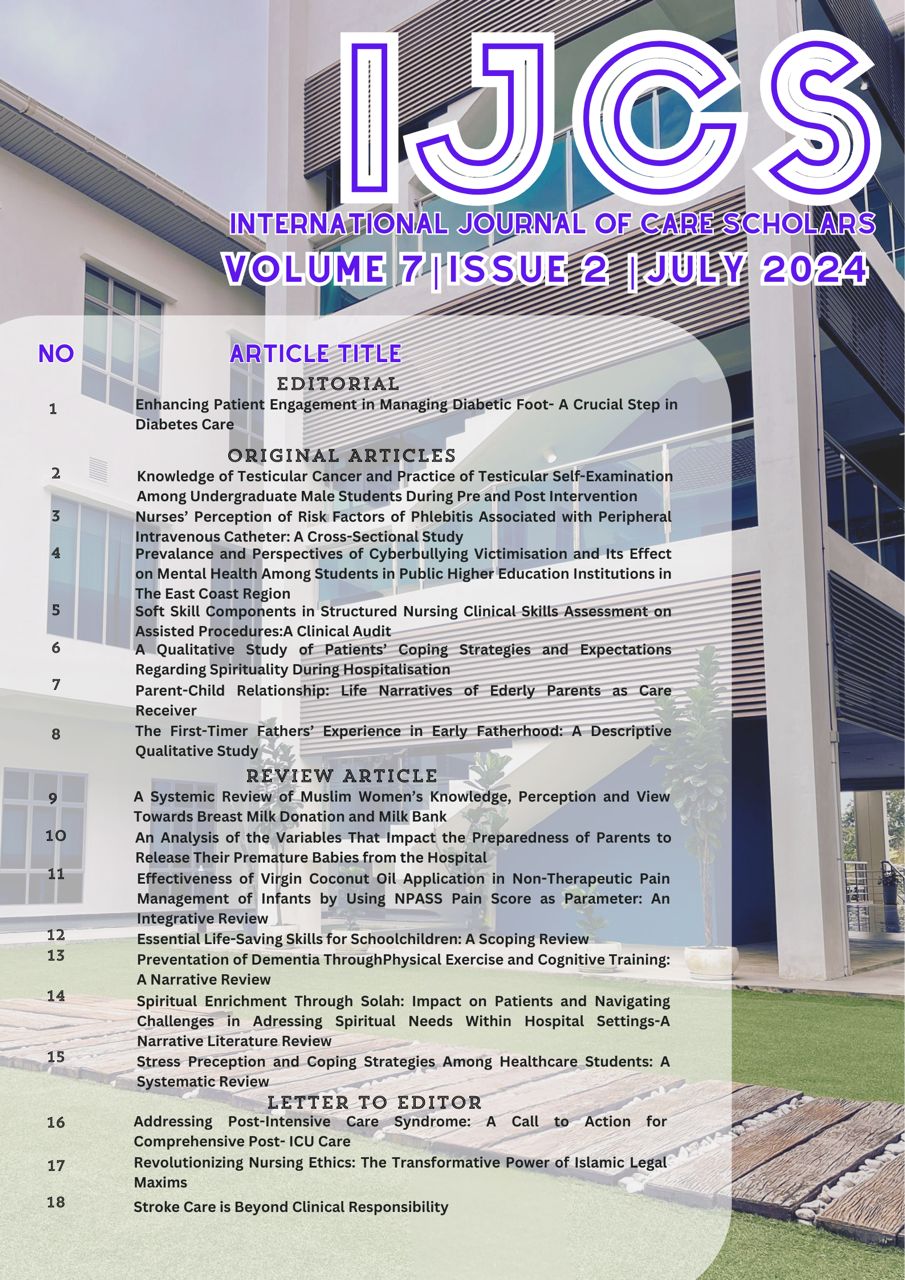
Prevalence and Perspectives of Cyberbullying Victimisation and Its Effect on Mental Health Among Students in Public Higher Education Institutions in the East Coast Region
DOI:
https://doi.org/10.31436/ijcs.v7i2.366Keywords:
Cyberbullying victimization, Mental health, StudentAbstract
Introduction: Cyberbullying has emerged as a prevalent issue, were perpetrators harm victims through technology, often anonymously. It is also has been linked with significant negative outcomes in psychological aspects such as social anxiety, low self-esteem, depression, affective disorders, sleeping and eating disorders. Thus, this study aims to examine the association between students' socio-demographics, their experience of cyberbullying and its psychological effects among Public Higher Education Institutions (IPTA) students in the East Coast region.
Methods: The cross-sectional study was conducted among 355 IPTA students in East Coast region by using a convenient sampling. The online survey was distributed consist mainly of 3 parts, sociodemographic data, perspective and experiences of being cyberbullied and DASS-21 questionnaires.
Results: 36.6% students have experienced of being cyberbullied, with 19.6% have been cyberbullied almost every day. However, 23.3% reported that the cyberbullying was not harsh at all, 11.4% harsh and 2.0% really harsh. About 24.1% respondents do not have an impact at all, 10.5% have small impact and 2.0% have huge impact on daily life. There was no significant difference between gender and year of study concerning the experience of being cyberbullied among undergraduate IPTA students in the East Coast region (p-value>0.05). However, age showed a significant association with the experience of being cyberbullied (p-value<0.05) with majority of students that had experienced of being cyberbullied was in the range 22-23 years old. There was no significant difference in perspectives on cyberbullying between males and females (p-value>0.05), but age significantly influenced perspectives on cyberbullying (p-value<0.05).
Conclusion: This study suggest that the emotional impact of cyberbullying varies based on individual circumstances and personal perspectives on cyberbullying. Future research should explore the underlying factors contributing to the higher prevalence of cyberbullying among female students and those aged 22-23.
References
Balakrishnan V. Cyberbullying among young adults in Malaysia: The roles of gender, age and Internet frequency. Comput Human Behav. 2015 May 31;46.
Chan HC (Oliver), Wong D. Traditional school bullying and cyberbullying in Chinese societies: Prevalence and a review of the whole-school intervention approach. Aggress Violent Behav. 2015 May 1;23.
Sticca F, Perren S. Is Cyberbullying Worse than Traditional Bullying? Examining the Differential Roles of Medium, Publicity, and Anonymity for the Perceived Severity of Bullying. J Youth Adolesc [Internet]. 2013;42(5):739–50. Available from: https://doi.org/10.1007/s10964-012-9867-3
H1 2013: Cyber security scene in Malaysia. CyberSecurity Malaysia. [Internet]. [cited 2024 Jul 19]. Available from: https://www.cybersecurity.my/en/knowledge_bank/news/2013/main/detail/2318/index.html#:~:text=H1%202013%3A%20Cyber%20security%20scene%20in%20Malaysia&text=According%20to%20national%20agency%20CyberSecurity,developed%20nation%20status%20by%202020
Balakrishnan V. Cyberbullying among young adults in Malaysia: The roles of gender, age and Internet frequency. Comput Human Behav. 2015 May 31;46.
Chan HC (Oliver), Wong D. Traditional school bullying and cyberbullying in Chinese societies: Prevalence and a review of the whole-school intervention approach. Aggress Violent Behav. 2015 May 1;23.
Sticca F, Perren S. Is Cyberbullying Worse than Traditional Bullying? Examining the Differential Roles of Medium, Publicity, and Anonymity for the Perceived Severity of Bullying. J Youth Adolesc [Internet]. 2013;42(5):739–50. Available from: https://doi.org/10.1007/s10964-012-9867-3
H1 2013: Cyber security scene in Malaysia. CyberSecurity Malaysia. [Internet]. [cited 2024 Jul 19]. Available from: https://www.cybersecurity.my/en/knowledge_bank/news/2013/main/detail/2318/index.html#:~:text=H1%202013%3A%20Cyber%20security%20scene%20in%20Malaysia&text=According%20to%20national%20agency%20CyberSecurity,developed%20nation%20status%20by%202020
Abaido GM. Cyberbullying on social media platforms among university students in the United Arab Emirates. Int J Adolesc Youth. 2020;25(1):407–20.
Lovibond PF, Lovibond SH. The structure of negative emotional states: Comparison of the Depression Anxiety Stress Scales (DASS) with the Beck Depression and Anxiety Inventories. Behaviour Research and Therapy. 1995 Mar 1;33(3):335–43.
Zuckerman W. 60 Cyberbullying Statistics: 2019/2020 Data, Insights & Predictions. CompareCamp [Internet]. 2020 [cited 2024 Jul 19]. Available from: https://comparecamp.com/cyberbullying-statistics.
Raskauskas J, Gregory J, Harvey S, Rifshana F, Evans I. Bullying among primary school children in New Zealand:
Downloads
Published
How to Cite
Issue
Section
License
Copyright (c) 2024 INTERNATIONAL JOURNAL OF CARE SCHOLARS

This work is licensed under a Creative Commons Attribution-NonCommercial 4.0 International License.