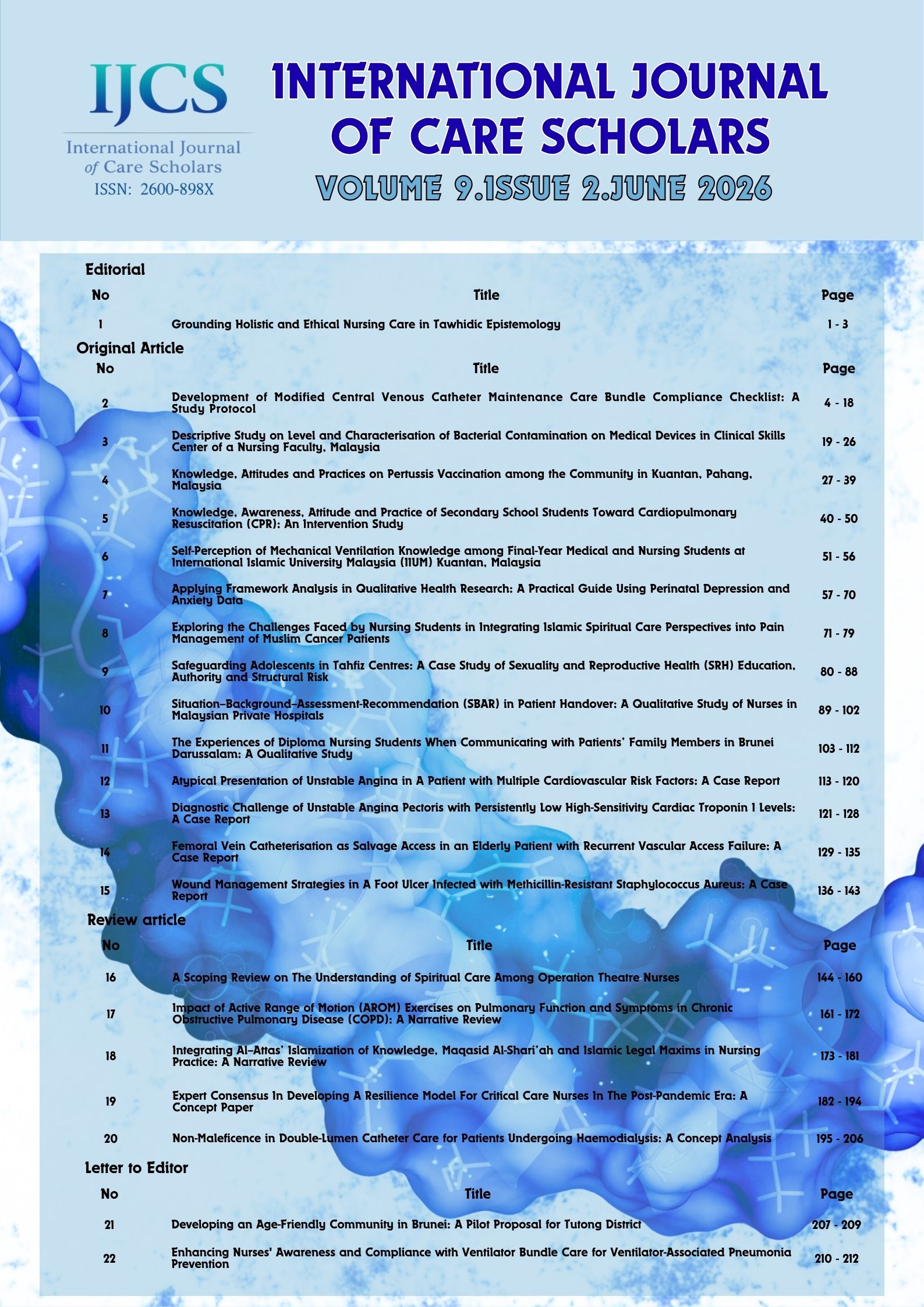
Situation–Background–Assessment-Recommendation (SBAR) in Patient Handover: A Qualitative Study of Nurses in Malaysian Private Hospitals
DOI:
https://doi.org/10.31436/ijcs.v9i2.581Keywords:
Situation–Background–Assessment-Recommendation (SBAR), Patient handoff, Communication, Patient safety, Hospitals, PrivateAbstract
Background: Patient safety and care continuity rely heavily on effective communication during handovers. While the SBAR framework is a standard global tool, there is a lack of context-specific research on its implementation within Malaysian private healthcare, particularly comparing general wards and critical care. This study addresses that gap by exploring how SBAR is utilized in these diverse clinical settings.
Methods: Using a qualitative design, semi-structured interviews were conducted with 20 purposively selected nurses (10 from general wards; 10 from critical care). Data were analysed via reflexive thematic analysis using NVivo to identify experiences and contextual influences.
Results: SBAR was found to enhance the organization, clarity, and consistency of handovers. Three key themes emerged: SBAR as a structured cognitive tool, its role in coordinating patient safety, and organizational factors influencing its use. While SBAR improved shared understanding, application was more consistent in critical care than in general wards due to differences in workload and workflow support. Barriers included initial resistance and the necessity for ongoing education.
Conclusion: SBAR is a valuable framework for structuring clinical handovers and improving team coordination in Malaysian private healthcare. However, its effectiveness is highly context-dependent, often influenced by a nurse's designation and educational level. To achieve consistent application across all ward types, hospital leadership must prioritize targeted training and integrate SBAR into routine workflows to overcome workload-related barriers and initial resistance.
References
McCarthy D, Shekelle PG. Patient safety in healthcare: a global perspective. Lancet. 2024;403(10431):1023-35.
Joint Commission International. International patient safety goals (IPSG). 2024.
Abbaszade A, Borhani F, Abbaszadeh S. The effect of SBAR communication model on improving nurse-physician communication: a systematic review. J Nurs Manag. 2021;29(4):789-97.
Daicampi M, Rossi S, Bianchi M. Effectiveness of SBAR communication in clinical handover: a systematic review. Int J Nurs Stud. 2025;145:104567.
Shrivastava SRBL, Chong SV, Bobhate PS. Facilitating effective communication through the adoption of SBAR tool in medical training. Journal of Education and Health Promotion. 2025; 14:249. doi: 10.4103/jehp.jehp_1213_24.
Wulandari R, Suryani M, Hidayati N. The effectiveness of SBAR in improving communication quality among nurses. J Nurs Pract. 2025;9(1):15-25.
Achrekar MS, Murthy V, Kanan S, et al. Introduction of situation, background, assessment, and recommendation into nursing practice: a prospective study. Asia Pac J Oncol Nurs. 2020;7(1):45-50.
Randmaa M, Mårtensson G, Swenne CL, et al. SBAR improves communication and patient safety outcomes. Scand J Caring Sci. 2021;35(1):123-30.
Alizadeh-Risani S, Ahmadi F, Sadeghi T. Barriers to SBAR implementation in clinical practice: a qualitative study. BMC Nurs. 2024;23(1):112-20.
Nur Azmi N, Rahman RA, Ismail S. Evaluating SBAR usage among nurses in Malaysian hospitals. Malays J Nurs. 2025;16(2):45-55.
Soed N, Ludin SM, Syed Abdullah SN, et al. Exploring the impact of the SBAR on nursing handover: a scoping review. Malays J Nurs. 2025;17(1).
Lim SH, Tong SF, Ang E. Implementation challenges of SBAR in Malaysian healthcare settings. Malays J Med Sci. 2021;28(3):102-10.
World Health Organization. Global patient safety action plan 2021-2030. Geneva: WHO; 2021.
Ministry of Health Malaysia. SBAR communication tool guideline. Putrajaya: Ministry of Health Malaysia; 2017.
Müller M, Jürgens J, Redaèlli M, et al. Impact of structured communication tools on patient outcomes: a systematic review. BMJ Open. 2021;11(1): e043275.
Yun S, Kim H, Park E. Communication practices during patient handover in acute care settings. Int J Nurs Stud. 2023; 139:104456.
Herawati H, Jubaidah S. Factors influencing communication effectiveness in healthcare settings: a systematic review. Nurse Media J Nurs. 2025;15(1):23-35.
Institute for Healthcare Improvement (IHI). SBAR tool: Situation-background-assessment-recommendation [Internet]. Boston: IHI; [cited 2026 May 14]. Available from: https://www.ihi.org/library/tools/sbar-tool-situation-background-assessment-recommendation
Braun V, Clarke V. Thematic analysis: a practical guide. London: SAGE Publications; 2023.
Lo L, Staggers N, Ezeonwu M. Nursing communication and patient safety outcomes: a systematic review. J Nurs Care Qual. 2021;36(4):331-8.
World Health Organization. Global patient safety action plan 2021–2030. Geneva: World Health Organization; 2022.
Aicken CRH, McPherson G, Ker JS. Simulation-based training and structured communication tools improve interprofessional collaboration. Med Educ. 2021;55(3):315-23.
Davis R, Johnson L, Patel S. High-reliability organisations and communication practices in healthcare. BMJ Qual Saf. 2023;32(5):321-8.
Rogers EM. Diffusion of innovations. 5th ed. New York: Free Press; 2003.
Oliveira J, Brown T. Nurses’ perceptions of structured communication tools in clinical practice. J Adv Nurs. 2021;77(6):2805-14.
Pavitt S, Sevdalis N, Vincent C. Improving patient handover through multimodal communication strategies. BMJ Qual Saf. 2021;30(7):569-77.
Assarroudi A, Heshmati Nabavi F, Armat MR. Structured communication and leadership roles in clinical practice: a qualitative study. J Clin Nurs. 2020;29(9-10):1505-17.
Lee YJ, Chen H, Lin C. Effectiveness of SBAR-based communication in improving nursing handovers. Nurs Open. 2023;10(4):2456-64.
World Health Organization. (2023). Patient safety report 2023. https://www.who.int
Thomas CM, Bertram E, Johnson D. The SBAR communication technique: teaching nursing students professional communication skills. Nurse Educator. 2009;34(4):176-180.
Ahmed HA, Ali MH, Koko A, Ibrahim MF, Omar RS, Mahmoud DS, et al. The use of the Situation, Background, Assessment, and Recommendation (SBAR) form as a tool for handoff communication in the pediatrics department in a Sudanese teaching hospital. Cureus. 2022;14(11):e31998.
Nguyen T, Brown A, Taylor R. Barriers to communication tool adoption in clinical practice. Nurse Educ Today. 2023; 125:105750.
Brown TM, Richards S. SBAR implementation in healthcare settings: a systematic review. J Healthc Commun. 2020;28(4):56-62.
Garcia M, Lee H, Wong J. Organisational strategies for implementing structured communication tools in hospitals. J Healthc Manag. 2024;69(2):101-10.
Davis, R., Johnson, L., & Patel, S. (2023). High-reliability organisations and communication practices in healthcare. BMJ Quality & Safety, 32(5), 321–328. https://doi.org/10.1136/bmjqs-2022-015432
Pinto F, Roberto P, Ferrario L, Marotta L, Montani D, Auletta G, et al. Using “Situation-Background-Assessment-Recommendation” method in palliative care to enhance handover quality and nursing practice: a mixed-method study. J Clin Nurs. 2025;34(1):117-127. https://doi:10.1111/jocn.17537
Downloads
Published
How to Cite
Issue
Section
License
Copyright (c) 2026 INTERNATIONAL JOURNAL OF CARE SCHOLARS

This work is licensed under a Creative Commons Attribution-NonCommercial 4.0 International License.