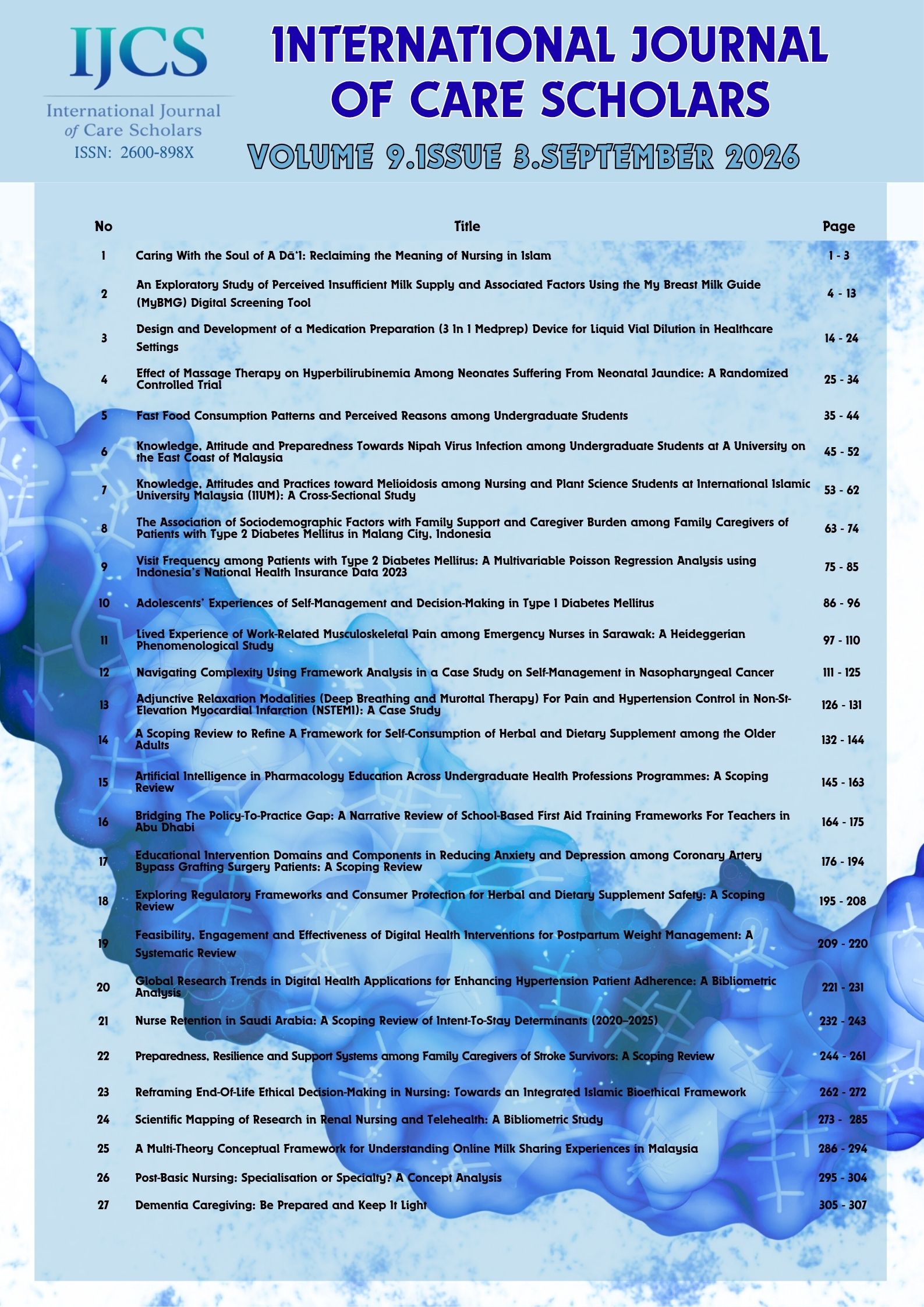
Navigating Complexity Using Framework Analysis in a Case Study on Self-Management in Nasopharyngeal Cancer
DOI:
https://doi.org/10.31436/ijcs.v9i3.544Keywords:
Framework analysis, Qualitative research, Case study, Methodological reflectionAbstract
Background: Nasopharyngeal cancer presents unique self-management challenges due to its complex treatment regimens, long-term side effects, and cultural influences on patient care. While qualitative approaches are widely used to explore these experiences, there remains limited methodological discussion on how specific analytic frameworks can enhance rigor and transparency in case study designs. Therefore, this paper critically examines the application of framework analysis in a qualitative case study exploring self-management among patients with nasopharyngeal cancer.
Methods: Data was generated through in-depth interviews with patients, family, and healthcare providers. The data was analysed using framework analysis that consists of three iterative processes: 1. Data management, 2. Descriptive account, 3. Explanatory account while considering the concept of ‘self-management’ as the main ‘case’. NVivo software supported data management.
Results: Themes, subthemes, and categories emerged and presented at the end of the analysis process. Framework analysis allowed systematic insight to synchronise with the case study design strategies. Analysis of data by using this approach offered in-depth findings and understanding of the ‘case’ being studied. Importantly, the paper demonstrates how qualitative research and rigorous analytic strategies in framework analysis can strengthen methodological literacy and reflexivity, thereby contributing to the advancement of qualitative inquiry within higher education.
Conclusion: Application of framework analysis in a qualitative case study provided a systematic means of organizing diverse data while retaining contextual depth. Its flexibility allowed integration of both deductive and inductive themes, though challenges arose in managing overlapping codes and sustaining reflexivity to avoid imposing predefined categories.
References
Che Abdullah CA, Saidi S, Lee SP. (2021 ). Understanding self-management related experience of patients with nasopharyngeal cancer?: a review . Enfermeria Clinica , 31. 2021;(July 2008):1–7.
Lin YL, Chuang CY, Hsieh VCR, Tsai MS, Liu YF, Chen XX, et al. Unmet supportive care needs of survival patients with nasopharyngeal carcinoma. Int J Environ Res Public Health. 2020 May 2;17(10). doi:10.3390/ijerph17103519 PubMed PMID: 32443492.
Abdullah CAC, Saidi S, Lee SP. Self-management through perceived symptoms impact among patients with nasopharyngeal cancer during phase 1 of cancer trajectory. Systematic Reviews in Pharmacy. 2020;11(6):1228–33. doi:10.31838/srp.2020.6.178
Mori M, Lin CP, Cheng SY, Suh SY, Takenouchi S, Ng R, et al. Communication in Cancer Care in Asia: A Narrative Review. JCO Glob Oncol. 2023 Sep;(9). doi:10.1200/go.22.00266 PubMed PMID: 37364221.
Yazan B, De Vasconcelos ICO. Three approaches to case study methods in education: Yin, Merriam, and Stake. Meta: Avaliacao. 2016;8(22):149–82. doi:10.22347/2175-2753v8i22.1038
Smith JA, Flowers P, Larkin M. Interpretive Phenomenological Analysis Theory, Method, and Research. 2nd ed. SAGE; 2021. 1–240 p.
Strauss A, Corbin J. Basics of Qualitative Research: Techniques and Procedures for Developing Grounded Theory. Basics of Qualitative Research Grounded Theory Procedures and Techniques [Internet]. 2008. 379 p. Available from: http://srmo.sagepub.com/view/basics-of-qualitative-research/SAGE.xml doi:10.4135/9781452230153 PubMed PMID: 2142574.
Nowell LS, Norris JM, White DE, Moules NJ. Thematic Analysis: Striving to Meet the Trustworthiness Criteria. https://doi.org/101177/1609406917733847. 2017 Oct 2;16(1). doi:10.1177/1609406917733847
Vaismoradi M, Turunen H, Bondas T. Content analysis and thematic analysis: Implications for conducting a qualitative descriptive study. Nursing and Health Sciences. 2013. p. 398–405. doi:10.1111/nhs.12048 PubMed PMID: 23480423.
Braun V, Clarke V. Using thematic analysis in psychology. Qual Res Psychol. 2006 Jan;3(2):77–101. doi:10.1191/1478088706qp063oa
Goldsmith LJ. Using framework analysis in applied qualitative research. Qualitative Report. 2021 Jun 1;26(6):2061–76. doi:10.46743/2160-3715/2021.5011
Ritchie J, Lewis J. The foundations of qualitative research . Qualitative research practice?: a guide for social science students and researchers. Qualitative Research. 2003. 1–23 p.
Ritchie J, Lewis J, Elam G. Designing and Selecting Samples. In: Ritchie J, Lewis J, editors. Qualitative Research Practice. london; 2012. p. 77–108.
Gale NK, Heath G, Cameron E, Rashid S, Redwood S. Using the framework method for the analysis of qualitative data in multi-disciplinary health research. BMC Med Res Methodol. 2013 Sep 18;13:117. doi:10.1186/1471-2288-13-117 PubMed PMID: 24047204.
Yin RK. Case Study Reasearch and Applications; Design and Methods. 6th ed. SAGE Publications Inc.; 2018. 27–28 p.
Morgan DL. Pragmatism as a Paradigm for Social Research [Internet]. 2014. doi:10.1177/1077800413513733
Goldkhul G. Pragmatism vs interpretivism in qualitative information systems research. European Journal of Information Systems. 2012;21(2):135–46.
Patton MQ. Sampling, Qualitative (Purposeful). The Blackwell Encyclopedia of Sociology. 2015;2–4. doi:10.1002/9781405165518.wbeoss012.pub2
Yin RK. A (VERY) BRIEF REFRESHER ON THE CASE STUDY METHOD The. Applications of Case Study Research. 2012;3–20.
Yin RK. Case Study Reseach Design and Methods. Fourth Edi. Sage Publications; 2009.
Lincoln YS, Guba EG. Naturalistic Inquiry [Internet]. 1985 [cited 2018 Jun 4]. Available from: https://books.google.com.my/books?hl=en&lr=&id=2oA9aWlNeooC&oi=fnd&pg=PA5&sig=GoKaBo0eIoPy4qeqRyuozZo1CqM&dq=naturalistic+inquiry&prev=http://scholar.google.com/scholar%3Fq%3Dnaturalistic%2Binquiry%26num%3D100%26hl%3Den%26lr%3D&redir_esc=y#v=onepage&q=nat
Downloads
Published
How to Cite
Issue
Section
License
Copyright (c) 2026 INTERNATIONAL JOURNAL OF CARE SCHOLARS

This work is licensed under a Creative Commons Attribution-NonCommercial 4.0 International License.