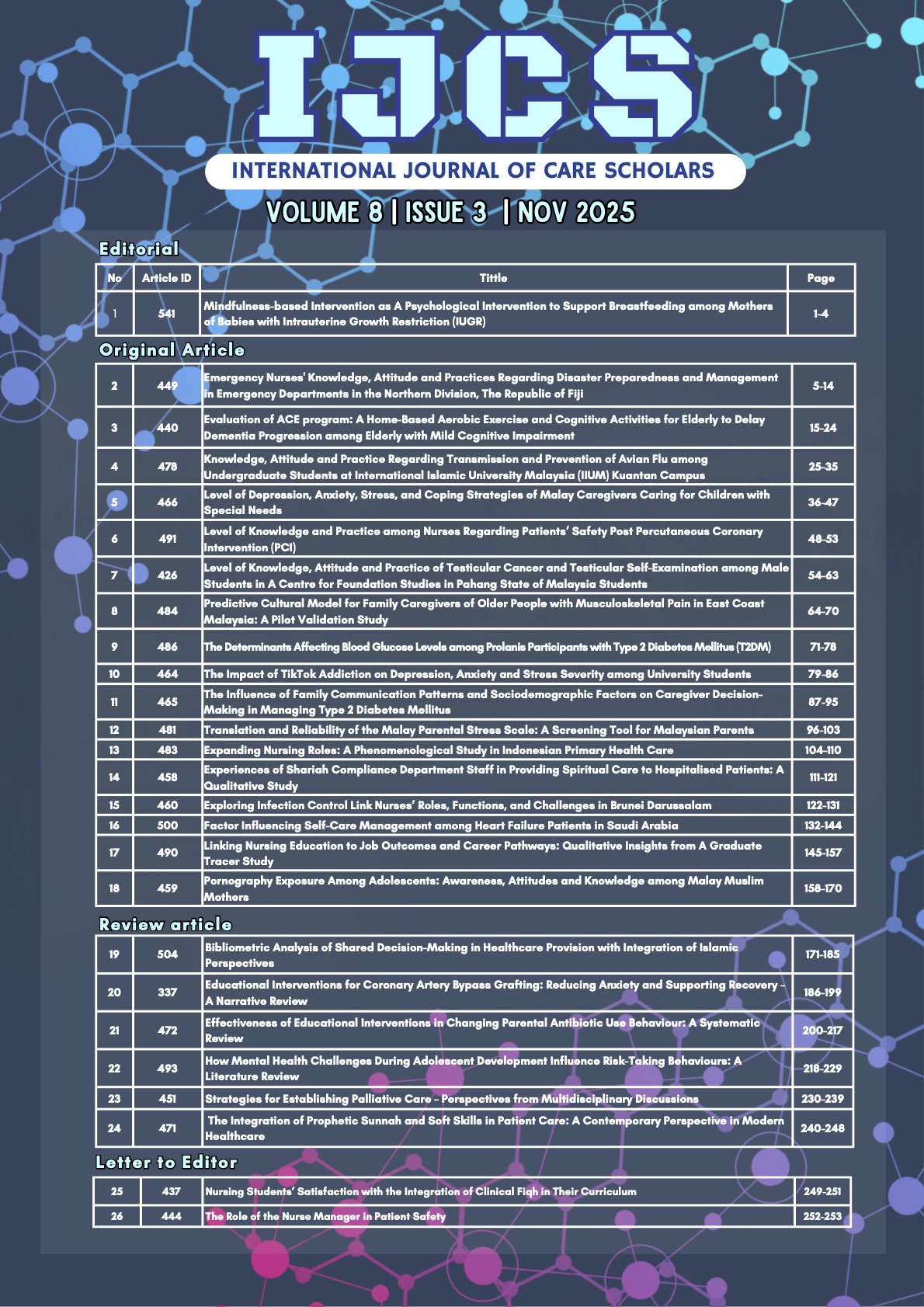
The Impact of TikTok Addiction on Depression, Anxiety and Stress Severity among University Students
DOI:
https://doi.org/10.31436/ijcs.v8i3.464Keywords:
Digital addiction, Malaysia, Mental health, Social media, TikTok, Young adultAbstract
Background: TikTok’s personalized content and short video format have contributed to its widespread popularity, particularly among university students. However, these same features make it potentially addictive, raising concerns about its impact on mental health. This study aims to examine the relationship between TikTok addiction and levels of depression, anxiety, and stress among university students in Malaysia.
Methods: A cross-sectional survey was conducted among 402 undergraduate students at IIUM Kuantan Campus using a structured questionnaire comprising socio-demographic items, the TikTok Addiction Scale (TTAS), and the Depression, Anxiety, and Stress Scale (DASS-21). Across different academic disciplines; TTAS differences were tested with one-way ANOVA and DAS score differences with Kruskal-Wallis. Correlation analysis was run using Spearman’s correlation. Data were analysed using Jamovi software.
Results: Results indicated that 20.1% (N=81) of participants were classified as TikTok addicted, while the remaining 79.9% (N=321) were not. Most students reported mild to moderate levels of depression and anxiety, with minimal stress; however, some experienced more severe symptoms. A positive correlation was found between TikTok addiction and higher levels of depression, anxiety, and stress. Sociodemographic factors such as gender and academic program showed no significant association with either TikTok addiction or mental health outcomes.
Conclusion: The findings suggest that excessive TikTok use is associated with students’ psychological well-being. Efforts from educational institutions, parents, and students themselves are essential to promote balanced usage, potentially reducing mental health risks and supporting academic and personal development.
References
Ma Y, Zhao X, He X, Ren L. The impact of social media on executive functions: Beneficial or harmful?. Advances in Psychological Science. 2022;Feb 15;30(2):406.
Hanifah K, Anggraeni SB, Sa'adah M, Zahra FA, Marhamah S, Az-Zahra F, Hayati SN, Maryam M, Hidayat F. Critical study live tilawah on tiktok by taking income according to sharia. Demak Universal Journal of Islam and Sharia. 2024;Jun 4;2(03):231-42.
Oh Lam S. Concentration in the attention economy. Available at SSRN 4861720. 2024;Mar 19.
Foroughi B, Griffiths MD, Iranmanesh M, Salamzadeh Y. Associations between Instagram addiction, academic performance, social anxiety, depression, and life satisfaction among university students. International Journal of Mental Health and Addiction. 2022;Aug;20(4):2221-42.
Rogowska AM, Cincio A. Procrastination mediates the relationship between problematic TikTok use and depression among young adults. Journal of clinical medicine. 2024;Feb 22;13(5):1247. https://doi.org/10.3390/jcm13051247
National Institute of Mental Health. Mental Illness. National Institute of Mental Health. [updated 2024; cited 17 Oct 2014]. Available from: https://www.nimh.nih.gov/health/statistics/mental-illness
Azenal A, Zaw C. Association between social media addiction and mental health among International Islamic University Malaysia (IIUM) undergraduate nursing students. International Journal of Care Scholars. 2021;Dec 9;4(Supp1):32-9. https://journals.iium.edu.my/ijcs/index.php/ijcs/article/view/216
Elhai JD, Levine JC, Dvorak RD, Hall BJ. Non-social features of smartphone use are most related to depression, anxiety and problematic smartphone use. Computers in Human Behavior. 2017;69:75–82. https://doi.org/10.1016/j.chb.2016.12.023
AlFaris E, Irfan F, Ponnamperuma G, et al. The pattern of social media use and its association with academic performance among medical students. Medical Teacher. 2018;40(S1):S76–S81. https://doi.org/10.1080/0142159X.2018.1465536
Ophir Y, Lipshits-Braziler Y, Rosenberg H. New-media screen time is not (necessarily) linked to depression: Results from a pilot study of vocational interests, media use, and mental health among university students. Computers in Human Behavior. 2019;93:62–70. https://doi.org/10.1016/j.chb.2018.11.024
Raosoft, Inc. Sample size calculator. [updated 2004; cited 9 Sep 2024]. Available from: http://www.raosoft.com/samplesize.html
Galanis P, Katsiroumpa A, Moisoglou I, Konstantakopoulou O. The TikTok addiction scale: development and validation. AIMS Public Health. 2024;Dec 11;11(4):1172. https://doi.org/10.21203/rs.3.rs-4762742/v1
Lovibond PF, Lovibond SH. The structure of negative emotional states: comparison of the depression anxiety stress scales (DASS) with the beck depression and anxiety inventories. Behaviour research and therapy. 1995;Mar 1;33(3):335-43. https://doi.org/10.1016/0005-7967(94)00075-u
The Jamovi Project. jamovi (Version 2.5) [Computer Software] 2024. Available from: https://www.jamovi.org
Oliva A, Antolín-Suárez L, Rodríguez-Meirinhos A. Uncovering the link between self-control, age, and psychological maladjustment among Spanish adolescents and young adults. Psychosocial Intervention. 2019;Mar 5;28(1):49-55. https://doi.org/10.5093/pi2019a1
Rathy A. A systematic review: the influence of tiktok contents and its effects towards mental health among youth in Malaysia. Journal of Media and Information Warfare Vol. 2023;Apr;16(1):1-3.
Hasan S. Use of social media in college going students. SSRN 3695794 [Internet]. 2020;Sep 20. [cited 2024 Dec 28] Available from: https://doi.org/10.2139/ssrn.3695794
Rogowska AM, Cincio A. Procrastination mediates the relationship between problematic TikTok Use and depression among young adults. Journal of clinical medicine. 2024;Feb 22;13(5):1247.
Selviana S, Maulida L, Nuzula F. Exploring the impact of TikTok and social media addiction on bedtime procrastination among high school students. International Journal of Advanced Health Science and Technology. 2024;Feb 13;4(1):32-5. https://doi.org/10.35882/ijahst.v4i1.312
Marino C, Gini G, Vieno A, Spada MM. The associations between problematic Facebook use, psychological distress and well-being among adolescents and young adults: A systematic review and meta-analysis. Journal of Affective Disorders. 2018;226:274–281. https://doi.org/10.1016/j.jad.2017.10.007
Jagtap P, Kanade V, Jagtap H, Kale O, Kadam A. Impact of social media on youth. SSRN.2024. https://papers.ssrn.com/sol3/papers.cfm?abstract_id=5220468
Elhai JD, Levine JC, Dvorak RD, Hall BJ. Non-social features of smartphone use are most related to depression, anxiety and problematic smartphone use. Computers in Human Behavior. 2017;69:75–82. https://doi.org/10.1016/j.chb.2016.12.0
Kok Wah DJN. Exploring the role of perceived social support in enhancing psychological well-being: investigating its mediating effect and implications for mental health outcomes. Tobacco Science and Technology. 2025. Available from:https://www.academia.edu/128493908/Exploring_the_Role_of_Perceived_Social_Support_in_Enhancing_Psychological_Well_Being_Investigating_Its_Mediating_Effect_and_Implications_for_Mental_Health_Outcomes
Herman PY, Karneli Y. Efektivitas konseling kelompok dengan pendekatan rational emotive behavior untuk meningkatkan self-esteem pada remaja. Socius: Jurnal Penelitian Ilmu-Ilmu Sosial. 2025; 12(1):34–49. https://ojs.daarulhuda.or.id/index.php/Socius/article/view/1656
Al Shawi AF, Hameed AK, Shalal AI, Abd Kareem SS, Majeed MA, Humidy ST. Internet addiction and its relationship to gender, depression and anxiety among medical students in Anbar Governorate-West of Iraq. Community Health Equity Research & Policy. 2022;Apr;42(3):253-6. https://doi.org/10.1177/0272684x20985708
Liang L, Zhou D, Yuan C, Shao A, Bian Y. Gender differences in the relationship between internet addiction and depression: A cross-lagged study in Chinese adolescents. Computers in Human Behavior. 2016;Oct 1;63:463-70. https://doi.org/10.1016/j.chb.2016.04.043
Sadeeq SH, Omar JH. Effectiveness of a psychological program to reduce social media addiction among high school students. Edusia: Jurnal Ilmiah Pendidikan Asia. 2025 May 13;5(1):1-9.
Downloads
Published
How to Cite
Issue
Section
License
Copyright (c) 2025 INTERNATIONAL JOURNAL OF CARE SCHOLARS (ISSN: 2600-898X)

This work is licensed under a Creative Commons Attribution-NonCommercial 4.0 International License.