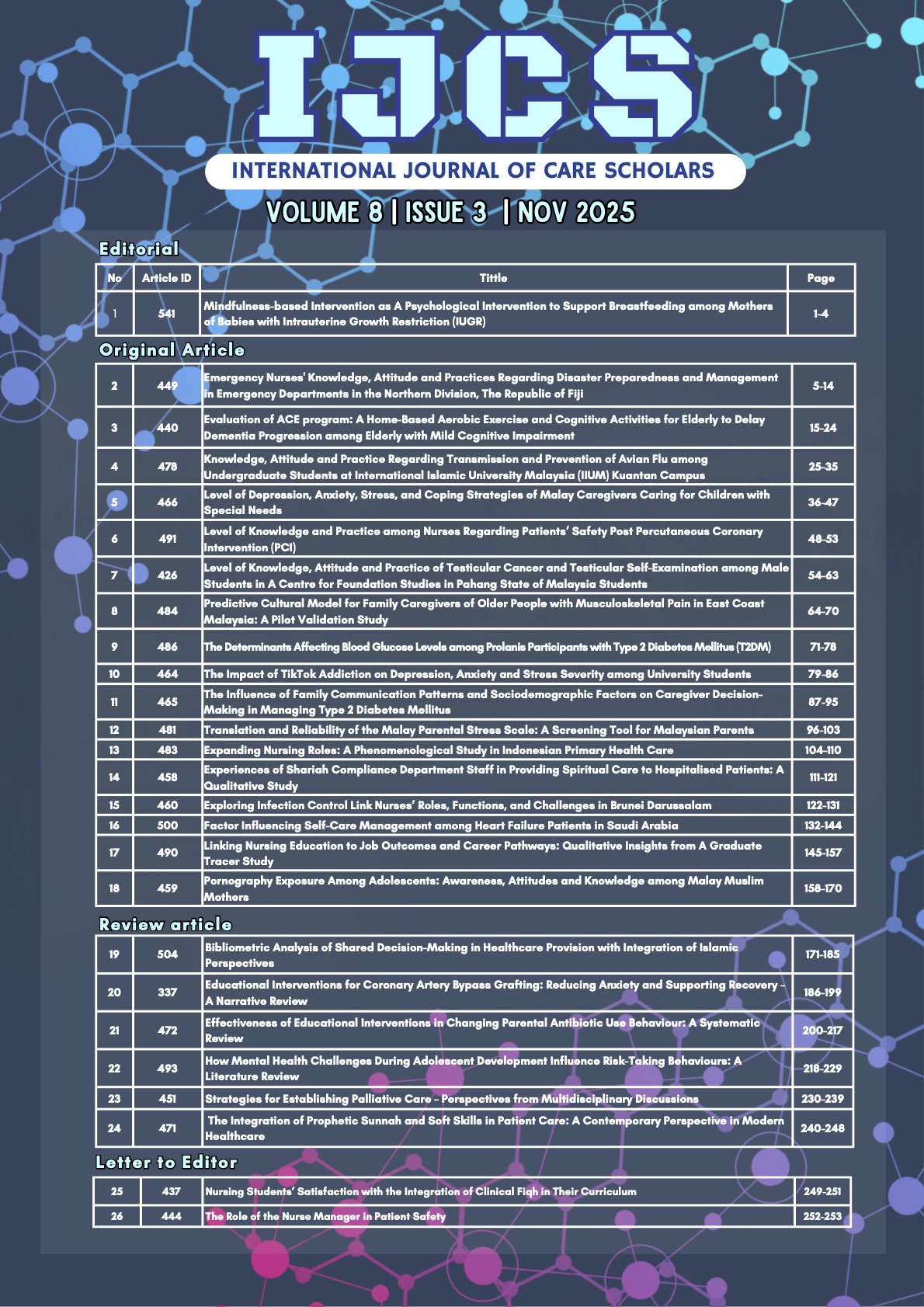
Effectiveness of Educational Interventions in Changing Parental Antibiotic Use Behaviour: A Systematic Review
DOI:
https://doi.org/10.31436/ijcs.v8i3.472Keywords:
Antibiotic use, Antimicrobial resistance, Parental behaviour, Educational interventions, Behaviour changeAbstract
Background: Antibiotics are essential for treating bacterial infections but are ineffective against viral illnesses. Parental misconceptions often lead to the inappropriate use of antibiotics, contributing to antimicrobial resistance. While educational interventions aim to improve parental awareness, their effectiveness in changing actual behaviour remains unclear. This systematic review aimed to evaluate the effectiveness of educational interventions in modifying parental antibiotic use behaviour, assessing whether increased knowledge translates into responsible antibiotic practices.
Methods: A systematic search was conducted in Scopus, EBSCO Discovery Service (EDS), Google Scholar, and Science Direct for studies published between January 1, 2014, and December 31, 2024. Studies assessing educational interventions targeting parental knowledge, attitudes, and behavioural outcomes related to antibiotic use were screened and reviewed.
Results: Of 1,921 articles screened, seven met the inclusion criteria. While all studies reported improved parental knowledge and attitudes, only three assessed actual behavioural changes. Most studies lacked objective behavioural outcome measures, limiting conclusions on intervention effectiveness. Geographically, only one study was conducted in Asia (Hong Kong), with no studies from Malaysia, highlighting a significant regional research gap.
Conclusion: This review underscores the scarcity of studies evaluating behavioural outcomes in parental antibiotic use interventions, particularly in Southeast Asia. Future research should prioritise robust study designs that assess real-world behavioural changes to develop effective, region-specific educational programs.
References
Salam MA, Al-Amin MY, Salam MT, Pawar JS, Akhter N, Rabaan AA, Alqumber MA, editors. Antimicrobial resistance: a growing serious threat for global public health. Healthcare; 2023: MDPI.
Muteeb G, Rehman MT, Shahwan M, Aatif M. Origin of antibiotics and antibiotic resistance, and their impacts on drug development: A narrative review. Pharmaceuticals. 2023;16(11):1615.
Bianco A, Licata F, Nobile CG, Napolitano F, Pavia M. Pattern and appropriateness of antibiotic prescriptions for upper respiratory tract infections in primary care paediatric patients. International journal of antimicrobial agents. 2022;59(1):106469.
Organization WH. Antimicrobial stewardship interventions: a practical guide. Antimicrobial stewardship interventions: a practical guide2021.
Tang J, Chen J, He T, Jiang Z, Zhou J, Hu B, Yang S. Diversity of upper respiratory tract infections and prevalence of Streptococcus pneumoniae colonization among patients with fever and flu-like symptoms. BMC infectious diseases. 2019; 19:1-10.
Wong LP, Alias H, Husin SA, Ali ZB, Sim B, Ponnampalavanar SSLS. Factors influencing inappropriate use of antibiotics: Findings from a nationwide survey of the general public in Malaysia. Plos one. 2021;16(10): e0258698.
Aricò MO, Valletta E, Caselli D. Appropriate use of antibiotic and principles of antimicrobial stewardship in children. Children. 2023;10(4):740.
Romandini A, Pani A, Schenardi PA, Pattarino GAC, De Giacomo C, Scaglione F. Antibiotic resistance in pediatric infections: global emerging threats, predicting the near future. Antibiotics. 2021;10(4):393.
Finkelstein JA, Dutta-Linn M, Meyer R, Goldman R. Childhood infections, antibiotics, and resistance: what are parents saying now? Clinical pediatrics. 2014;53(2):145-50.
Jairoun A, Hassan N, Ali A, Jairoun O, Shahwan M. Knowledge, attitude and practice of antibiotic use among university students: a cross-sectional study in UAE. BMC public health. 2019;19(1):1-8.
Salama RA, Bader KN, Rahmen AS, Hashmi F. Parents Knowledge, attitude and practice of antibiotic use for upper respiratory tract infections in children: a cross-sectional study in Ras Al khaimah, United Arab Emirates. Epidemiology, Biostatistics, and Public Health. 2018;15(4).
Marsh SA, Byrne MK, Parsafar S. What influences parental decisions about antibiotic use with their children: A qualitative study in rural Australia. PLoS ONE. 2023;18(7 July).
Orok E, Ikpe F, Williams T, Ekada I. Impact of educational intervention on knowledge of antimicrobial resistance and antibiotic use patterns among healthcare students: a pre-and post-intervention study. BMC Medical Education. 2025;25(1):283.
Alder S, Wuthrich A, Haddadin B, Donnelly S, Hannah EL, Stoddard G, et al. Community intervention model to reduce inappropriate antibiotic use. American Journal of Health Education. 2010;41(1):20-8.
Price L, Gozdzielewska L, Young M, Smith F, MacDonald J, McParland J, et al. Effectiveness of interventions to improve the public’s antimicrobial resistance awareness and behaviours associated with prudent use of antimicrobials: a systematic review. Journal of Antimicrobial Chemotherapy. 2018;73(6):1464-78.
Lansink C. Why do physicians prescribe antibiotics? An in-depth understanding of psycho-socio-cultural factors related to antimicrobial prescribing: A mixed-method approach: University of Twente; 2023.
Nathwani D, Varghese D, Stephens J, Ansari W, Martin S, Charbonneau C. Value of hospital antimicrobial stewardship programs [ASPs]: a systematic review. Antimicrobial Resistance & Infection Control. 2019;8(1):35.
Sulis G, Sayood S, Gandra S. How can we tackle the overuse of antibiotics in low- and middle-income countries? Expert Review of Anti-Infective Therapy. 2023;21(11):1189-201.
Thangaraju P, Venkatesan S. WHO Ten threats to global health in 2019: Antimicrobial resistance. Cukurova Medical Journal. 2019;44(3):1150-1.
Bosley H, Henshall C, Appleton JV, Jackson D. A systematic review to explore influences on parental attitudes towards antibiotic prescribing in children. Journal of clinical nursing. 2018;27(5-6):892-905.
Higgins JP, Altman DG, Gøtzsche PC, Jüni P, Moher D, Oxman AD, et al. The Cochrane Collaboration’s tool for assessing risk of bias in randomised trials. bmj. 2011;343.
Hansen MB, Rasmussen IS, Marloth T, Jarløv JO, Arpi M, Mogensen D, Jensen JN. A pre?post intervention study: Knowledge among parents about child infections and antibiotic use facilitated by maternal and child health nurses. Nursing Open. 2023;10(2):641-8.
Aika IN, Enato E. Bridging the gap in knowledge and use of antibiotics among pediatric caregivers: comparing two educational interventions. Journal of Pharmaceutical Policy and Practice. 2023;16(1):1-7.
Appiah B, Asamoah-Akuoko L, Samman E, Koduah A, Kretchy IA, Ludu JY, et al. The impact of antimicrobial resistance awareness interventions involving schoolchildren, development of an animation and parents engagements: a pilot study. Antimicrobial Resistance & Infection Control. 2022;11(1):26.
Or P-L, Ching T-Y. The effectiveness of raising Hong Kong parents’ awareness of antimicrobial resistance through an education program with peer support on social media: A randomized, controlled pilot study. BMC Public Health. 2022;22(1):315.
Abd El-Kader RG, Mohammed HH. Effect of an educational intervention on mother' knowledge, attitude, and practice about proper antibiotic use in a selected family health center. The Malaysian Journal of Nursing (MJN). 2021;12(3):16-23.
Ivanovska V, Angelovska B, van Dijk L, Zdravkovska M, Leufkens HG, Mantel-Teeuwisse AK. Change in parental knowledge, attitudes and practice of antibiotic use after a national intervention programme. European Journal of Public Health. 2018;28(4):724-9.
Coxeter PD, Del Mar CB, Hoffmann TC. Preparing Parents to make an informed choice about antibiotic use for common acute respiratory infections in children: a randomised trial of brief decision aids in a hypothetical scenario. Patient. 2017;10(4):463-74.
Bhardwaj S, Mehra P, Dhanjal DS, Sharma P, Sharma V, Singh R, et al. Antibiotics and antibiotic resistance-flipsides of the same coin. Current pharmaceutical design. 2022;28(28):2312-29.
Ayukekbong JA, Ntemgwa M, Atabe AN. The threat of antimicrobial resistance in developing countries: causes and control strategies. Antimicrobial Resistance & Infection Control. 2017;6(1):47.
Patey AM, Hurt CS, Grimshaw JM, Francis JJ. Changing behaviour ‘more or less’—do theories of behaviour inform strategies for implementation and de-implementation? A critical interpretive synthesis. Implementation Science. 2018;13(1):134.
Shehadeh MB, Suaifan GA, Hammad EA. Active educational intervention as a tool to improve safe and appropriate use of antibiotics. Saudi Pharmaceutical Journal. 2016;24(5):611-5.
Rabbani SA, Sridhar SB, Abazer D, Ahmed HS, Usman HA, Mahtab A, El-Dahiyat F. Impact of community-based educational intervention on antibiotic use and resistance awareness among the people living in Ras Al Khaimah, United Arab Emirates. Journal of Pharmaceutical Health Services Research. 2020;11(3):197-204.
Svendsen MT, Bak CK, Sørensen K, Pelikan J, Riddersholm SJ, Skals RK, et al. Associations of health literacy with socioeconomic position, health risk behavior, and health status: a large national population-based survey among Danish adults. BMC public health. 2020;20(1):565.
Vaz LE, Kleinman KP, Lakoma MD, Dutta-Linn MM, Nahill C, Hellinger J, Finkelstein JA. Prevalence of parental misconceptions about antibiotic use. Pediatrics. 2015;136(2):221-31.
Shaheen N, Shaheen A, Ramadan A, Hefnawy MT, Ramadan A, Ibrahim IA, et al. Appraising systematic reviews: a comprehensive guide to ensuring validity and reliability. Frontiers in research metrics and analytics. 2023;8:1268045.
Shea BJ, Reeves BC, Wells G, Thuku M, Hamel C, Moran J, et al. AMSTAR 2: a critical appraisal tool for systematic reviews that include randomised or non-randomised studies of healthcare interventions, or both. bmj. 2017;358.
Huttner B, Saam M, Moja L, Mah K, Sprenger M, Harbarth S, Magrini N. How to improve antibiotic awareness campaigns: findings of a WHO global survey. BMJ global health. 2019;4(3):e001239.
Downloads
Published
How to Cite
Issue
Section
License
Copyright (c) 2025 INTERNATIONAL JOURNAL OF CARE SCHOLARS (ISSN: 2600-898X)

This work is licensed under a Creative Commons Attribution-NonCommercial 4.0 International License.