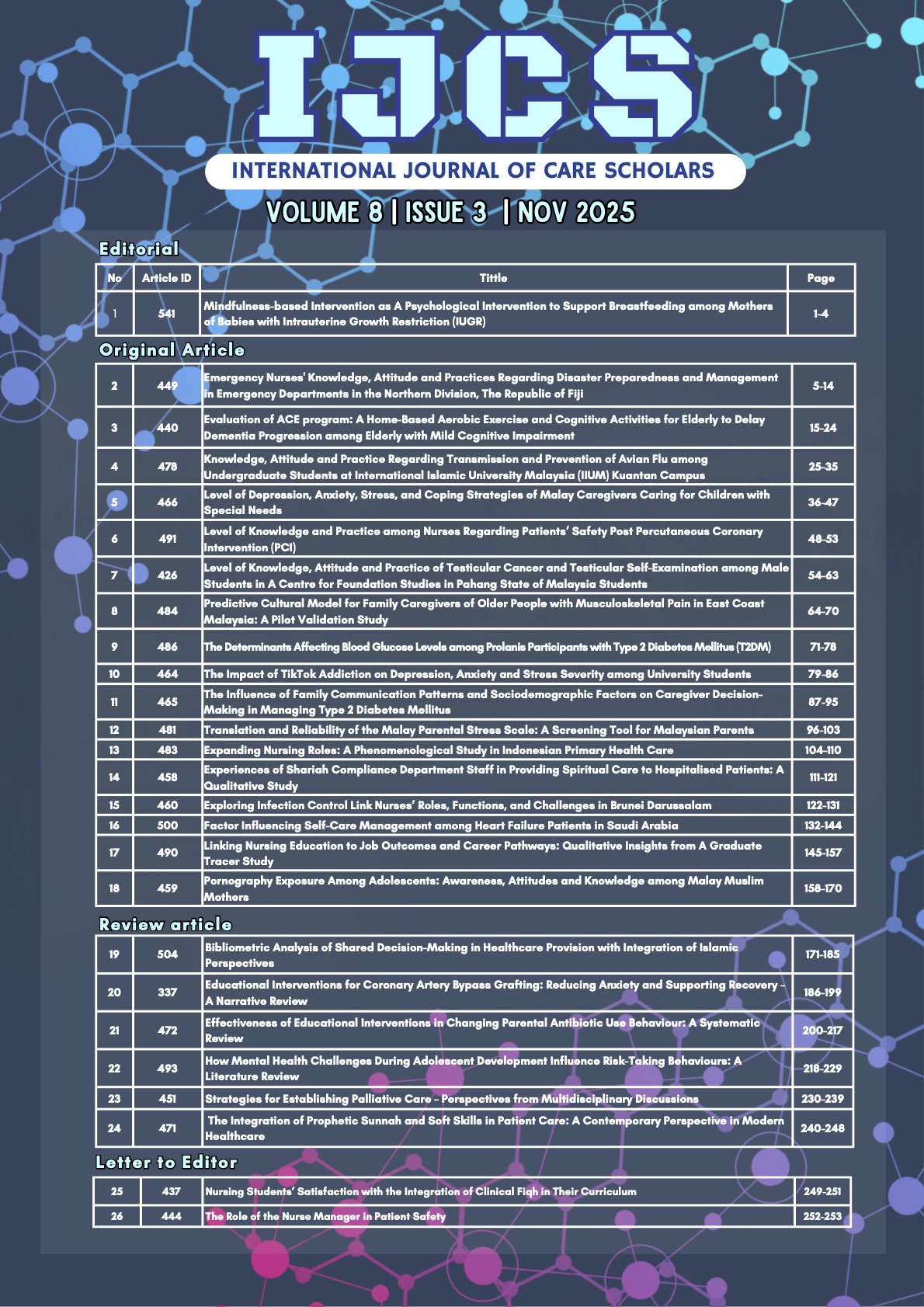
Strategies for Establishing Palliative Care – Perspectives from Multidisciplinary Discussions
DOI:
https://doi.org/10.31436/ijcs.v8i3.451Keywords:
Bereavement, Community health, Palliative care, Program developmentAbstract
Background: Access to palliative care is limited in many low-resource settings, despite being a fundamental component of universal health coverage. This paper presents a practical perspective on initiating and scaling up palliative care services, based on the collective experiences of healthcare professionals from diverse regions.
Methods: Structured multidisciplinary group discussions were conducted during a Fellowship in Palliative Care program and thematically analyzed. Insights were informed by institutional experiences, regional models, and supporting literature.
Results: There were experiential perspectives from ten clinicians and 36 supporting publications. To cultivate awareness and competence, the integration of palliative care into health sciences curricula and continued professional education is recommended. Nurse-led palliative care clinics, community volunteer training, and telemedicine services are identified as scalable, context-sensitive models to extend care beyond traditional settings. Initiatives such as Hope Cafes are proposed to normalize conversations around serious illness and dying and offer supportive environments for patients, caregivers, and the public. Challenges such as limited manpower, inadequate funding, medico-legal constraints, and sociocultural barriers are acknowledged. Solutions suggested include cross-sector partnerships, targeted training, use of digital platforms, and alignment with existing health and social systems. The role of bereavement support and palliative care research is highlighted as essential to holistic palliative care service delivery.
Conclusion: This paper offers a roadmap for institutions and regions aiming to introduce or strengthen palliative care services. Through leveraging available human resources, community structures, and innovative delivery models, a compassionate, culturally sensitive, and scalable palliative care framework can be achieved, even in resource-constrained environments.
References
Mechelen W, Aertgeerts B, Ceulaer K, Thoonsen B, Vermandere M, Warmenhoven F, et al. Defining the palliative care patient: A systematic review. Palliat Med. 2013 Mar 1;27:197–208.
Sallnow L, Smith R, Ahmedzai SH, Bhadelia A, Chamberlain C, Cong Y, et al. Report of the lancet commission on the value of death: bringing death back into life. Vol. 399, The Lancet. Elsevier B.V.; 2022. p. 837–84.
Connor S, Centeno C, Garralda E, Ma D, Clelland D, Clark. Estimating the Number of Patients Receiving Specialized Palliative care globally in 2017. J Pain Symptom Manage. 2020 Sep 30;61.
Luta X, Ottino B, Hall P, Bowden J, Wee B, Droney J, et al. Evidence on the economic value of end-of-life and palliative care interventions: a narrative review of reviews. BMC Palliat Care [Internet]. 2021;20(1):89. Available from: https://doi.org/10.1186/s12904-021-00782-7
Mills J, Abel J, Kellehear A, Patel M. Access to palliative care: the primacy of public health partnerships and community participation. Lancet Public Health. 2021 Oct 8;6.
Collingridge Moore D, Payne S, Van den Block L, Ling J, Froggatt K. Strategies for the implementation of palliative care education and organizational interventions in long-term care facilities: A scoping review. Palliat Med. 2020 May 1;34:558–70.
Pesut B, Duggleby W, Warner G, Fassbender K, Antifeau E, Hooper B, et al. Volunteer navigation partnerships: Piloting a compassionate community approach to early palliative care. BMC Palliat Care. 2017 Jul 3;17.
Claxton-Oldfield S. Got Volunteers? The selection, training, roles, and impact of hospice palliative care volunteers in canada’s community-based volunteer programs. Home Health Care Manag Pract. 2014 Jan 5;27:36–40.
Yildiz B, van der Heide A, Bakan M, Iversen GS, Haugen DF, McGlinchey T, et al. Facilitators and barriers of implementing end-of-life care volunteering in a hospital in five European countries: the iLIVE study. BMC Palliat Care [Internet]. 2024;23(1):88. Available from: https://doi.org/10.1186/s12904-024-01423-5
Pesut B, Duggleby W, Warner G, Kervin E, Bruce P, Antifeau E, et al. Implementing volunteer-navigation for older persons with advanced chronic illness (Nav-CARE): a knowledge to action study. BMC Palliat Care. 2020 May 22;19.
Nahyeni B, Vaughn L, Santos Salas A. Nurse?led adult palliative care models in low? and middle?income countries: A scoping review. J Adv Nurs. 2023 Mar 25;79:4112–26.
Owens D, Eby K, Burson S, Green M, McGoodwin W, Isaac M. primary palliative care clinic pilot project demonstrates benefits of a nurse practitioner?directed clinic providing primary and palliative care. J Am Acad Nurse Pract [Internet]. 2011;24(1):52–8. Available from: http://dx.doi.org/10.1111/j.1745-7599.2011.00664.x
Nagarajan S V., Lewis V, Halcomb E, Rhee J, Morton RL, Mitchell GK, et al. Barriers and facilitators to nurse-led advance care planning and palliative care practice change in primary healthcare: a qualitative study. Aust J Prim Health. 2022 Apr 1;28(2):151–7.
Prasad A, Brewster R, Rajasekaran D, Rajasekaran K. Preparing for telemedicine visits: guidelines and setup. Front Med (Lausanne). 2020 Nov 25;7.
Worster B, Swartz K. Telemedicine and palliative care: an increasing role in supportive oncology. Curr Oncol Rep. 2017 Apr 18;19:37.
Khandelwal N, Kross E, Engelberg R, Coe N, Jennerich A, Curtis J. Estimating the effect of palliative care interventions and advance care planning on icu utilization: a systematic review*. Crit Care Med. 2015 Jan 8;43.
Engel P, Thavayogarajah T, Görlich D, Lenz P. Establishment of a palliative care consultation service (pccs) in an acute hospital setting. Int J Environ Res Public Health. 2020 Jul 10;17:4977.
Erlenwein J, Geyer A, Schlink J, Petzke F, Nauck F, Alt-Epping B. Characteristics of a palliative care consultation service with a focus on pain in a German university hospital. BMC Palliat Care. 2014 Sep 24;13(1).
Hua M, Li G, Blinderman C, Wunsch H. Estimates of the need for palliative care consultation across united states icus using a trigger-based model. Am J Respir Crit Care Med. 2013 Nov 21;189.
Mercadante S, Gregoretti C, Cortegiani A. Palliative care in intensive care units: why, where, what, who, when, how. BMC Anesthesiol [Internet]. 2018;18(1):106. Available from: https://doi.org/10.1186/s12871-018-0574-9
Bloomer M. Palliative care provision in acute and critical care settings: What are the challenges? Palliat Med. 2019 Dec 1;33:1239–40.
Connolly M, Ryder M, Frazer K, Furlong E, Escribano TP, Larkin P, et al. Evaluating the specialist palliative care clinical nurse specialist role in an acute hospital setting: a mixed methods sequential explanatory study. BMC Palliat Care [Internet]. 2021;20(1):134. Available from: https://doi.org/10.1186/s12904-021-00834-y
Ito K, Tsuda S, Hagiwara M, Okamura T. Encouraging death communication in a death-avoidant society: analysis of interviews with death café organizers. BMC Health Serv Res. 2023 Sep 4;23.
Borque I, Oliete E, Arantzamendi M, Centeno C. Death Café conversations: evaluating the educational potential for university students in palliative care teaching. Palliat Care Soc Pract. 2024 Jan 1;18.
McLoughlin K, McGilloway S, Lloyd R, O’Connor M, Rhatigan J, Shanahan M, et al. Walls, wisdom, worries, and wishes: Engaging communities in discussion about death, dying, loss, and care using Café Conversation. Prog Palliat Care [Internet]. 2016 Jan 2;24(1):9–14. Available from: https://doi.org/10.1179/1743291X15Y.0000000011
Chowdhury MK, Ahmad N, Biswas F, Farheen N, Ferdous L, Akter K, et al. Program evaluation: improving the quality of life of older people in an urban slum in Bangladesh. Palliat Care Soc Pract. 2021 Dec 16;15:263235242110632.
Ritchie CS, Leff B. Population health and tailored medical care in the home: the roles of home-based primary care and home-based palliative care. J Pain Symptom Manage. 2018 Mar 1;55(3):1041–6.
Leff B, Carlson C, Saliba D, Ritchie C. The invisible homebound: setting quality-of-care standards for home-based primary and palliative care. Health Aff (Millwood). 2015 Jan 5;34:21–9.
Jurgens K, Currow D, Tieman J. What functions do palliative care bereavement services deliver? A scoping review. Palliat Care Soc Pract. 2025 Mar 22;19.
Hudson P, Hall C, Boughey A, Roulston A. Bereavement support standards and bereavement care pathway for quality palliative care. Palliat Support Care. 2017 Jul 13;16:1–13.
She WJ (Lavender), Prigerson H. “Caregrieving” in palliative care: Opportunities to improve bereavement services. Palliat Med. 2018 Dec 1;32:1635–6.
Mathieson S. Integrating research, teaching and practice in the context of new institutional policies: a social practice approach. High Educ (Dordr). 2019 Nov 1;78:1–17.
Walshe C, Dunleavy L, Preston N, Payne S, Ellershaw J, Taylor V, et al. Understanding barriers and facilitators to palliative and end-of-life care research: a mixed method study of generalist and specialist health, social care, and research professionals. BMC Palliat Care [Internet]. 2024;23(1):159. Available from: https://doi.org/10.1186/s12904-024-01488-2
Stjernswärd J, Foley KM, Ferris FD. Integrating palliative care into national policies. J Pain Symptom Manage [Internet]. 2007 May 1 [cited 2025 Nov 4];33(5):514–20. Available from: https://www.sciencedirect.com/science/article/pii/S0885392407001546
Robinson J, Gott M, Gardiner C, Ingleton C. The “problematisation” of palliative care in hospital: An exploratory review of international palliative care policy in five countries. BMC Palliat Care. 2016 Jul 25;15.
Aldridge Melissa D, Hasselaar Jeroen, Garralda Eduardo, van der Eerden Marlieke, Stevenson David, McKendrick Karen, et al. Education, implementation, and policy barriers to greater integration of palliative care: A literature review. Palliat Med [Internet]. 2015 Sep 24;30(3):224–39. Available from: https://doi.org/10.1177/0269216315606645
Downloads
Published
How to Cite
Issue
Section
License
Copyright (c) 2025 INTERNATIONAL JOURNAL OF CARE SCHOLARS (ISSN: 2600-898X)

This work is licensed under a Creative Commons Attribution-NonCommercial 4.0 International License.