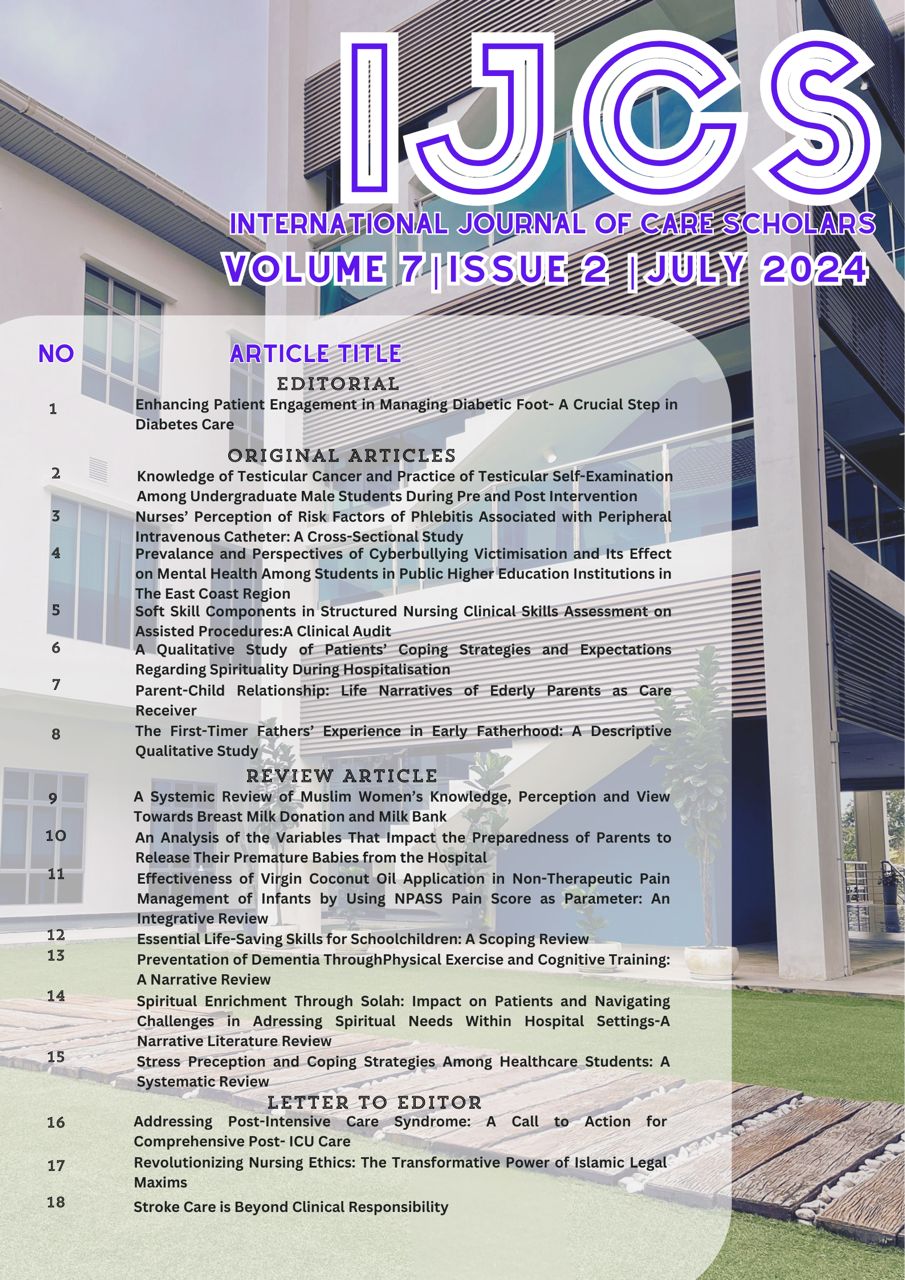
Nurses’ Perception of Risk Factors of Phlebitis Associated with Peripheral Intravenous Catheter: A Cross-Sectional Study
DOI:
https://doi.org/10.31436/ijcs.v7i2.381Keywords:
Phlebitis, Perception, Peripheral intravenous catheter, Risk factor, NurseAbstract
Background: Phlebitis is a main complication of peripheral intravenous catheters. Nurses play an important role in identifying the risk factors of phlebitis in order to reduce the incidence of phlebitis. The purpose of this study is to determine nurses' perceptions of the risk factors for phlebitis.
Methods: This cross-sectional study was conducted in Hospital Tengku Ampuan Afzan and a random sample of hospital nurses was recruited. 269 participants were involved in this study. All participants are required to answer the questionnaire which divided into two sections, section A regarding socio-demographic background and section B about perception on the risk factors of phlebitis that consist of ten multiple choice questions.
Results: The results showed majority of nurses, 75.8% (204), agreed that phlebitis is a significant problem, while 23.0% (62) thought phlebitis is a moderate problem, and only 1.1% (3) of nurses agreed that phlebitis is a minor problem. Nurses recognized some risk factors for phlebitis; however, more than half of the nurses were unaware that cannula material, size of the cannula, and the characteristics of fluid and drug can affect the development of phlebitis.
Conclusion: The study showed that nurses did not fully perceive the risk factors of phlebitis. However, they were knowledgeable about certain risk factors such as the duration for cannula replacement and the insertion site of the cannula. These findings indicate ongoing training for nurses in peripheral intravenous catheter (PIVC) management and education about the risk factors of phlebitis are necessary.
References
Keogh S, Mathew S, Alexandrou E, Bulmer AC, Cooke M, Coventry L, et al. Peripheral intravenous catheters: A review of guidelines and research 1 Peripheral intravenous catheters: A review of guidelines and research [Internet]. 2019. Available from: www.safetyandquality.gov.au
Mandal A, Raghu K. Study on incidence of phlebitis following the use of pherpheral intravenous catheter. J Family Med Prim Care [Internet]. 2019;8(9). Available from: https://journals.lww.com/jfmpc/fulltext/2019/08090/study_on_incidence_of_phlebitis_following_the_use.14.aspx
Marsh N, Webster J, Larsen E, Cooke M, Mihala G, Rickard CM. Observational Study of Peripheral Intravenous Catheter Outcomes in Adult Hospitalized Patients: A Multivariable Analysis of Peripheral Intravenous Catheter Failure. J Hosp Med [Internet]. 2018 Feb 1;13(2):83–9. Available from: https://doi.org/10.12788/jhm.2867
Milutinovi? D, Simin D, Zec D. Risk factor for phlebitis: A questionnaire study of nurses’ perception. Rev Lat Am Enfermagem. 2015 Jul 1;23(4):677–84.
Li X, Liu W, Qin Y. Nurses? perception of risk factors for infusion phlebitis?A cross-sectional ?survey. Chinese Nursing Research [Internet]. 2016;3:37–40. Available from: https://api.semanticscholar.org/CorpusID:76073886
Ku? B, Büyüky?lmaz F. Effectiveness of vialon biomaterial versus teflon catheters for peripheral intravenous placement: A randomized clinical trial. Jpn J Nurs Sci [Internet]. 2020;e12328. Available from: https://api.semanticscholar.org/CorpusID:211231877
O’Grady NP, Alexander M, Burns LA, Dellinger EP, Garland J, Heard SO, et al. Guidelines for the prevention of intravascular catheter-related infections. Clin Infect Dis. 2011 May;52(9).
Mermel LA. Prevention of long-term catheter-related bloodstream infection with prophylactic antimicrobial lock solutions: why so little use? Clinical Microbiology and Infection. 2023 Mar 1;29(3):288–90.
Simões AMN, Vendramim P, Pedreira MLG. Risk factors for peripheral intravenous catheter-related phlebitis in adult patients*. Revista da Escola de Enfermagem. 2022;56.
Downloads
Published
How to Cite
Issue
Section
License
Copyright (c) 2024 INTERNATIONAL JOURNAL OF CARE SCHOLARS

This work is licensed under a Creative Commons Attribution-NonCommercial 4.0 International License.