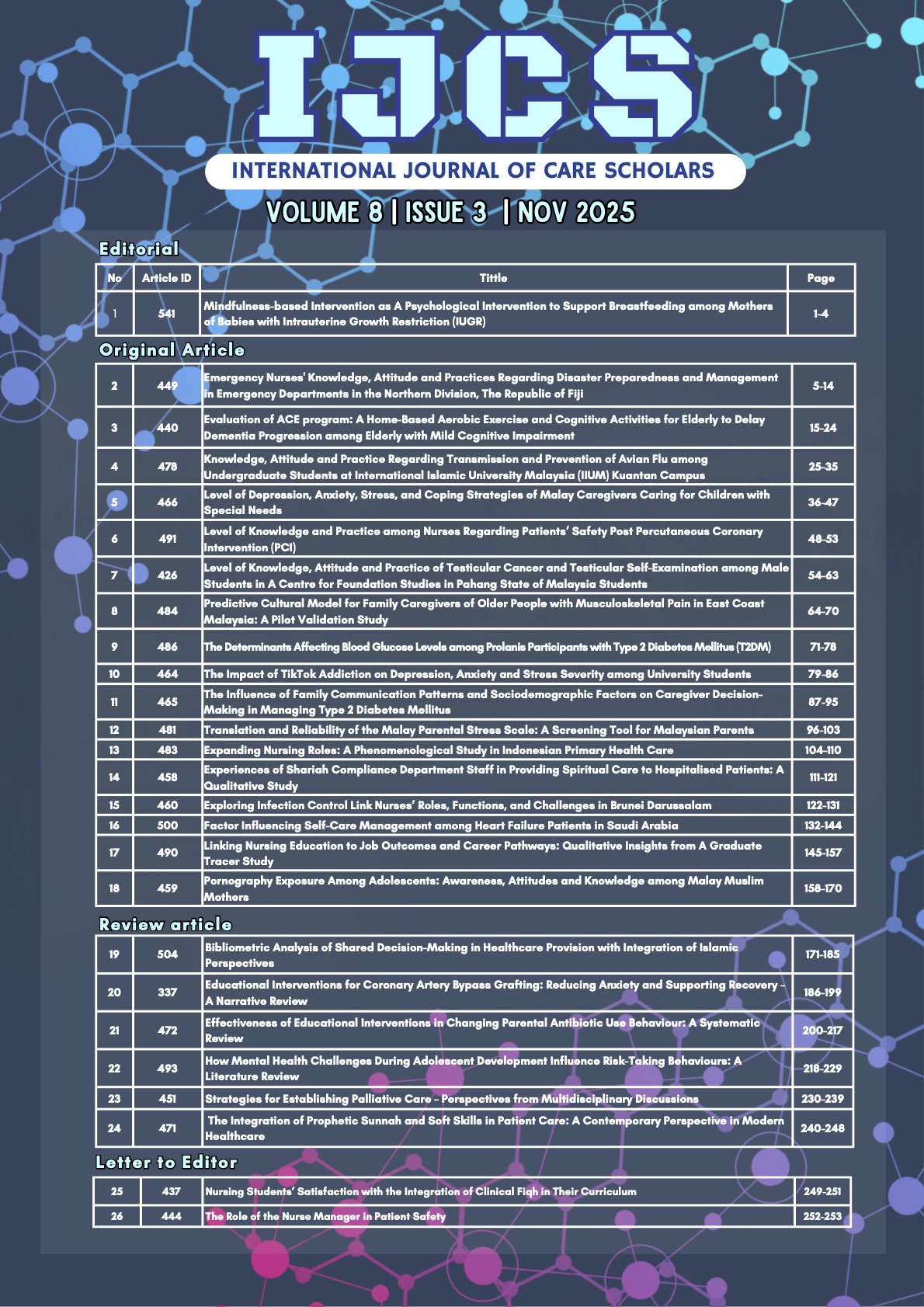
Emergency Nurses' Knowledge, Attitude and Practices Regarding Disaster Preparedness and Management in Emergency Departments in the Northern Division, The Republic of Fiji
DOI:
https://doi.org/10.31436/ijcs.v8i3.449Keywords:
Disaster management, Disaster preparedness, Knowledge, Attitude, Practice, Disaster nursingAbstract
Background: Since the adoption of the Hyogo Framework for Action (HFA), substantial efforts have been undertaken globally to reduce the impact of disasters. Nevertheless, individuals, families, communities and nations continue to be adversely affected. As front-line responders, nurses play a pivotal role in supporting communities during emergencies and crises. This study aimed to assess the knowledge, attitudes and practices (KAP) of emergency nurses in the Northern Division of Fiji regarding disaster preparedness and management, and to examine factors associated with these outcomes.
Methods: A descriptive, quantitative cross-sectional study was conducted using a self-administered questionnaire distributed to emergency nurses working in divisional and sub-divisional hospitals and health centres across the Northern Division of Fiji.
Results: A total of 61 nurses participated in the study, representing a 93.8% response rate. Most respondents were based in hospitals and health centres (82%). Overall, participants demonstrated adequate knowledge and positive attitudes towards disaster preparedness and management; however, fewer than half reported good practices, and less than half were aware of their institution’s disaster management policies and procedures. Nearly three-quarters had never read or seen the health disaster management policy, and 77% had never undergone disaster preparedness training. No significant associations were found between participants’ sociodemographic characteristics and their KAP scores.
Conclusion: Despite frequent disasters in Fiji, emergency nurses in the Northern Division showed a gap between knowledge/attitude and practice in disaster management. These findings underscore an urgent need for a comprehensive disaster management policy and structured training to strengthen emergency nurses’ preparedness and response capacity in the region.
References
Aitsi-Selmi A, Murray V. Protecting the health and well-being of populations from disasters: health and health care in the sendai framework for disaster risk reduction 2015–2030. Prehospital and Disaster Medicine. 2015;31(1):74–78.
United Nations Disaster Risk Reduction. Disaster risk reduction in the republic of Fiji: Status report 2019. United Nations Office for Disaster Risk Reduction. 2019.
United Nations. Sendai framework for disaster risk reduction 2015–2030. United nations office for disaster risk reduction. 2015.
World Health Organization. Health emergency and disaster risk management framework. World Health Organization. 2019.
Mulyasari F, Inoue S, Prashar S, Isayama K, Basu M, Srivastava N, et al. Disaster preparedness: looking through the lens of hospitals in Japan. International Journal of Disaster Risk Science. 2013;4(2):89–100.
Sharififar S, Jahangiri K, Zareiyan A, Khoshvaghti A. Factors affecting hospital response in biological disasters: A qualitative study. Medical Journal of the Islamic Republic of Iran. 2020;34:21.
Day SJ, Forster T, Himmelsbach J, Korte L, Mucke P, Radtke K, et al. World risk report 2019: focus—water supply. Bündnis Entwicklung Hilft & Ruhr University Bochum Institute for International Law of Peace and Armed Conflict. 2019.
Yeo S, Esler S, Taaffe F, Jordy D, Bonte-Grapentin M. Urban flood risk management in the Pacific: tracking progress and setting priorities. World Bank. 2017.
United Nations Capital Development Fund. Economic impacts of natural hazards on vulnerable populations in Fiji, Papua New Guinea, Samoa, Solomon Islands, Tonga, and Vanuatu. UNCDF. 2020.
Mansur A, Doyle J, Ivaschenko O. Social protection and humanitarian assistance nexus for disaster response: lessons learnt from Fiji’s Tropical Cyclone Winston. World Bank Group. 2017.
Government of Fiji. Fiji post-disaster needs assessment: tropical cyclone Winston. Government of Fiji. 2016.
Government of Fiji. 5-Year & 20-Year National development plan. Ministry of Economy, Republic of Fiji. 2017.
World Health Organization. Emergency and disaster risk management for health: humanitarian health action. World Health Organization. 2016.
Ahayalimudin N, Osman NNS. Disaster management: Emergency nursing and medical personnel’s knowledge, attitude and practices of the East Coast region hospitals of Malaysia. Australasian Emergency Nursing Journal. 2016;19(4):203–209.
Ahayalimudin N. Disaster management: A study on knowledge, attitude and practice of emergency nurses and community health nurses in Selangor. Master’s Dissertation, Universiti Kebangsaan Malaysia. 2012.
Australasian College for Emergency Medicine. Policy on emergency department disaster preparedness and response. Australasian College for Emergency Medicine. 2020.
Alzahrani F, Kyratsis Y. Emergency nurse disaster preparedness during mass gatherings: a cross-sectional survey of emergency nurses’ perceptions in hospitals in Mecca, Saudi Arabia. BMJ Open. 2017;7(4):e013563.
Hamouda GM. A comparative study to assess nurses’ perceptions of the disaster management process in Alexandria and Jeddah. IOSR Journal of Nursing and Health Science. 2018;7(5):21–30.
Taskiran G, Baykal U. Nurses’ disaster preparedness and core competencies in Turkey: A descriptive correlational design. International Nursing Review. 2019;66(2):165–175.
Baxter R, Edvardsson D. Impact of a critical care postgraduate certificate course on nurses’ self-reported competence and confidence: A quasi-experimental study. Nurse Education Today. 2018;65:156–161.
Naser WN, Saleem HB. Emergency and disaster management training: Knowledge and attitude of Yemeni health professionals – a cross-sectional study. BMC Emergency Medicine. 2018;18(1):23.
Labrague LJ, Yboa BC, McEnroe-Petitte DM, Lobrino LR, Brennan MGB. Disaster preparedness in Philippine nurses. Journal of Nursing Scholarship. 2016;48(1):98–105.
Mojtahedi M, Sunindijo RY, Lestari F, Suparni, Wijaya O. Developing hospital emergency and disaster management index using TOPSIS method. Sustainability. 2021;13(9):5213.
Usher K, Mills J, West C, Casella E, Dorji P, Guo A, et al. Cross-sectional survey of the disaster preparedness of nurses across the Asia-Pacific region. Nursing and Health Sciences. 2015;17(4):434–443.
Soltani T, Baghianimoghadam MH, Ehrampoush MH, Baghian N, Jafari A. Knowledge, attitude and performance of nurses’ crisis management in natural disasters in Yazd City. Journal of Community Health Research. 2016;5(3):195–201.
Downloads
Published
How to Cite
Issue
Section
License
Copyright (c) 2025 INTERNATIONAL JOURNAL OF CARE SCHOLARS (ISSN: 2600-898X)

This work is licensed under a Creative Commons Attribution-NonCommercial 4.0 International License.