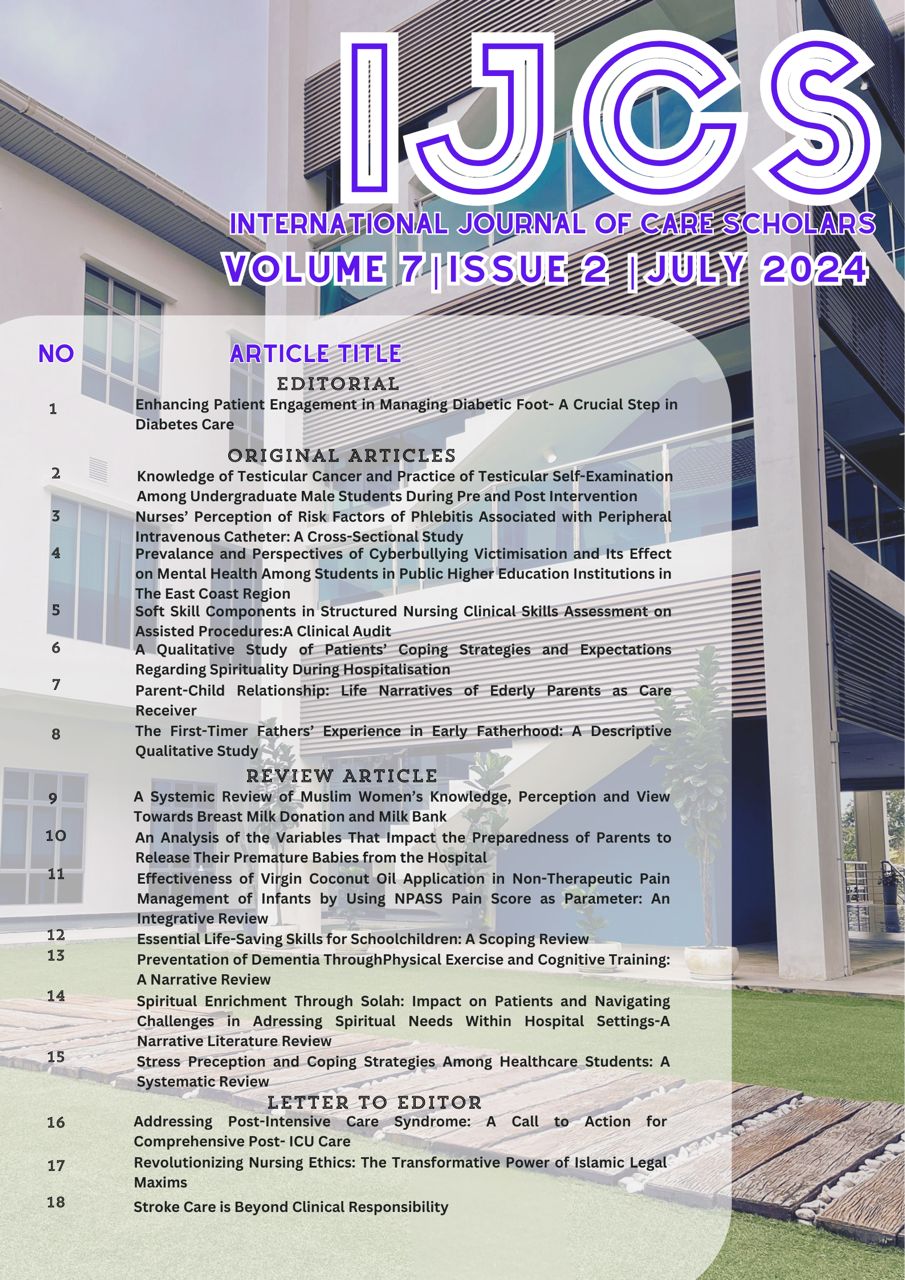
Prevention of Dementia Through Physical Exercise and Cognitive Training: A Narrative Review
DOI:
https://doi.org/10.31436/ijcs.v7i2.325Keywords:
Physical exercise, Cognitive training, Mild cognitive impairment, Elderly, DementiaAbstract
Background: Dementia reduces the ability to live independently, thus deteriorating the patient’s quality of life and caregivers' mental health. Consequently, dementia indirectly affects economic and social growth. Dementia is also a major contributor to death worldwide. There is no effective treatment for dementia, but preventing physical and cognitive inactivity among the elderly could help. Studies show that the risk of dementia increases in the elderly with mild cognitive impairment (MCI).
Methods: This review set out to compare the effects of physical exercise (PE) and cognitive training (CT) on cognitive performance among the elderly with MCI, by examining the evidence from published literature between 2013-2023. Four major electronic databases were used to search the relevant studies, resulting in 2782 articles. A total of fourteen articles were included in the review.
Results: The findings showed that interventions with naturally combined cognitive and physical training not only improved cognitive performance, but also prevented the elderly from stress and fatigue. Integrating physical exercise and cognitive training interventions with the best combination method is crucial to ensure participant adherence. Therefore, the intervention can be incorporated effectively into healthcare policies and programs to support cognitive health in aging populations.
Conclusion: Future studies should also explore the optimal duration of training sessions to maximise cognitive benefits and ensure participant adherence and motivation.
References
World Health Organization. World Health Organization. 2023. Dementia. Available from: https://www.who.int/news-room/fact-sheets/detail/dementia
Nichols E, Steinmetz JD, Vollset SE, Fukutaki K, Chalek J, Abd-Allah F, et al. Estimation of the global prevalence of dementia in 2019 and forecasted prevalence in 2050: an analysis for the Global Burden of Disease Study 2019. Lancet Public Health. 2022;7(2):e105–25.
Patterson C. World Alzheimer Report 2018 - The state of the art of dementia research: New frontiers. Alzheimer’s Disease International (ADI): London, UK. 2018;1–48.
Mahmud A, Mazalan MF, Abdul Razak AR. Ageing Phenomenon?: Malaysia Towards 2030. PopInfo Malaysia. 2017;(2).
Muhd Nur A, Aljunid SM, Ismail N, Haron SA, Shafie AA, Nor NM, et al. Provider costs of treating dementia among the elderly in government hospitals of Malaysia. Malaysian Journal of Public Health Medicine. 2017;17(2):121–7.
National Institute of Health. Malaysian Burden of Disease and Injury Study 2009-2014. 2017. 2–29 p.
Tulliani N, Bissett M, Bye R, Chaudhary K, Fahey P, Liu KPY. The efficacy of cognitive interventions on the performance of instrumental activities of daily living in individuals with mild cognitive impairment or mild dementia: Protocol for a systematic review and meta-analysis. Syst Rev. 2019;8(1):1–9.
Srivastava G, Tripathi RK, Tiwari SC, Singh B, Tripathi SM. Caregiver burden and quality of life of key caregivers of patients with dementia. Indian J Psychol Med. 2016;38(2):133–6.
World Health Organization. Dementia [Internet]. 2022 [cited 2022 Sep 27]. Available from: https://www.who.int/news-room/fact-sheets/detail/dementia
Ganapathy SS, Sooryanarayana R, Ahmad NA, Jamaluddin R, Abd Razak MA, Tan MP, et al. Prevalence of dementia and quality of life of caregivers of people living with dementia in Malaysia. Geriatr Gerontol Int. 2020;20(S2):16–20.
Hong SG, Kim JH, Jun TW. Effects of 12-week resistance exercise on electroencephalogram patterns and cognitive function in the elderly with mild cognitive impairment: A randomized controlled trial. Clinical Journal of Sport Medicinepeople at risk of developing dementia at earlier stages become a public health priority in order to target and implement preventive interventions (Untari et al, 2019). 2018 Nov;28(6):500–8.
Eshkoor SA, Hamid TA, Mun CY, Ng CK. Mild cognitive impairment and its management in older people. Clin Interv Aging. 2015;10:687–93.
Tangalos EG. Mild Cognitive Impairment in Geriatrics. Clin Geriatr Med. 2018;
Untari I, Subijanto AA, Mirawati DK, Probandari AN, Sanusi R. A combination of cognitive training and physical exercise for elderly with the mild cognitive impairment: A systematic review. J Health Res. 2019;33(6):504–16.
Nagamatsu LS, Chan A, Davis JC, Beattie BL, Graf P, Voss MW, et al. Physical activity improves verbal and spatial memory in older adults with probable mild cognitive impairment: A 6-month randomized controlled trial. J Aging Res. 2013;2013(Mci).
Roberts RO, Knopman DS, Mielke MM, Cha RH, Pankratz VS, Christianson TJH, et al. Higher risk of progression to dementia in mild cognitive impairment cases who revert to normal. Neurology. 2014;82(4):317–25.
Overton M, Pihlsgård M, Elmståhl S. Diagnostic Stability of Mild Cognitive Impairment, and Predictors of Reversion to Normal Cognitive Functioning. Dement Geriatr Cogn Disord. 2020;48(5–6):317–29.
Sanford AM. Mild Cognitive Impairment. Clin Geriatr Med. 2017;33(3):325–37.
Bisbe M, Fuente-Vidal A, López E, Moreno M, Naya M, De Benetti C, et al. Comparative Cognitive Effects of Choreographed Exercise and Multimodal Physical Therapy in Older Adults with Amnestic Mild Cognitive Impairment: Randomized Clinical Trial. Journal of Alzheimer’s Disease. 2020;73(2):769–83.
Cardalda IM, López A, Carral JMC. The effects of different types of physical exercise on physical and cognitive function in frail institutionalized older adults with mild to moderate cognitive impairment. A randomized controlled trial. Arch Gerontol Geriatr. 2019;83(May):223–30.
Hagovska M, Nagyova I. The transfer of skills from cognitive and physical training to activities of daily living: a randomised controlled study. Eur J Ageing. 2017;14(2):133–42.
Jurakic ZG, Krizanic V, Sarabon N, Markovic G. Effects of feedback-based balance and core resistance training vs. Pilates training on cognitive functions in older women with mild cognitive impairment: a pilot randomized controlled trial. Aging Clin Exp Res. 2017;29(6):1295–8.
Li BY, He NY, Qiao Y, Xu HM, Lu YZ, Cui PJ, et al. Computerized cognitive training for Chinese mild cognitive impairment patients: A neuropsychological and fMRI study. Neuroimage Clin. 2019;22(January):101691.
Park JS, Jung YJ, Lee G. Virtual reality-based cognitive–motor rehabilitation in older adults with mild cognitive impairment: A randomized controlled study on motivation and cognitive function. Healthcare (Switzerland). 2020;8(3):1–9.
Peng Z, Jiang H, Wang X, Huang K, Zuo Y, Wu X, et al. The efficacy of cognitive training for elderly Chinese individuals with mild cognitive impairment. Biomed Res Int. 2019;2019(Mci).
Sungkarat S, Boripuntakul S, Chattipakorn N, Watcharasaksilp K, Lord SR. Effects of Tai Chi on Cognition and Fall Risk in Older Adults with Mild Cognitive Impairment: A Randomized Controlled Trial. J Am Geriatr Soc. 2017;65(4):721–7.
Thapa N, Park HJ, Yang JG, Son H, Jang M, Lee J, et al. The Effect of a Virtual Reality-Based Intervention Program on Cognition in Older Adults with Mild Cognitive Impairment: A Randomized Control Trial. J Clin Med. 2020 May;9(5):1283.
Zhu Y, Wu H, Qi M, Wang SS, Zhang Q, Zhou L, et al. Effects of a specially designed aerobic dance routine on mild cognitive impairment. Clin Interv Aging. 2018 Jan 1;13:1691–700.
Kim H hee, Shim J myung. Effect of a group cognitive program on cognition and psychological symptoms in elderly people with mild cognitive impairment (MCI). International Journal of Pure and Applied Mathematics. 2018;118(24).
Kim Y, Chae M, Yang H. Simultaneous cognitive-physical dual task training based on fairy tales in older adults with mild cognitive impairment: A pilot study. Geriatr Nurs (Minneap). 2021;42(5):1156–63.
Zhao Y, Yin M, Yao X, Li Z. Effects of nurse-led square dancing on older patients with mild cognitive impairment combined with depressive symptoms: A pilot study. Geriatr Nurs (Minneap). 2021;42(5):1164–71.
Gheysen F, Poppe L, DeSmet A, Swinnen S, Cardon G, De Bourdeaudhuij I, et al. Physical activity to improve cognition in older adults: Can physical activity programs enriched with cognitive challenges enhance the effects? A systematic review and meta-analysis. International Journal of Behavioral Nutrition and Physical Activity. 2018;15(1):1–13.
Biazus-Sehn LF, Schuch FB, Firth J, Stigger F de S. Effects of physical exercise on cognitive function of older adults with mild cognitive impairment: A systematic review and meta-analysis. Arch Gerontol Geriatr. 2020;89:104048.
Chan JSY, Wu J, Deng K, Yan JH. The effectiveness of dance interventions on cognition in patients with mild cognitive impairment: A meta-analysis of randomized controlled trials. Neurosci Biobehav Rev. 2020;118(July):80–8.
Gavelin HM, Dong C, Minkov R, Bahar-Fuchs A, Ellis KA, Lautenschlager NT, et al. Combined physical and cognitive training for older adults with and without cognitive impairment: A systematic review and network meta-analysis of randomized controlled trials. Ageing Res Rev. 2021;66(September 2020):101232.
Bae S, Lee S, Lee S, Jung S, Makino K, Harada K, et al. The effect of a multicomponent intervention to promote community activity on cognitive function in older adults with mild cognitive impairment: A randomized controlled trial. Complement Ther Med. 2019;42:164–9.
Downloads
Published
How to Cite
Issue
Section
License
Copyright (c) 2024 INTERNATIONAL JOURNAL OF CARE SCHOLARS

This work is licensed under a Creative Commons Attribution-NonCommercial 4.0 International License.