Editorial Message Vol. 27 No. 2 2026: Engineering for Resilient, Intelligent, and Sustainable Futures
DOI:
https://doi.org/10.31436/iiumej.v27i2.4413Keywords:
EditorialAbstract
It is with great pleasure that we present the May 2026 edition of the IIUM Engineering Journal, an issue that reflects the expanding role of engineering in shaping a more sustainable, intelligent, safe, and resilient future. The contributions in this volume demonstrate that engineering research today is no longer confined to solving isolated technical problems. It is increasingly directed toward systems, communities, environments, and technologies that must perform reliably in complex real-world conditions.
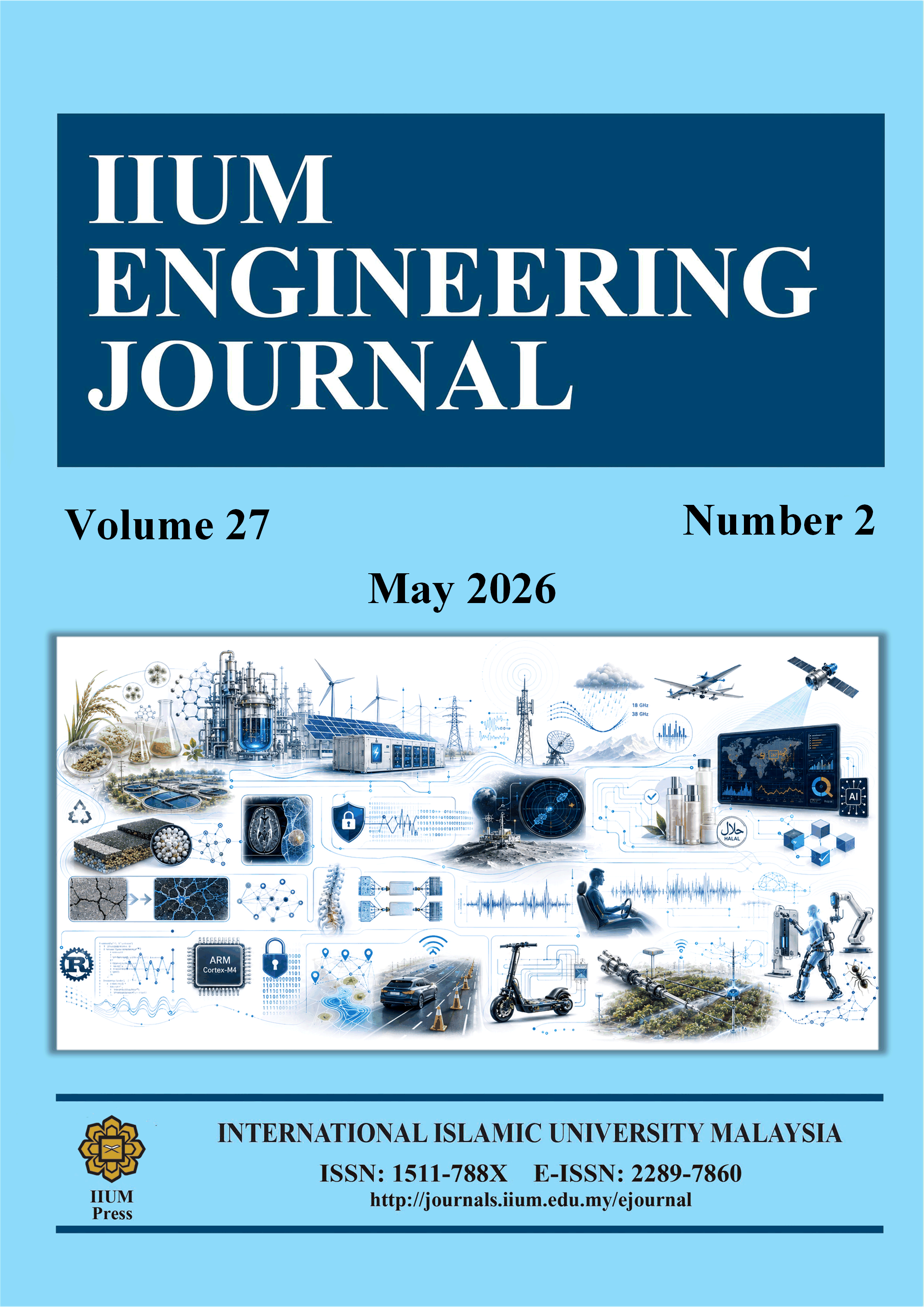
A strong sustainability thread runs throughout this issue. Several contributions explore how waste materials, biological resources, renewable energy systems, and intelligent control can be transformed into practical engineering solutions. Studies on microbial bio-coagulant production, sludge remediation, eco-friendly asphalt mixtures, precision irrigation, and energy storage control for renewable microgrids show that sustainable engineering requires more than good intentions. It requires process optimization, material innovation, system-level thinking, careful validation, and the courage to rethink conventional practices.
This issue also highlights the growing maturity of intelligent and data-driven engineering. Artificial intelligence, machine learning, deep learning, foundation models, blockchain, and optimization techniques are applied across diverse problems, including medical image classification, spinal disorder diagnosis, halal verification, satellite anomaly identification, crack segmentation, intrusion detection, facility location, and autonomous navigation. These works show a clear movement beyond algorithmic novelty toward explainability, robustness, efficiency, and practical deployment. In this sense, intelligence is not treated merely as computational performance, but as a means to support better decisions, safer systems, and more trustworthy engineering outcomes.
Equally important is the emphasis on safety, resilience, and trust. The papers on communication reliability, software-defined radar, tropical rain attenuation, embedded cryptography, vehicle safety alerts, highway cone deployment, UAV dynamics, electric vehicle control, and lunar navigation demonstrate the importance of engineering systems that can withstand uncertainty, disturbance, failure, and demanding operating environments. These studies remind us that high-performance engineering is incomplete without reliability, accountability, and resilience.
The human dimension of engineering is also clearly visible in this volume. Contributions on rehabilitation robotics, EMG-based assessment during prolonged driving, steering control, mobility systems, biomedical classification, and Rust-based visualization for teaching concurrency demonstrate that engineering research ultimately serves people. It supports health, safety, learning, mobility, productivity, and quality of life. This human-centered direction is especially important as engineered systems become more autonomous, more digital, and more deeply embedded in daily life.
Taken together, this May 2026 edition presents a compelling picture of engineering as purposeful innovation. The articles are diverse in method, domain, and application, yet they share a common commitment to transforming knowledge into responsible solutions. They also reflect the kind of scholarship that the IIUM Engineering Journal seeks to promote: rigorous in method, relevant in application, interdisciplinary in spirit, and meaningful in contribution.
On behalf of the editorial team, we sincerely thank the authors for their valuable contributions, the reviewers for their careful and constructive evaluations, and the editorial board members for their dedication to maintaining the journal's quality and integrity. We hope this issue will inspire further research, strengthen collaboration across disciplines, and encourage engineering innovations that contribute to society and the world in a wise and responsible way.
Prof. Ir. Ts. Dr. Teddy Surya Gunawan
Executive Editor
IIUM Engineering Journal

ISSN: 1511-788X E-ISSN: 2289-7860
Published by:
IIUM Press,
International Islamic University Malaysia
Jalan Gombak, 53100 Kuala Lumpur, Malaysia
Phone (+603) 6421-5014, Fax: (+603) 6421-6298
Downloads
Metrics
References
Downloads
Published
How to Cite
Issue
Section
License
Copyright (c) 2026 IIUM Press

This work is licensed under a Creative Commons Attribution-NonCommercial 4.0 International License.