Editorial Message Vol. 27 No. 1 2026
DOI:
https://doi.org/10.31436/iiumej.v27i1.4129Keywords:
EditorialAbstract
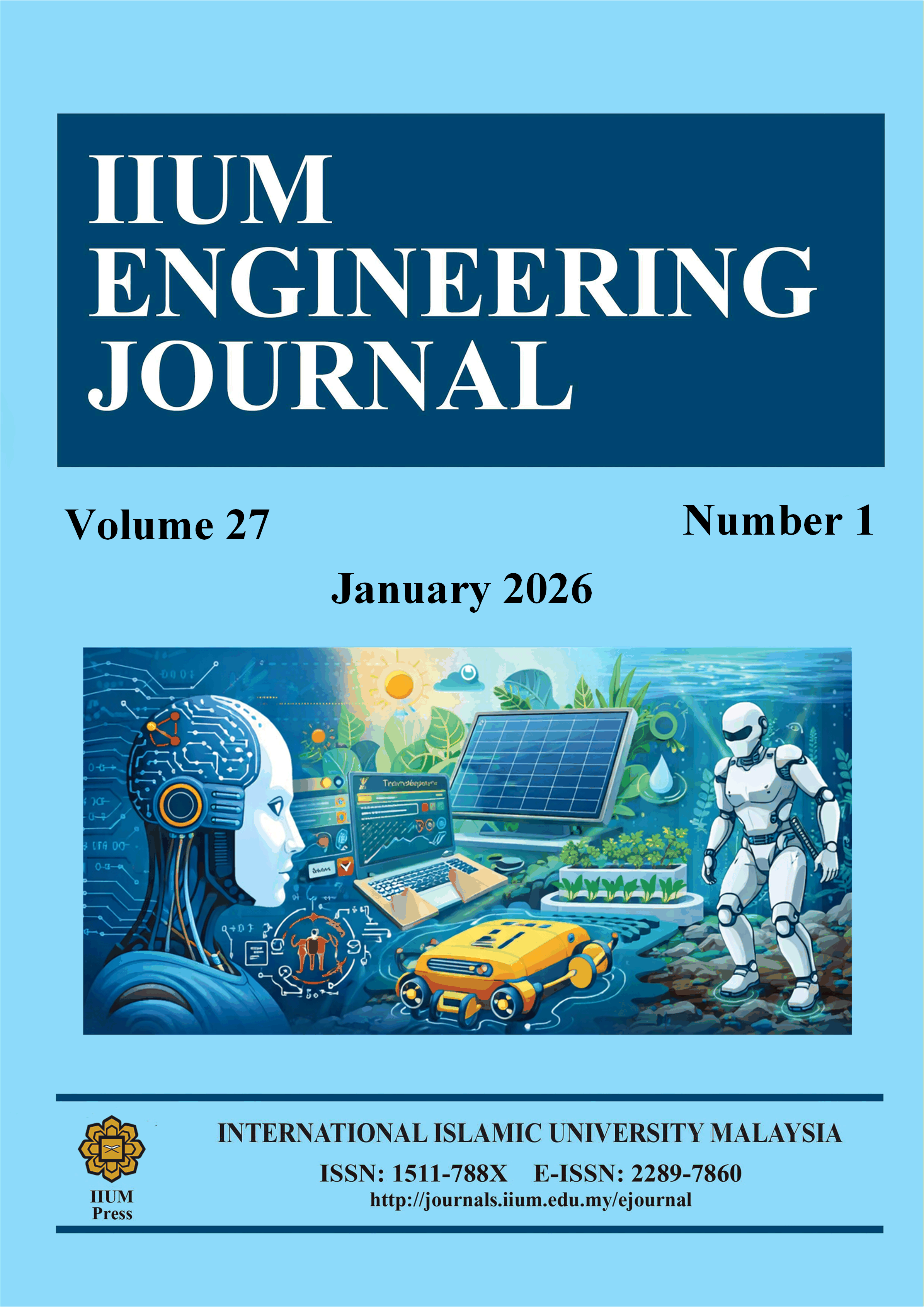
It is with great pleasure that we present Volume 27, Number 1 of the IIUM Engineering Journal, an issue that reflects the breadth, depth, and evolving priorities of contemporary engineering research. The papers published in this volume collectively demonstrate how rigorous theoretical foundations, advanced computational techniques, and practical engineering solutions converge to address pressing technological, environmental, and societal challenges.
This issue opens with contributions from Chemical and Biotechnology Engineering, where research on the growth kinetics of Pleurotus pulmonarius advances sustainable biotechnology practices through innovative methods to revive spawn culture. This work highlights how process optimization and biological engineering can contribute to food security and value-added agro-industrial applications.
A substantial portion of this volume is devoted to Electrical, Computer, and Communications Engineering, underscoring the rapid progress in intelligent systems, data-driven modeling, and energy-aware technologies. Several papers explore the integration of artificial intelligence and machine learning into diverse domains, including graph neural networks for large-scale skyline query processing, transformer-based malware detection at the byte level, deep learning with explainability for skin care detection, and advanced sentiment prediction models. Complementing these are applied engineering studies on inertial sensor self-calibration for autonomous underwater vehicles, LoRaWAN-based IoT systems for electric fence monitoring, optimized PID control for energy-efficient induction motors, and vision-transformer-based groundwater-level forecasting for sustainable water-resource management. Together, these works illustrate how AI-enhanced engineering is reshaping decision-making, automation, and system reliability.
In the Materials and Manufacturing Engineering section, the focus shifts to next-generation materials and devices that support sustainability and high-performance applications. Contributions on eco-friendly tin-based perovskite solar cells and graphene–silver hybrid inks provide valuable insights into material characterization, performance optimization, and the development of greener energy and electronic solutions. The Mechanical and Aerospace Engineering contribution in this issue addresses surrogate model-based optimization of unmanned aerial vehicle wings, demonstrating how computational intelligence and response surface methodologies can accelerate design cycles while maintaining aerodynamic efficiency and structural integrity.
Research in Mechatronics and Automation Engineering further enriches this volume, covering a wide spectrum of intelligent and autonomous systems. Papers in this section examine humanoid robot stability on uneven terrain, vehicle identification using YOLO-based deep learning, autonomous underwater vehicles for subaquatic exploration, FSM-based MBIST controller implementation, adaptive energy balance control for solar-powered hydroponics, and advanced medical image segmentation using attention-enhanced neural architectures. Collectively, these studies highlight the increasing role of autonomy, robustness, and sustainability in modern engineered systems.
Taken as a whole, Vol. 27 No. 1 exemplifies the journal’s commitment to publishing high-quality, interdisciplinary engineering research that bridges theory and practice. The diversity of topics and methodologies presented here reflects not only the dynamic nature of engineering as a discipline but also its critical role in supporting sustainable development, digital transformation, and technological innovation.
We extend our sincere appreciation to the authors for their valuable contributions, to the reviewers for their rigorous and constructive evaluations, and to the editorial team for their dedication in bringing this issue to publication. We hope that the articles in this volume will stimulate further research, inspire collaboration across disciplines, and serve as a meaningful reference for researchers, practitioners, and policymakers alike.
Prof. Ir. Ts. Dr. Teddy Surya Gunawan
Executive Editor
IIUM Engineering Journal

ISSN: 1511-788X E-ISSN: 2289-7860
Published by:
IIUM Press,
International Islamic University Malaysia
Jalan Gombak, 53100 Kuala Lumpur, Malaysia
Phone (+603) 6421-5014, Fax: (+603) 6421-6298
Downloads
Metrics
References
Downloads
Published
How to Cite
Issue
Section
License
Copyright (c) 2026 IIUM Press

This work is licensed under a Creative Commons Attribution-NonCommercial 4.0 International License.