Editorial Message Vol. 27 No. 3 2026: From Intelligent Models to Responsible Engineering Systems
DOI:
https://doi.org/10.31436/iiumej.v27i3.4768Keywords:
EditorialAbstract
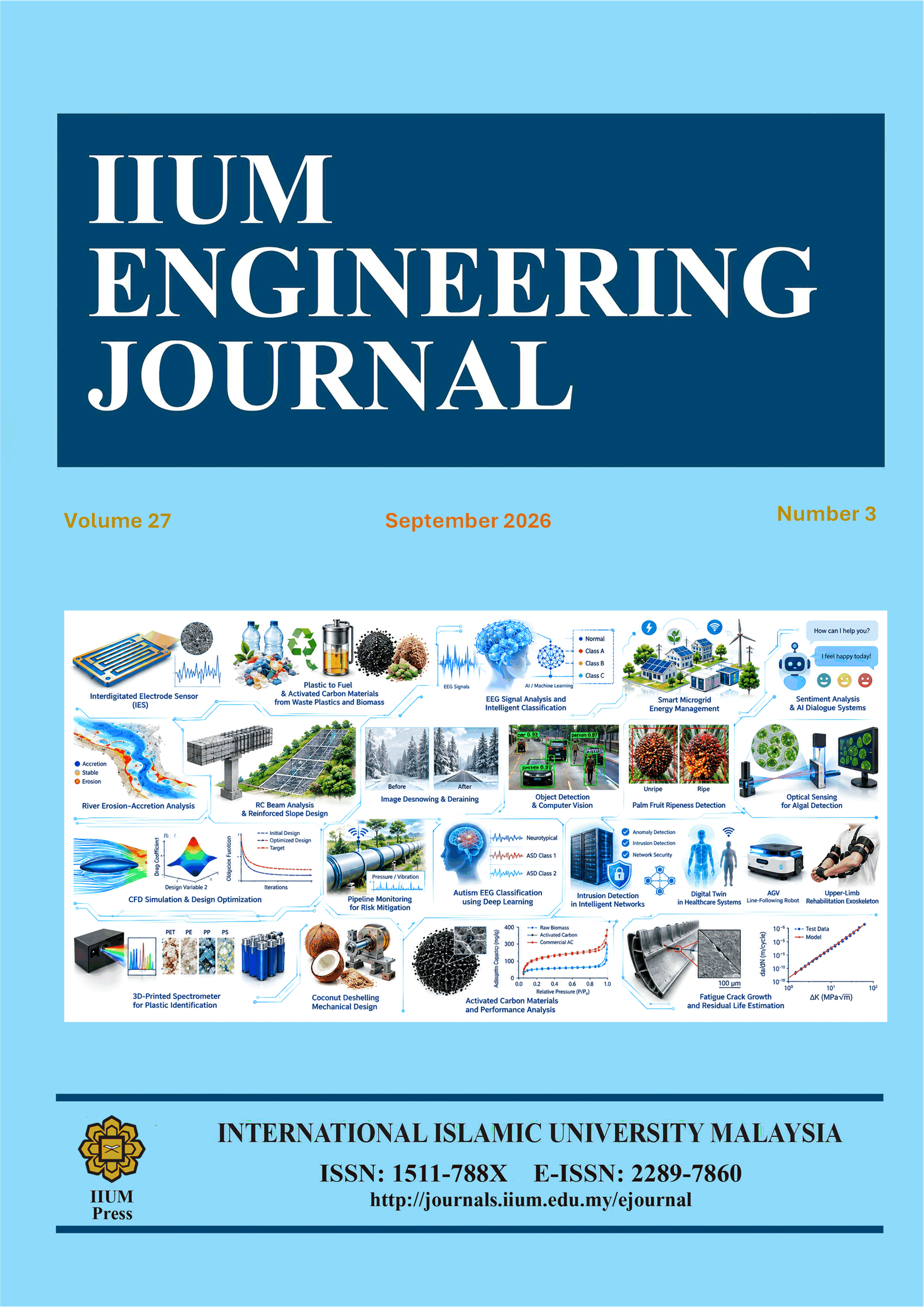
It is our pleasure to present the September 2026 issue of the IIUM Engineering Journal. This issue captures an important transition in contemporary engineering: the movement from isolated models, devices, and analyses toward integrated systems that are expected to be intelligent, efficient, sustainable, reliable, and useful in real operating environments. Across the papers in this volume, advanced computation is increasingly coupled with physical engineering, while experimental validation, resource awareness, safety, and practical deployment remain central.
A defining feature of this issue is the breadth of data-driven engineering. Machine learning and artificial intelligence are applied to EEG classification, autism-spectrum assessment, intrusion detection, pipeline condition monitoring, sentiment analysis, object detection, microgrid energy management, image restoration, agricultural vision, asphalt characterization, and plastic identification. These studies illustrate how AI is becoming embedded within engineering workflows rather than treated as a separate computational layer. Equally important, several contributions address explainability, efficiency, synthetic-data augmentation, knowledge distillation, real-time operation, and compute-aware evaluation: issues that increasingly determine whether intelligent methods can be trusted and deployed responsibly.
The issue also demonstrates the continuing importance of modeling, optimization, and digital engineering. Finite-element analysis supports the design of interdigitated electrodes and strengthened concrete structures; numerical and predictive approaches address progressive collapse, reinforced slopes, hydraulic-drive stability, fatigue life, and microgrid operation; and digital-twin and surrogate-assisted optimization frameworks extend advanced computation into manufacturing and autonomous systems. Together, these works show how simulation and optimization can reduce development cost, improve design confidence, and accelerate the transition from concept to implementation.
Sustainability is another strong thread. Research on plastic-waste pyrolysis, activated carbon derived from palm empty fruit bunches, riverbank erosion and accretion, low-cost spectroscopy for plastic identification, and energy management for residential microgrids reflects engineers' growing responsibility to address resource use, environmental risk, and circularity. Sustainability here is not presented as an abstract objective, but as a measurable engineering problem requiring better materials, processes, sensing, control, and decision support.
The human and societal dimensions of engineering are equally visible. Work on rehabilitation exoskeletons, mobility and stability systems, biomedical signal analysis, and safe infrastructure reminds us that engineering performance must ultimately be judged by its contribution to human well-being. Even as systems become more autonomous and computationally sophisticated, usability, robustness, interpretability, and safety remain indispensable.
Taken together, the papers in Vol. 27 No. 3 demonstrate a mature and increasingly integrated view of engineering research: one that combines intelligence with physical understanding, sustainability with performance, and innovation with responsibility. This is the direction the IIUM Engineering Journal seeks to advance: rigorous research that crosses disciplinary boundaries, responds to real-world needs, and contributes meaningfully to technological and societal progress.
On behalf of the editorial team, I thank all authors, reviewers, and editorial board members for their contributions and commitment to scholarly quality. We hope this issue stimulates new ideas, strengthens interdisciplinary collaboration, and encourages engineering solutions that are not only technically advanced, but also responsible, resilient, and relevant.
Prof. Ir. Ts. Dr. Teddy Surya Gunawan
Executive Editor
IIUM Engineering Journal

ISSN: 1511-788X E-ISSN: 2289-7860
Published by:
IIUM Press,
International Islamic University Malaysia
Jalan Gombak, 53100 Kuala Lumpur, Malaysia
Phone (+603) 6421-5014, Fax: (+603) 6421-6298
Downloads
Metrics
References
Downloads
Published
How to Cite
Issue
Section
License
Copyright (c) 2026 IIUM Press

This work is licensed under a Creative Commons Attribution-NonCommercial 4.0 International License.