|
MENU |
|
INFORMATION |
|
INDEXING |

|
AWARD |
Every manuscript that is submitted to the IJPCC must pass a double-blind peer review procedure and adhere to the journal's requirements for originality, research integrity, and academic excellence. After passing the first editorial screening, manuscripts will be forwarded to a minimum of two independent reviewers with relevant experience. Both authors and reviewers maintain their anonymity throughout the review process.
The recommendations of the reviewers, the intellectual merit of the paper, and its applicability to the goals and scope of the journal are all taken into consideration when making editorial choices. When making decisions about suitable actions, such as hiring reviewers with specialized knowledge, having additional editors evaluate the proposal, or refusing to examine a submission further, the Editorial Office may confer with specialists and the academic editor as needed.
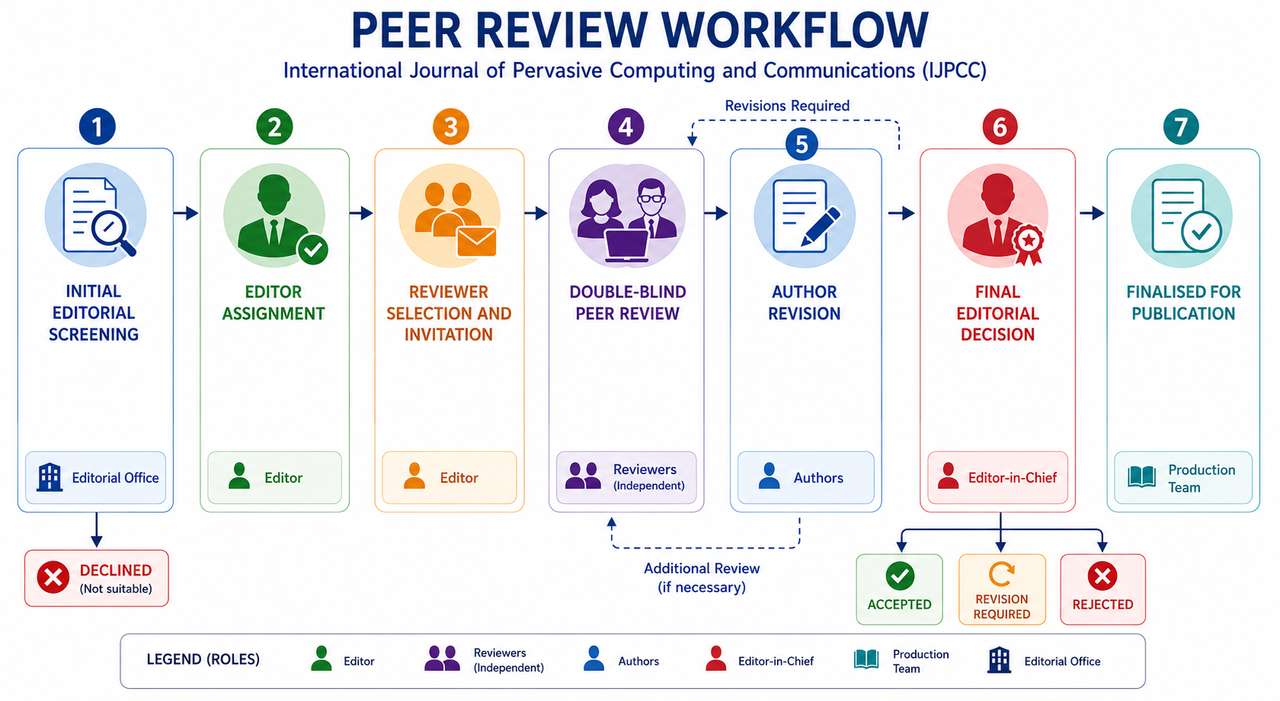
1. Initial Editorial Screening
The Editorial Office conducts an initial assessment to determine whether the manuscript falls within the journal's scope, complies with the Author Guidelines, satisfies formatting and demonstrates sufficient academic quality for peer review. Manuscripts failing to meet these criteria may be declined without external review.
Editors first review the submitted manuscript, called initial review by the editors. It will be evaluated whether the submitted manuscript is suitable for the IJPCC based on focus and scope, similarity score by using Crosscheck-TurnitIn, AI-percentage, methodological flaw, readability of the articles, and adhering to the submitted paper template.
2. Editor Assignment
Eligible manuscripts are assigned to an editor with appropriate subject expertise, who oversees the review process and selects suitable independent reviewers.
3. Reviewer Selection and Invitation
The assigned editor invites at least two independent reviewers with relevant expertise while ensuring that potential conflicts of interest are avoided.
4. Double-Blind Peer Review
Reviewers evaluate the manuscript's originality, significance, methodological quality, validity of the findings, literature support, presentation, and overall contribution to the field. They submit detailed comments for the authors together with confidential recommendations for the editor.
5. Author Revision
Where revisions are required, authors submit a revised manuscript accompanied by a detailed response letter addressing each reviewer comment. Revised manuscripts may undergo additional rounds of peer review where necessary.
6. Final Editorial Decision
The assigned editor evaluates the revised manuscript together with the reviewers' recommendations and advises the Chief Editor. The final decision to accept, request further revision, or reject the manuscript is made by the Chief Editor based on the overall academic quality and reviewers' recommendations.
7. Finalised for publication
After being accepted, the manuscript underwent copyediting and layout editing to get it ready for the camera.
Reviewers are instructed to assess the quality of submissions solely based on the academic merit of their content along the following dimensions:
In addition, all of the articles will be checked for textual overlap in an effort to detect possible signs of plagiarism by the publisher.
The editor will decide whether to publish the work based on input from the peer review process. It will take four to twelve weeks to complete the evaluation procedure. Among the decision categories are:
The Editors declare no competing interests with the submissions which they have handled through the peer-review process. The peer-review of any submissions for which the Editors have competing interests is handled by another Editor who has no competing interests.
The papers published in IJPCC will be considered to retract in the publication if :
The mechanism of retraction follows the Retraction Guidelines of the Committee on Publication Ethics (COPE), which can be accessed at [https://publicationethics.org/files/retraction%20guidelines.pdf](https://publicationethics.org/files/retraction%20guidelines.pdf).
All correspondence concerning manuscripts should be directed to the Editor of IJPCC and cc to [IJPCC@iium.edu.my](mailto:IJPCC@iium.edu.my). The Editor will direct all correspondence to the corresponding author; the corresponding author is responsible for sharing communications with other authors. Beyond communication concerning the review, manuscripts accepted for publication may require additional correspondence to complete copyediting and layout editing.
The role of peer review in scholarly publishing is crucial to ensure that all manuscripts submitted are high quality papers. Reviewers evaluate and provide feedback on manuscripts submitted according to the publishing criteria of each journal, validity of the research done and the completeness of the research presented.
Manuscripts submitted are subjected to a double-blind peer review process. Thus, the identities of reviewers are withheld from author(s) and vice versa. All manuscripts will be reviewed by at least two reviewers. The whole double-blind peer review process will take 14 working days to complete. However, a reviewer may request from the Chief Editor for more time to review a paper, if required.
All author(s) are advised to avoid multiple submissions of the same article. All manuscripts submitted will undergo the following peer review process:
|
VISITORS |
Kulliyyah of Information and Communication Technology
International Islamic University Malaysia
P.O. Box 10, 50728 Kuala Lumpur
Malaysia
Email: ijpcc@iium.edu.my | Phone No: 0108253622
INDEXING & ABSTRACTING