|
MENU |
|
INFORMATION |
|
INDEXING |

|
AWARD |
Authors are expected to be aware of, and comply with, best practice in publication ethics.
Reviewers and Chief Editor are required to treat manuscripts fairly and in confidence, and to declare any competing interests.
The Chief Editor will investigate allegations of research or publication misconduct and reserve the right to contact the authors’ institutions, funders or regulatory bodies if needed.
In cases of suspected or alleged misconduct, the COPE guidelines will be adhered to and advice may be sought at the COPE forum. If conclusive evidence of misconduct is found, steps will be taken to correct the scientific record, which may include issuing a correction or retraction.
The Chief Editor may be formally contacted via email or any other means suitable if there are any concerns about potential misconduct.
The peer review process and appeal to the Chief Editor’s’ decisions are as follows:
Complaints pertaining to matters related to a failure of process (e.g. lengthy delays) or reviewer misconduct should be emailed to the Chief Editor.
All complaints should be accompanied with adequate supporting information (e.g., copies of email correspondence). If the complaint is related to a specific article, include the title and URL (if it is published) or the manuscript ID number (if it is unpublished).
If there are any complaints regarding the author's misconduct, please email the Chief Editor.
All complaints must include sufficient supporting information, such as copies of relevant email correspondence. If your complaint pertains to a specific article, please provide the title and URL of that article.
Concerns may involve, but are not limited to, the following unethical matters:
Any complaints about the Chief Editor regarding severe misjudgements (e.g. an improperly applied retraction notice) should be directed to IJPCC Press.
IJPCC Press will consider the complaints against the Chief Editor only when there is a clear breach of policy.
A rejection of the submission of a manuscript is not a ground for complaint, unless there is evidence of misconduct on the part of the Editorial or the Chief Editor.
IJPCC Press will consider appeals against the Chief Editor’s decision only when there is a clear breach of policy.
Investigations will be made to establish that correct procedures are followed, ensuring the decisions are reached based on academic criteria and not by personal prejudice or any form of biased decision that influences the outcome, and to resolve any outstanding issues.
Withdrawal of articles is not encouraged. It is granted on a case by case basis. Withdrawal refers to Articles of the early version, which have been accepted for publication. Reasons for withdrawal may include reasons such as:
Note to authors:
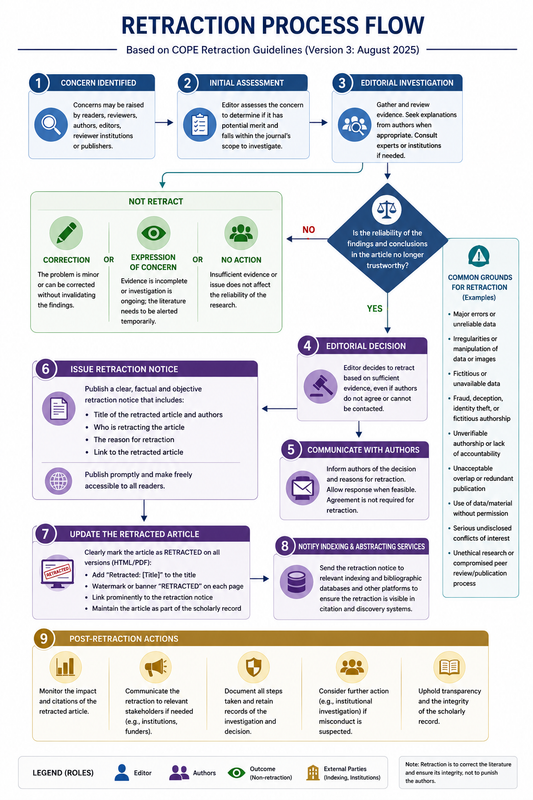
Articles may be retracted as per COPE retraction guidelines found at Retraction Guidelines website. on the following grounds:
The decision to retract an article is made on a case by case basis only after the editor consults the author(s) and reviewers.
The author(s) must sign the retraction note and submit it to the Chief Editor before an article can be retracted. All the authors must consent to the retraction before a retraction note can be published in the paginated part of a subsequent issue of the journal and listed in the contents list. However, in the case of some co-authors disagreeing to the retraction of the article, the editor will decide on the retraction upon identifying the dissenting co-authors.
On the webpages of the retracted article, a note stating that the article has been retracted from the journal will be posted to replace the article.
Albeit exceptionally, it may be necessary for a published Article to be removed due to the following reasons:
In such circumstances, the bibliographic information and the PDF file will also be removed. A note, stating that the article has been removed will replace the Article text.
Flawed original articles can be replaced with a corrected version.
Only significant corrections such as inaccurately published information etc. will be published. Minor corrections such as spelling or grammatical errors which do not alter the comprehension of a paper will require no corrections.
The following actions can be taken for errors discovered in the published article:
For Errata and Corrigenda, the PDF version of the correction Article is attached to the online version of the original article and a link is created between the errata/corrigenda article and the original article for readers and other users/systems to be aware of the corrections. For corrigenda, the article must follow the format: “Corrigenda: “original article title” (“original article reference”).
|
VISITORS |
Kulliyyah of Information and Communication Technology
International Islamic University Malaysia
P.O. Box 10, 50728 Kuala Lumpur
Malaysia
Email: ijpcc@iium.edu.my | Phone No: 0108253622
INDEXING & ABSTRACTING