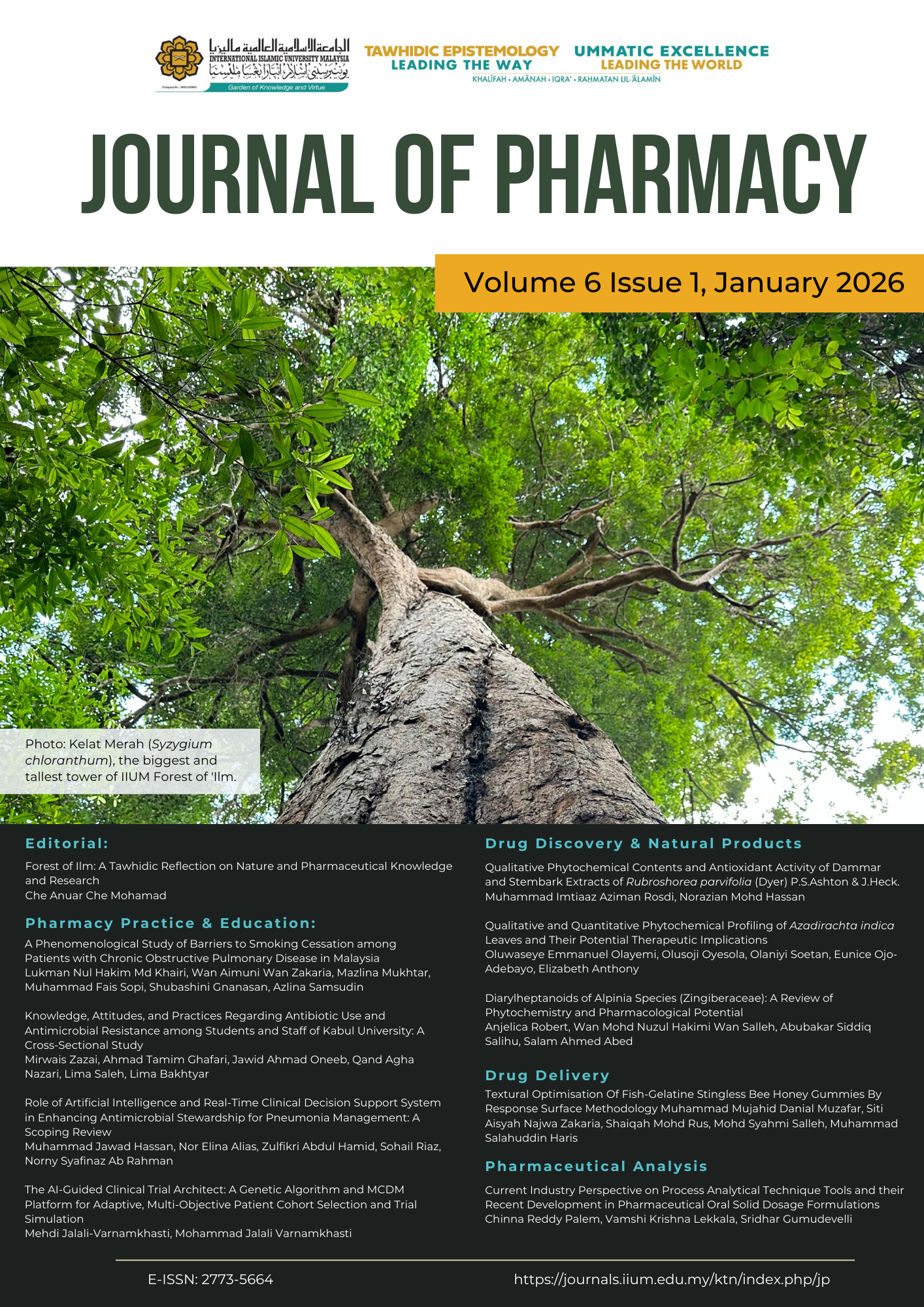
Forest of Ilm: A Tawhidic Reflection on Nature and Pharmaceutical Knowledge and Research
Article Sidebar
Main Article Content
Abstract
Nature has long served as one of the most fundamental sources of knowledge and guidance for human civilisation, particularly in the field of medicine and pharmacy. Modern pharmacology continues to benefit from natural sources in the discovery and development of therapy. However, contemporary scientific practice often approaches nature through a predominantly utilitarian and reductionist lens, viewing it largely as a reservoir of extractable compounds for new therapy discovery. This article revisits a more holistic framework rooted in Islamic Worldview where nature is understood not only as a material resource, but also as a trust (Amanah) and a source of spiritual and metaphysical knowledge. The article also highlights how principle of Tawhid and moral accountability has shaped earlier scientific inquiry by earlier generation of muslim scientists, particularly in pharmacology and natural product research. Using Forest of Ilm at International Islamic University Malaysia (IIUM) Kuantan as a contemporary case example, the article argues for an integrated approach to scientific research that harmonises empirical investigation with ethical responsibility and spiritual reflection.
Article Details

This work is licensed under a Creative Commons Attribution 4.0 International License.
Journal of Pharmacy at https://journals.iium.edu.my/ktn/index.php/jp is licensed under a Creative Commons Attribution 4.0 International License.
References
Açikgenç, A. (2014). Islamic scientific tradition in history. Penerbit IKIM.
Al-Hassani, S. T. (2007). 1001 inventions: Muslim heritage in our world. Foundation for Science Technology & Civilisation, FSTC
Alshaqhaa, M. A., Souid, I., Korchef, A., & Alshehri, M. D. (2025). Ethnobotanical study on medicinal plants used in the Aseer province, Southwestern Saudi Arabia. Journal of Ethnobiology and Ethnomedicine, 21(1), 39. DOI: https://doi.org/10.1186/s13002-025-00793-1
Ashimi, T. A. (2018). The contribution of Muslim scholars to the field of medicine (with particular reference to Ibn Sina and Al-Razi during the Islamic Golden Age). Journal of Education and Social Sciences, 9(3), 73-77.
Bakar, O. (1991). The Unity of Science and Spiritual Knowledge. Science and Sprit. New York: Paragon House.
Bakar, O. (2008). Tawhid and science Islamic perspectives on religion and science. Arah Pendidikan Sdn Bhd.
Bakar, O. (2025, June 11) Engagement session with the Honourable Rector, Kulliyyah of Pharmacy IIUM, Kuantan (Unpublished speech).
Borhan, N. A., Nor, N. M., & Ruskam, A. (2014). Ibn Al-Baitar: The Pioneer of Botanist and Pharmacist By. University Teknologi
Dumiadi, A. D., & Ramli, R. M. (2024). Halal Herbal Medicine market in Malaysia and Indonesia: Challenges and its global significance. SARJANA, 39(1), 29-40. Malaysia, 1-7.
El-Seedi, H. R., Khalifa, S. A., Yosri, N., Khatib, A., Chen, L., Saeed, A., ... & Verpoorte, R. (2019). Plants mentioned in the Islamic Scriptures (Holy Qur'ân and Ahadith): Traditional uses and medicinal importance in contemporary times. Journal of ethnopharmacology, 243, 112007. DOI: https://doi.org/10.1016/j.jep.2019.112007
Hajar R. The Air of History Part III: The Golden Age in Arab Islamic Medicine An Introduction. Heart Views. 2013 Jan;14(1):43-6. doi: 10.4103/1995-705X.107125. PMID: 23580929; PMCID: PMC3621228. DOI: https://doi.org/10.4103/1995-705X.107125
Haque,A.U. (2020). Ibn al-Baitar: A Great Botanist, Pharmacist, Scientist and Physician. International Journal of Pathology, 18(2), 66-67.
Herdiana, Y., Sofian, F. F., Shamsuddin, S., & Rusdiana, T. (2024). Towards halal pharmaceutical: Exploring alternatives to animal-based ingredients. Heliyon, 10 (1), e23624. DOI: https://doi.org/10.1016/j.heliyon.2023.e23624
Ramya, R., Othman, R., Hatta, F. A. M., & Wan, W. S. H. (2024). The Ethnobotanical Elements in Traditional Malay Medical Knowledge: A Review. International Journal of Research and Innovation in Social Science, 8(11), 2903-2918. DOI: https://doi.org/10.47772/IJRISS.2024.8110225
Saad, B., & Said, O. (2011). Greco-Arab and Islamic herbal medicine: traditional system, ethics, safety, efficacy, and regulatory issues. John Wiley & Sons. DOI: https://doi.org/10.1002/9780470944363
Saad, Bashar. (2014). Greco-Arab and Islamic Herbal Medicine: A Review. European Journal of Medicinal Plants. 4. 249-258. DOI: https://doi.org/10.9734/EJMP/2014/6530
Saad, B. (2015). Greco-Arab and Islamic diet therapy: Tradition, research and practice. Arabian Journal of Medicinal and Aromatic Plants, 1(1), 2-23.
Hassan, M. K. (2019). 01 | The Necessity of Understanding the Cosmos, Nature and Man, as Well as the Unity of Knowledge, Faith and Ethics from the Worldview of the Qur’an: Implications on an International Islamic University. REVELATION AND SCIENCE, 8(2),1–12.
International Islamic University Malaysia (2024, May 7). Teaching Learning activities. Forest of ‘Ilm-IIUM. https://forest-ilm.iium.edu.my/teaching-and-learning-activities/
Nasr, S. H. (2007). Man and nature: The spiritual crisis of modern man. Kazi Publication.
Nasr, S. H. (1996). Religion and the Order of Nature (No. 167). Oxford University Press, USA. DOI: https://doi.org/10.1093/acprof:oso/9780195108231.001.0001
Nasr, S. H. (2001). Science and civilization in Islam. ABC International Group.
Newman, D. J., & Cragg, G. M. (2016). Natural Products as Sources of New Drugs from 1981 to 2014. Journal of natural products, 79(3), 629–661. https://doi.org/10.1021/acs.jnatprod.5b01055 DOI: https://doi.org/10.1021/acs.jnatprod.5b01055
Sayyid Qutb, & Salahi, A. (2003). In the Shade of the Qur'an. Islamic Foundation.
Takubessi, M. I., Jalil, B., & Heinrich, M. (2025). The impact of climate change on medicinal plants and natural products: A scoping review. Frontiers in pharmacology, 16, 1697581. https://doi.org/10.3389/fphar.2025.1697581 DOI: https://doi.org/10.3389/fphar.2025.1697581
Tibi S. (2006). Al-Razi and Islamic medicine in the 9th century. Journal of the Royal Society of Medicine, 99(4), 206–207. https://doi.org/10.1177/014107680609900425 DOI: https://doi.org/10.1177/014107680609900425