In vitro antiplasmodial activity of six plants against chloroquine-sensitive and resistant strains of Plasmodium falciparum
Article Sidebar
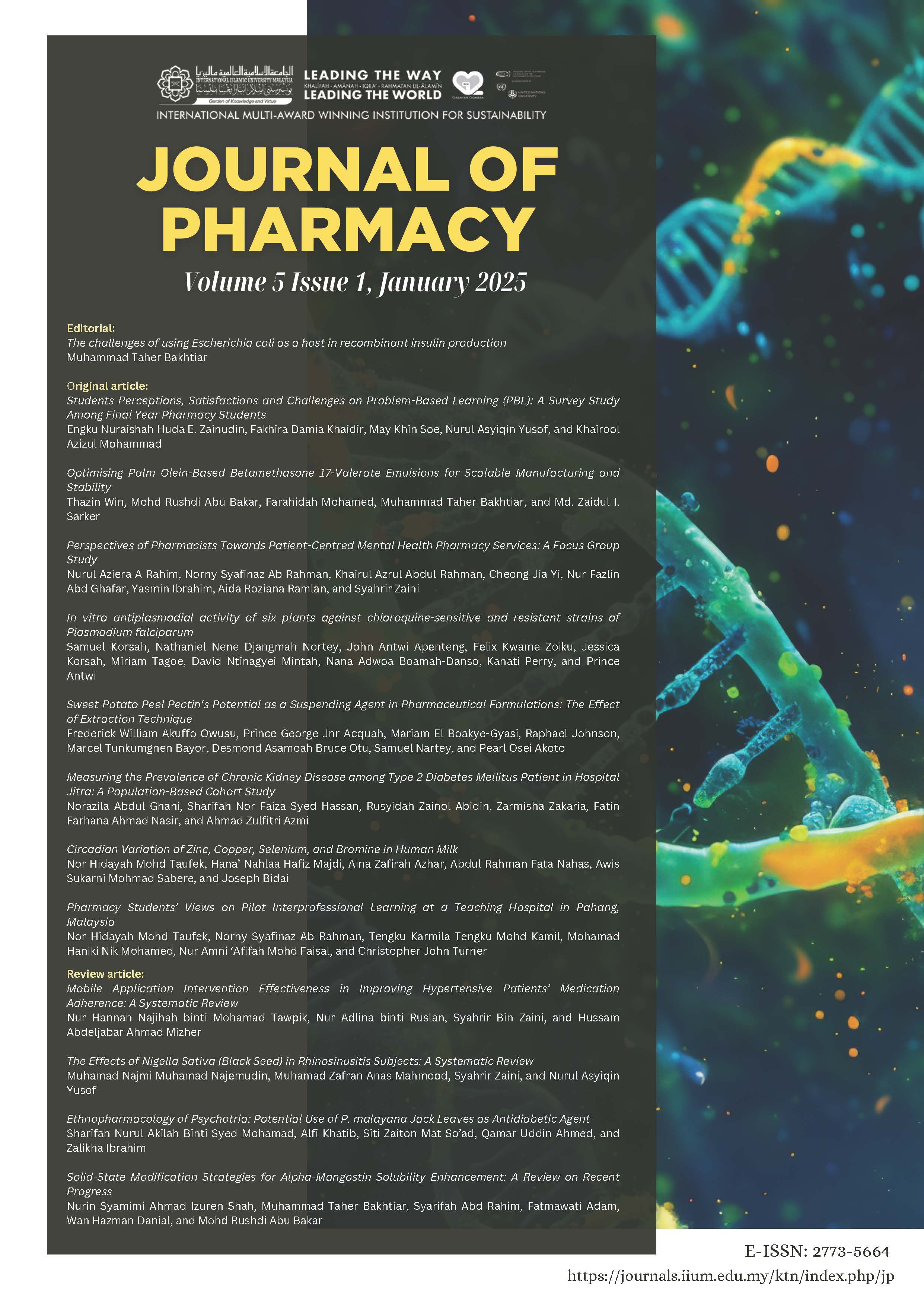
Main Article Content
Abstract
Introduction: The effectiveness of the first-line malaria treatment has been affected by drug resistance and adverse side effects leading to a limited number of treatment options. This calls for the search for alternative antimalarial agents. The study evaluated the in vitro antimalarial activity of six plants frequently used in herbal antimalarial products in Ghana against chloroquine-sensitive strain (3D7) and chloroquine-resistant strain (DD2) of Plasmodium falciparum. Method: Aqueous extracts were prepared from the plants by decoction and freeze-dried. A fluorescence-based SYBR Green assay was used to evaluate the antimalarial activity of the extracts against Plasmodium falciparum strains 3D7 and DD2. Also, the cytotoxic e?ects (CC50) of the plant extracts against red blood cells were evaluated using 3-(4,5-dimethylthiazol-2-yl)-2,5-diphenyltetrazolium bromide (MTT) rapid calorimetric assay technique. Results: Alstonia boonei, Cryptolepis sanguinolenta, and Azadirachta indica were the most effective mono-herbal extracts with IC50 of 8.64 ?g/mL, 6.12 ?g/mL, and 5.22 ?g/mL respectively against 3D7 lab strain and 8.47 ?g/mL, 5.12 ?g/mL and 5.22?g/mL respectively against DD2 lab strain. The aqueous extracts of Paullinia pinnata, Citrus aurantiifolia, and Tetrapleura tetraptera exhibited moderate activity against both lab strains with IC50 values of 24.72 ?g/mL, 34.89 ?g/mL and 14.94 ?g/mL respectively against 3D7 strain and 14.84 ?g/mL, 31.01 ?g/mL and14.74 ?g/mL respectively against DD2 strain. All plant extracts exhibited no cytotoxicity against RBC (?100 ?g/mL, except Cryptolepis sanguinolenta with CC50 92.7 ?g/mL). Moreover, except Paullinia pinnata, Citrus aurantiifolia and Tetrapleura tetraptera (with low selectivity index: SI < 10), all the plants displayed a good selectivity index (SI>10). Conclusion: All six frequently used antimalarial plants in monotherapy possess significant antimalarial activity against Plasmodium falciparum (3D7) and (DD2) strains. The data obtained from this study support the folkloric and frequent use of these plants in several herbal antimalarial products on the Ghanaian market.
Article Details

This work is licensed under a Creative Commons Attribution 4.0 International License.
Journal of Pharmacy at https://journals.iium.edu.my/ktn/index.php/jp is licensed under a Creative Commons Attribution 4.0 International License.
References
Agidew, M. G. (2022). Phytochemical analysis of some selected traditional medicinal plants in Ethiopia. Bulletin of the National Research Centre, 46(1), 87. https://doi.org/10.1186/s42269-022-00770-8 DOI: https://doi.org/10.1186/s42269-022-00770-8
Alven, S., & Aderibigbe, B. (2019). Combination therapy strategies for the treatment of malaria. Molecules, 24(19), 3601. https://doi.org/10.3390/molecules24193601 DOI: https://doi.org/10.3390/molecules24193601
Amengor, C. D. K., Biniyam, P. D., Brobbey, A. A., Kekessie, F. K., Zoiku, F. K., Hamidu, S., Gyan, P., & Abudey, B. M. (2024). N?Substituted Phenylhydrazones Kill the Ring Stage of Plasmodium falciparum. BioMed Research International, 2024(1), 6697728. https://doi.org/10.1155/2024/6697728 DOI: https://doi.org/10.1155/2024/6697728
Aslam, M. S., Ahmad, M. S., Mamat, A. S., Ahmad, M. Z., & Salam, F. (2016). An update review on polyherbal formulation: A global perspective. Systematic Reviews in Pharmacy, 7(1), 35-41. https://doi.org/10.5530/srp.2016.7.5 DOI: https://doi.org/10.5530/srp.2016.7.5
Bapna, S., Ramaiya, M., & Chowdhary, A. (2014). Brine shrimp toxicity and invitro antimalarial activity of Citrus aurantifolia (Christm.) Swingle against Plasmodium falciparum 3D7. IOSR Journal of Pharmaceutical and Biological Science, 9(5), 24-27. DOI: https://doi.org/10.9790/3008-09512427
Bapna, S., Satvekar, T., Jadhav, P., & Sawant, M. G. (2017). Evaluation of in Vitro Antimalarial Activity of Calotropis gigantia and Citrus aurantifolia Flower extract against Plasmodium falciparum 3D7. World Journal of Pharmaceutical Research, 6(16), 1619-1626.
Bello, I., Oduola, T., Adeosun, O., Omisore, N., Raheem, G., & Ademosun, A. (2009). Evaluation of antimalarial activity of various fractions of Morinda lucida leaf extract and Alstonia boonei stem bark. Global Journal of Pharmacology, 3(3), 163-165. https://doi.org/10.13140/RG.2.2.13010.91849
Chaitanya, D. M. (2021). Current Aspects in Pharmaceutical Research and Development. https://doi.org/10.9734/bpi/caprd/v8 DOI: https://doi.org/10.9734/bpi/caprd/v4
Chetia, M. R. D. (2019). In vitro in vivo and models used for antimalarial activity: A brief review. Asian Journal of Pharmacy and Pharmacology, 5(6), 1251-1255. DOI: https://doi.org/10.31024/ajpp.2019.5.6.21
Cooper, R. A., Ferdig, M. T., Su, X.-Z., Ursos, L. M., Mu, J., Nomura, T., Fujioka, H., Fidock, D. A., Roepe, P. D., & Wellems, T. E. (2002). Alternative mutations at position 76 of the vacuolar transmembrane protein PfCRT are associated with chloroquine resistance and unique stereospecific quinine and quinidine responses inPlasmodium falciparum. Molecular pharmacology, 61(1), 35-42. https://doi.org/10.1124/mol.61.1.35 DOI: https://doi.org/10.1124/mol.61.1.35
Cudjoe, E., Donu, D., Okonu, R. E., Amponsah, J. A., & Amoah, L. E. (2020). The in vitro antiplasmodial activities of aqueous extracts of selected Ghanaian herbal plants. Journal of Parasitology Research, 2020(1), 5041919. https://doi.org/10.1155/2020/5041919 DOI: https://doi.org/10.1155/2020/5041919
Dar, R. A., Shahnawaz, M., Ahanger, M. A., & Majid, I. (2023). Exploring the diverse bioactive compounds from medicinal plants: a review. J. Phytopharm, 12, 189-195. https://doi.org/10.31254/phyto.2023.12307 DOI: https://doi.org/10.31254/phyto.2023.12307
Deshpande, P. K., Gothalwal, R., & Pathak, A. K. (2014). Phytochemical analysis and evaluation of antimalarial activity of Azadirachta indica. The Pharma Innovation, 3(9, Part A), 12.
Elhassanny, A. E., Soliman, E., Marie, M., McGuire, P., Gul, W., ElSohly, M., & Van Dross, R. (2020). Heme-dependent ER stress apoptosis: a mechanism for the selective toxicity of the dihydroartemisinin, NSC735847, in colorectal cancer cells. Frontiers in Oncology, 10, 965. https://doi.org/10.3389/fonc.2020.00965 DOI: https://doi.org/10.3389/fonc.2020.00965
Essoh, A. P., Cassiano, G. C., Mandim, F., Gomes, I., Moura, M., Medeiros, M. M., Cravo, P., & Romeiras, M. M. (2022). Studies on the in vitro antiplasmodial activity of endemic and native plants from Cabo Verde. https://doi.org/10.21203/rs.3.rs-1881844/v1 DOI: https://doi.org/10.21203/rs.3.rs-1881844/v1
Ettebong, E., Ubulom, P., & Etuk, A. (2019). Antiplasmodial activity of methanol leaf extract of Citrus aurantifolia (Christm) Swingle. Journal of Herbmed Pharmacology, 8(4), 274-280. https://doi.org/10.15171/jhp.2019.40 DOI: https://doi.org/10.15171/jhp.2019.40
Evans, W. C. (2009). Trease and Evans' pharmacognosy. Elsevier Health Sciences.
Fred-Jaiyesimi, A., & Anthony, O. (2011). Larvicidal activities of the extract and fractions of Paullinia pinnata Linn leaf. Pharmacognosy Communications, 1(2), 37-40. https://doi.org/10.5530/pc.2011.2.7 DOI: https://doi.org/10.5530/pc.2011.2.7
Gathirwa, J., Rukunga, G., Njagi, E., Omar, S., Mwitari, P., Guantai, A., Tolo, F., Kimani, C., Muthaura, C., & Kirira, P. (2008). The in vitro anti-plasmodial and in vivo anti-malarial efficacy of combinations of some medicinal plants used traditionally for treatment of malaria by the Meru community in Kenya. Journal of ethnopharmacology, 115(2), 223-231. https://doi.org/10.1016/j.jep.2007.09.021 DOI: https://doi.org/10.1016/j.jep.2007.09.021
Hariyanti, H., Mauludin, R., Sumirtapura, Y. C., & Kurniati, N. F. (2022). A review: Pharmacological activities of quinoline alkaloid of Cinchona sp. Biointerface Research in Applied Chemistry, 13(4), 3. https://doi.org/10.33263/BRIAC134.319 DOI: https://doi.org/10.33263/BRIAC134.319
Ikem, C. J., Appiah-opong, R., Oli, A. N., Ugwu, M. C., Amoateng, P., Agyemang, K., Nwobodo, D. C., & Esimone, C. O. (2020). In vitro and in vivo antiplasmodial assays of selected Nigerian commercial herbal formulations. Journal of Herbmed Pharmacology, 9(4), 374-381. https://doi.org/10.34172/jhp.2020.47 DOI: https://doi.org/10.34172/jhp.2020.47
Karole, S., Shrivastava, S., Thomas, S., Soni, B., Khan, S., Dubey, J., Dubey, S. P., Khan, N., & Jain, D. K. (2019). Polyherbal formulation concept for synergic action: a review. Journal of Drug Delivery and Therapeutics, 9(1-s), 453-466. DOI: https://doi.org/10.22270/jddt.v9i1-s.2339
Korsah, S., Gbedema, S. Y., Bayor, M. T., Boakye-Gyasi, M. E., Owusu, F. W. A., & Forkuo, A. D. (2021). In Vivo antimalarial activity of Polyalthia longifolia (Annonaceae) leaf extract and assessment of its formulated oral dosage forms. Evidence?Based Complementary and Alternative Medicine, 2021(1), 6519346. https://doi.org/10.1155/2021/6519346 DOI: https://doi.org/10.1155/2021/6519346
Laksemi, D. A., Tunas, I. K., Damayanti, P. A., Sudarmaja, I., Widyadharma, I. P. E., Wiryanthini, I. A., & Linawati, N. M. (2023). Evaluation of Antimalarial Activity of Combination Extract of Citrus aurantifolia and Honey against Plasmodium berghei-?nfected Mice. Tropical Journal of Natural Product Research, 7(1). https://doi.org/10.26538/tjnpr/v7i1.13. DOI: https://doi.org/10.26538/tjnpr/v7i1.13
Lekana-Douki, J. B., Oyegue Liabagui, S. L., Bongui, J. B., Zatra, R., Lebibi, J., & Toure-Ndouo, F. S. (2011). In vitro antiplasmodial activity of crude extracts of Tetrapleura tetraptera and Copaifera religiosa. BMC Research Notes, 4, 1-5. https://doi.org/10.1186/1756-0500-4-506 DOI: https://doi.org/10.1186/1756-0500-4-506
Maje, I., Anuka, J., Hussaini, I., Katsayal, U., Yaro, A., Magaji, M., Jamilu, Y., Sani, M., & Musa, Y. (2007). Evaluation of the anti-malarial activity of the ethanolic leaves extract of Paullinia pinnata (Linn.)(sapindaceae). Nigerian Journal of Pharmaceutical Sciences, 6(2), 67-72.
Majrashi, T. A., Alshehri, S. A., Alsayari, A., Muhsinah, A. B., Alrouji, M., Alshahrani, A. M., Shamsi, A., & Atiya, A. (2023). Insight into the biological roles and mechanisms of phytochemicals in different types of cancer: targeting cancer therapeutics. Nutrients, 15(7), 1704. https://doi.org/10.3390/nu15071704 DOI: https://doi.org/10.3390/nu15071704
Nortey, N. N. D., Korsah, S., Tagoe, M., Apenteng, J. A., Owusu, F. A., Oppong, J., Attah, A. E., & Allotey, S. (2023). Herbs Used in Antimalarial Medicines: A Study in the Greater Accra Region of Ghana. Evidence?Based Complementary and Alternative Medicine, 2023(1), 6697078. https://doi.org/10.1155/2023/6697078 DOI: https://doi.org/10.1155/2023/6697078
Nsofor, W. N., Nwaoguikpe, R. N., Ujowundu, F. N., Keke, C. O., Uba, M. T. u., & Edom, C. V. (2023). Phytochemical, GC-MS, FTIR and Amino acid profile of methanol extract of Tetrapleura tetraptera fruit. Journal of Drug Delivery and Therapeutics, 13(2), 61-69. https://doi.org/10.22270/jddt.v13i2.5739 DOI: https://doi.org/10.22270/jddt.v13i2.5739
Obbo, C., Kariuki, S., Gathirwa, J., Olaho-Mukani, W., Cheplogoi, P., & Mwangi, E. (2019). In vitro antiplasmodial, antitrypanosomal and antileishmanial activities of selected medicinal plants from Ugandan flora: refocusing into multi-component potentials. Journal of ethnopharmacology, 229, 127-136. https://doi.org/10.1016/j.jep.2018.09.029 DOI: https://doi.org/10.1016/j.jep.2018.09.029
Omoya, F., & Oyebola, T. F. (2019). Antiplasmodial activity of stem bark and leaves of Alstonia boonei (De Wild). Journal of Microbiology & Experimentation, 7(5), 241-245. DOI: https://doi.org/10.15406/jmen.2019.07.00267
Opoku-Agyemang, F., Dodoo, J. N. O., Hlomador, T. E., Gilday, K., & Amissah, J. N. (2022). Conservation and Sustainable Use of Cryptolepis sanguinolenta. In Herbs and Spices-New Advances. IntechOpen. https://doi.org/10.5772/intechopen.108249 DOI: https://doi.org/10.5772/intechopen.108249
Oseni, L., & Akwetey, G. (2012). An in-vivo evaluation of antiplasmodial activity of aqueous and ethanolic leaf extracts of Azadirachta indica in Plasmodium berghei infected balb/c mice. International Journal of Pharmaceutical Sciences and Research, 3(5), 1406-1410.
Ouji, M., Augereau, J.-M., Paloque, L., & Benoit-Vical, F. (2018). Plasmodium falciparum resistance to artemisinin-based combination therapies: A sword of Damocles in the path toward malaria elimination. Parasite, 25. https://doi.org/10.1051/parasite/2018021 DOI: https://doi.org/10.1051/parasite/2018021
Paulo, A., Gomes, E. T., Steele, J., Warhurst, D. C., & Houghton, P. J. (2000). Antiplasmodial activity of Cryptolepis sanguinolenta alkaloids from leaves and roots. Planta medica, 66(01), 30-34. https://doi.org/10.1055/s-2000-11106 DOI: https://doi.org/10.1055/s-2000-11106
Podsiedlik, M., Markowicz-Piasecka, M., & Sikora, J. (2020). Erythrocytes as model cells for biocompatibility assessment, cytotoxicity screening of xenobiotics and drug delivery. Chemico-Biological Interactions, 332, 109305. https://doi.org/10.1016/j.cbi.2020.109305 DOI: https://doi.org/10.1016/j.cbi.2020.109305
Rizvi, S. A., Einstein, G. P., Tulp, O. L., Sainvil, F., & Branly, R. (2022). Introduction to traditional medicine and their role in prevention and treatment of emerging and re-emerging diseases. Biomolecules, 12(10), 1442. https://doi.org/10.3390/biom12101442 DOI: https://doi.org/10.3390/biom12101442
Sæbø, I. P., Bjørås, M., Franzyk, H., Helgesen, E., & Booth, J. A. (2023). Optimization of the hemolysis assay for the assessment of cytotoxicity. International journal of molecular sciences, 24(3), 2914. https://doi.org/10.3390/ijms24032914 DOI: https://doi.org/10.3390/ijms24032914
Sanchez, C. P., McLean, J. E., Stein, W., & Lanzer, M. (2004). Evidence for a substrate specific and inhibitable drug efflux system in chloroquine resistant Plasmodium falciparum strains. Biochemistry, 43(51), 16365-16373. https://doi.org/10.1021/bi048241x DOI: https://doi.org/10.1021/bi048241x
Shaikh, J. R., & Patil, M. (2020). Qualitative tests for preliminary phytochemical screening: An overview. International Journal of Chemical Studies, 8(2), 603-608. https://doi.org/10.22271/chemi.2020.v8.i2i.8834 DOI: https://doi.org/10.22271/chemi.2020.v8.i2i.8834
Trager, W., & Jensen, J. B. (1976). Human malaria parasites in continuous culture. Science, 193(4254), 673-675. https://doi.org/10.1126/science.781840 DOI: https://doi.org/10.1126/science.781840
Turschner, S., & Efferth, T. (2009). Drug resistance in Plasmodium: natural products in the fight against malaria. Mini Reviews in Medicinal Chemistry, 9(2), 206-214. https://doi.org/10.2174/138955709787316074 DOI: https://doi.org/10.2174/138955709787316074
Wang, Y. (2022). Malaria in Sub-Saharan Africa: Current situation and future strategies. Highlights in Science, Engineering and Technology, 8, 215-221. https://doi.org/10.54097/hset.v8i.1130 DOI: https://doi.org/10.54097/hset.v8i.1130
White, N. J. (2022). Severe malaria. Malaria journal, 21(1), 284. https://doi.org/10.1186/s12936-022-04301-8 DOI: https://doi.org/10.1186/s12936-022-04301-8