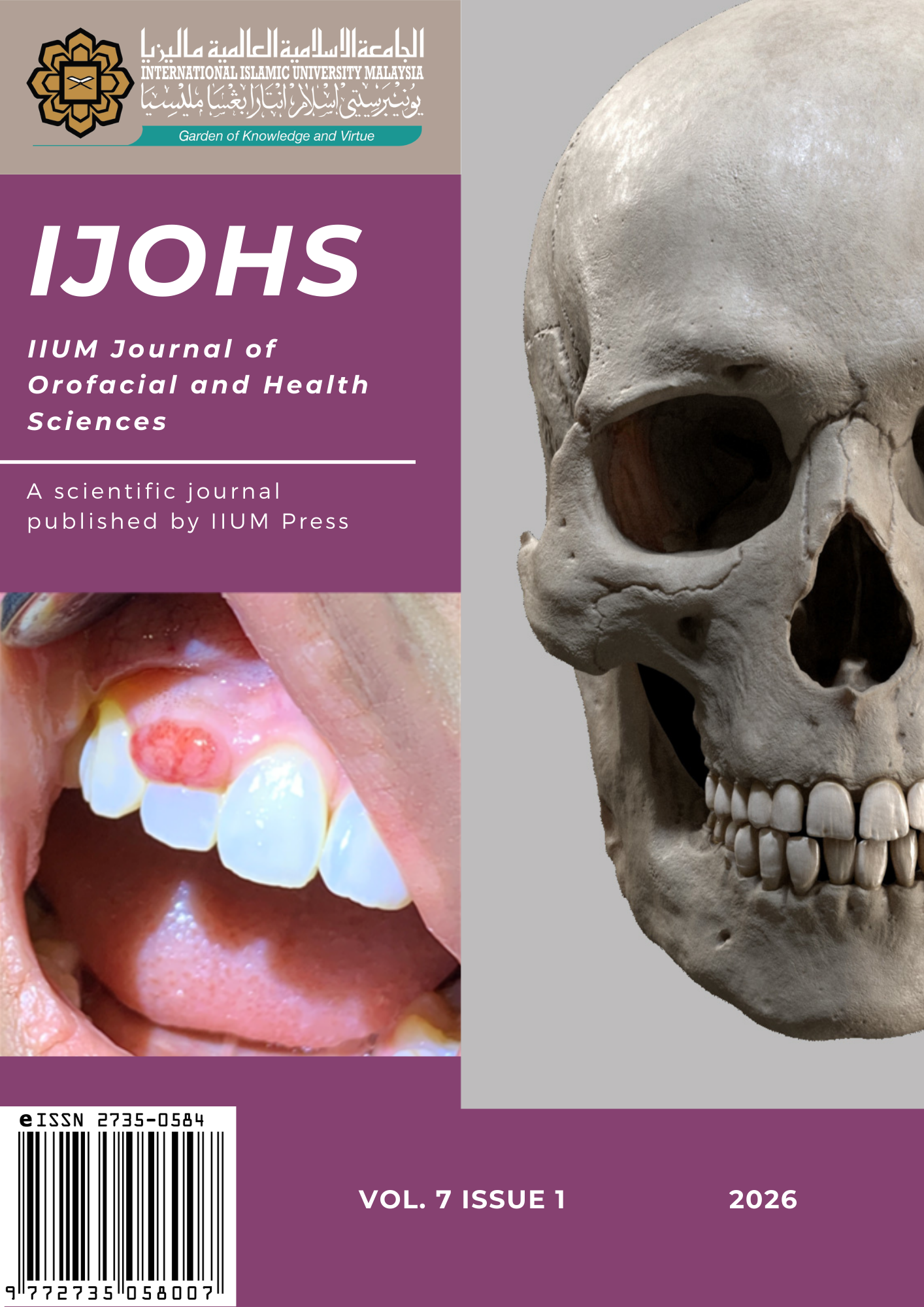
Furcation management: a viable surgical for apical migration of the gingival margin on mandibular molar
DOI:
https://doi.org/10.31436/ijohs.v7i1.432Keywords:
apical migration, furcation plasty, gingival recession, molarAbstract
Furcation involvement (FI) poses significant challenges in periodontal management due to anatomical complexities and limited accessibility for cleaning, often resulting in the progression of periodontal diseases if not properly addressed and treated. This case report presented a 50-year-old male patient with gingival recession and FI in the left mandibular molar, tooth 36. A f) procedure was performed under local anaesthesia, involving incision and flap reflection, exposure and debridement of the furcation area, and apical repositioning of the flap to facilitate plaque control and reduce disease progression risk. Post-operative healing was satisfactory, with no signs of inflammation observed at the two-week follow-up. Supportive p therapy (SPT) was implemented to maintain long-term satisfactory clinical outcomes. This case highlights the efficacy of FP as a treatment modality for FI, emphasising the significance of meticulous and proper case selection.
References
Bowers, G. M., Schallhorn, R. G., McClain, P. K., Morrison, G. M., Morgan, R., & Reynolds, M. A. (2003). Factors influencing the outcome of regenerative therapy in mandibular Class II furcations: part I. Journal of Periodontology, 74(9), 1255-1268. DOI: https://doi.org/10.1902/jop.2003.74.9.1255
Chiu, B. M., Zee, K. Y., Corbet, E. F., & Holmgren, C. J. (1991). Periodontal implications of furcation entrance dimensions in Chinese first permanent molars. Journal of Periodontology, 62(5), 308-311. DOI: https://doi.org/10.1902/jop.1991.62.5.308
Dannewitz, B., Zeidler, A., Hüsing, J., Saure, D., Pfefferle, T., Eickholz, P., et al. (2016). Loss of molars in periodontally treated patients: results 10 years and more after active periodontal therapy. Journal of Clinical Periodontology, 43(1), 53-62. DOI: https://doi.org/10.1111/jcpe.12488
Kassab, M. M., & Cohen, R. E. (2003). The etiology and prevalence of gingival recession. Journal of the American Dental Association, 134(2), 220-225. DOI: https://doi.org/10.14219/jada.archive.2003.0137
Nibali, L., Zavattini, A., Nagata, K., Di Iorio, A., Lin, G. H., Needleman, I., et al. (2016). Tooth loss in molars with and without furcation involvement- a systematic review and meta-analysis. Journal of Clinical Periodontology, 43, 156-166. DOI: https://doi.org/10.1111/jcpe.12497
Oral Health Programme (2023) Fact Sheet National Health and Morbidity Survey (NHMS) 2020: National Oral Health Survey of Adults (NOHSA) 2020.
Rasperini, G., Majzoub, J., Tavelli, L., Limiroli, E., Katayama, A., Barootchi, S., et al. (2020). Management of furcation-involved molars: recommendation for treatment and regeneration. International Journal of Periodontics & Restorative Dentistry, 40(4), e137-e146. DOI: https://doi.org/10.11607/prd.4341
Reddy, M. S., Aichelmann-Reidy, M. E., Avila-Ortiz, G., Klokkevold, P. R., Murphy, K. G., Rosen, P. S., et al. (2015). Periodontal regeneration-Furcation defects: a consensus report from the AAP Regeneration Workshop. Journal of Periodontology, 86(Suppl 2), s131-133. DOI: https://doi.org/10.1902/jop.2015.140379
Schwendicke, F., Graetz, C., Stolpe, M., Dorfer, C.E. (2014). Retaining or replacing molars with furcation involvement: a cost-effectiveness comparison of different strategies. Journal of Clinical Periodontology, 41, 1090-1097. DOI: https://doi.org/10.1111/jcpe.12315
Tonetti, M.S., Christiansen, A.L., Cortellini, P. (2017). Vertical subclassification predicts survival of molars with class II furcation involvement during supportive periodontal care. Journal of Clinical Periodontology, 44, 1140-1144. DOI: https://doi.org/10.1111/jcpe.12789
Tonetti, M. S., Cortellini, P., Graziani, F., Cairo, F., Lang, N. P., Abundo, R., et al. (2022). Management of stage I–III periodontitis—The EFP S3 level clinical practice guideline. Journal of Clinical Periodontology, 49(Suppl 24), 4–71. DOI: https://doi.org/10.1111/jcpe.13639
Trombelli, L., Simonelli, A., Minenna, L., Rasperini, G., Farina, R. (2017). Effect of a connective tissue graft in combination with a single flap approach in the regenerative treatment of intraosseous defects. Journal of Periodontology, 88, 348-356. DOI: https://doi.org/10.1902/jop.2016.160471
Downloads
Published
How to Cite
Issue
Section