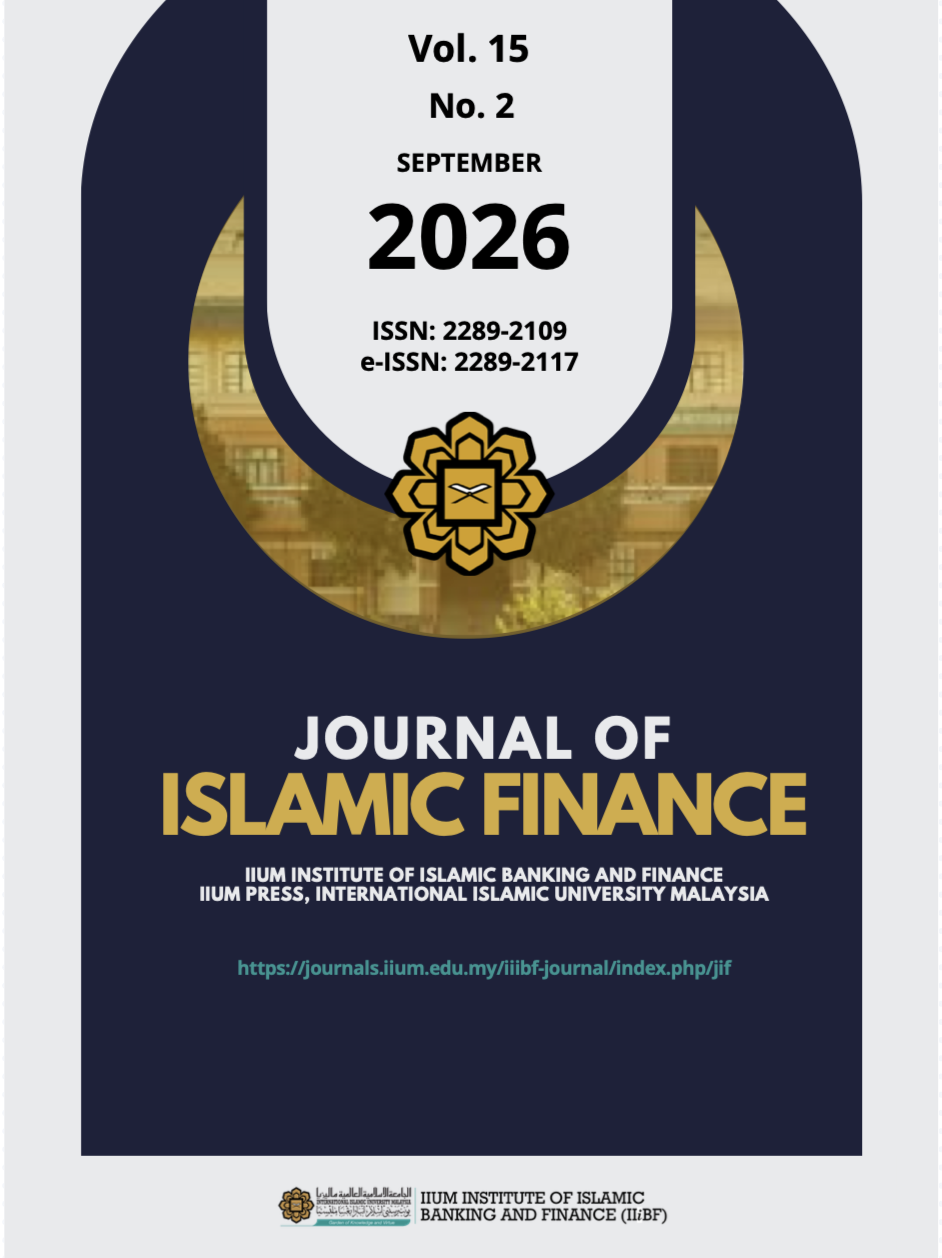
The Impact of Economic Diversification on Sustainable Development in the Kingdom of Bahrain: The Moderating Role of Islamic Banks’ Performance
DOI:
https://doi.org/10.31436/jif.v15i2.1123Keywords:
Economic diversification, Sustainable development, Islamic banking performance, Temporal disaggregation, Small-sample inferenceAbstract
This paper examines whether economic diversification has improved sustainable development in the Kingdom of Bahrain over the period 2015 to 2024, and whether the performance of the Islamic banking sector conditions that relationship. Annual data from official sources were disaggregated into quarterly series (N = 40) and analysed within an ARDL/ECM framework, with Newey-West HAC standard errors and a mean-centred interaction term used to test moderation. The results show no statistically significant direct effect of economic diversification on sustainable development in any of its dimensions, a finding consistent with the persistent gap between productive diversification (non-oil sectors average 82.5 per cent of GDP) and fiscal diversification (non-oil revenues average 28 per cent of government income). Islamic banks’ performance, by contrast, has a significant positive effect on the social dimension (β = 0.113, p = 0.018) and a strong positive effect on the environmental dimension (β = 0.385, p < 0.001) of sustainable development, and cointegration tests confirm a long-run equilibrium relationship between banking performance and development. The interaction term between diversification and banking performance is negative and significant (δ = -0.044, p = 0.018), indicating a buffering form of moderation: as Islamic banks perform better, they generate an independent development effect that reduces the economy’s reliance on the diversification path alone. The paper draws implications for Islamic finance policy under Bahrain’s Economic Vision 2030.
Downloads
References
Abdulla, Y., Ebrahim, R., & Kumaraswamy, S. (2021). Islamic finance and sustainable development goals in Bahrain. In 2021 International Conference on Sustainable Islamic Business and Finance (pp. 8–13). New York: IEEE.
Al-Doski, K., & Al-Arkoub, H. (2023). The impact of economic diversification on fiscal sustainability in the Arab Gulf Cooperation Council countries for the period 2004-2020. Journal of the University of Duhok, 26(1), 1–20.
Alghafes, M., Al-Malkawi, H.N., & Pillai, R. (2024). Influence of key ESG factors on Islamic banks' financial performance: Evidence from GCC countries. Research in International Business and Finance, 71, 102445.
Andrews, D.W.K. (1993). Tests for parameter instability and structural change with unknown change point. Econometrica, 61(4), 821–856.
Asaad, A., & Al-Saad, A. (2025). The role of Islamic finance in achieving sustainable development: Islamic banks as a model. International Islamic University Malaysia Journal, 9(2), 1–22.
Avdukic, A., & Asutay, M. (2025). Testing the development impact of Islamic banking: Islamic moral economy approach to development. Economic Systems, 49(2), 101229.
Chapra, M.U., Khan, S., & Al Shaikh-Ali, A.A. (2008). The Islamic vision of development in the light of Maqasid al-Shari'ah. London: The International Institute of Islamic Thought.
Chow, G.C., & Lin, A. (1971). Best linear unbiased interpolation, distribution, and extrapolation of time series by related series. The Review of Economics and Statistics, 53(4), 372–375.
Dusuki, A.W., & Bouheraoua, S. (2011). The framework of Maqasid al-Shari'ah and its implication for Islamic finance. ISRA International Journal of Islamic Finance, 2(2), 316–336.
Espinoza, R., & Senhadji, A. (2011). How strong are fiscal multipliers in the GCC? (IMF Working Paper 11/61). Washington: International Monetary Fund.
Gylfason, T., Herbertsson, T., & Zoega, G. (1999). A mixed blessing: Natural resources and economic growth. Macroeconomic Dynamics, 3(2), 204–225.
Hvidt, M. (2013). Economic diversification in GCC countries: Past record and future trends (Kuwait Programme Research Paper 27). London: London School of Economics.
Levine, R. (2005). Finance and growth: Theory and evidence. In Aghion, P., & Durlauf, S.N. (Eds.). Handbook of economic growth (Vol. 1A, pp. 865–934). Amsterdam: Elsevier.
Nakibullah, A. (2018). Economic diversification in Bahrain. Applied Economics and Finance, 5(5), 67–74.
Otman, A. (2022). Islamic banks and sustainable development goals in the Arab world: A case study of selected countries. Abu Dhabi: Arab Monetary Fund.
Pesaran, M.H., Shin, Y., & Smith, R.J. (2001). Bounds testing approaches to the analysis of level relationships. Journal of Applied Econometrics, 16(3), 289–326.
Phillips, P.C.B., & Hansen, B.E. (1990). Statistical inference in instrumental variables regression with I(1) processes. Review of Economic Studies, 57(1), 99–125.
Sax, C., & Steiner, P. (2013). Temporal disaggregation of time series. The R Journal, 5(2), 80–87.
World Commission on Environment and Development. (1987). Our common future. Oxford: Oxford University Press.